When Your Jaw Locks Up: The Truth About Lockjaw

What Is Lockjaw? Distinguishing Trismus from TMJ Locking
Lockjaw often refers to two distinct conditions that feel similar but have very different causes. Trismus is the involuntary tightening of the masseter and temporalis muscles that literally prevents the jaw from opening. This is a muscular phenomenon: the muscles simply contract and refuse to relax. TMJ locking, by contrast, occurs when the articular disc inside the temporomandibular joint becomes displaced and mechanically blocks jaw movement. Understanding the difference is crucial because the treatments diverge significantly.
Trismus typically presents as sudden, often complete inability to open the mouth beyond a few millimeters. Patients describe a rigid feeling, as though the jaw is clamped shut. TMJ locking usually develops more gradually and may allow partial opening; the jaw feels stuck at a certain point rather than rigidly closed. Both conditions are deeply unsettling, but trismus stems from muscle physiology while TMJ locking involves joint mechanics. That distinction shapes how you approach relief.
Real-world example: a patient who developed trismus after a dental procedure could not open their mouth at all for three days because the muscles simply would not cooperate. Another patient with TMJ locking could open partway but heard a click and felt resistance at the limit, a mechanical constraint rather than pure muscle tension. Recognizing which type you are experiencing helps direct your treatment strategy.
Primary Causes of Lockjaw: From Infection to Muscle Overload
Lockjaw has multiple origins, and the cause often determines both severity and recovery timeline. Tetanus, historically the most feared cause, arises from bacterial infection (Clostridium tetani) and produces severe, life-threatening trismus. Today in vaccinated populations it remains rare, but it is a medical emergency when it does occur. Other infectious causes include dental abscesses, wisdom tooth infections, and post-extraction complications. Muscle-based causes span trauma (jaw fracture or severe impact), surgical trauma, and stress-induced muscle clenching.
Temporomandibular joint disorders (TMD) create locking through several mechanisms. Articular disc displacement without reduction keeps the disc permanently out of position, preventing normal joint gliding. Muscle spasm accompanying TMD can tighten the jaw acutely. Bruxism, meaning grinding and clenching that is often stress-driven or sleep-related, chronically overloads jaw muscles. That sustained muscle tension and microtrauma gradually reduce the jaw's opening capacity and raise the likelihood of acute locking episodes. Over time, this muscle fatigue primes the system for sudden, complete closure.
Acute joint inflammation, whether from arthritis or direct trauma, causes swelling that mechanically limits opening. Post-surgical locking is common after oral surgery, dental work, or intubation, since the surgical trauma and subsequent inflammation tighten the protective muscles. Stress and anxiety amplify muscle tension, particularly at night. Chronic jaw muscle stress from bruxism is a silent risk factor: years of clenching and grinding fatigue the muscles and degrade disc positioning, creating the perfect conditions for lockjaw episodes.
How to Tell Which Type of Lockjaw You Have
Differentiating between muscle-based and joint-based locking requires attention to specific features of your experience. With trismus, the jaw feels rigidly locked immediately: there is no range of motion at all, or only millimeters. The resistance feels muscular and uniform; trying to open further meets consistent resistance throughout the attempted movement. Onset is often sudden, following trauma, infection, or stress. The condition usually improves gradually over hours or days as the muscles begin to relax.
TMJ locking typically allows partial opening before hitting a hard stop. You might open halfway normally and then encounter a mechanical block. There may be clicking, popping, or grinding sounds. The sensation is one of mechanical interference rather than muscular rigidity. History often includes gradual onset over weeks or months, with episodes becoming more frequent. Patients frequently report a pattern: the jaw locks after wide yawning, forceful chewing, or extended talking.
A practical test: gentle, sustained pressure might gradually improve opening slightly in true trismus as the muscles tire and begin to release. In TMJ locking, that pressure typically meets unyielding mechanical resistance because the disc simply will not reposition. If you can open to roughly 30 millimeters but no further, that is mechanically distinct from 5-millimeter total rigidity. Document your maximum opening and whether it changes over hours. Trismus tends to improve with time and rest, while TMJ locking persists until the disc repositions.
Emergency Warning Signs: When to Seek Immediate Care
Certain lockjaw presentations require emergency medical evaluation. Any lockjaw accompanied by fever, difficulty swallowing, or facial swelling suggests infection such as a dental abscess, tetanus, or another infectious cause. These are non-negotiable red flags. Inability to swallow saliva, slurred speech, or respiratory difficulty signals severity that demands urgent care. Lockjaw following an unknown injury such as a puncture wound raises tetanus risk, especially if vaccination status is uncertain.
Severe pain out of proportion to the degree of locking, progressive worsening despite rest, or lockjaw combined with headache and a stiff neck all warrant evaluation. Sudden onset after head trauma or a motor vehicle accident requires imaging to rule out fracture or dislocation. If you cannot open your mouth even slightly, or if locking comes with vomiting or any compromise of the airway, treat it as an emergency.
Most muscle-based locking and many TMJ locking episodes are manageable at home, but do not hesitate if any warning signs appear. Emergency departments can assess for infection, fracture, or severe dislocation. Follow-up with a dentist, oral surgeon, or TMD specialist then stabilizes the jaw and helps prevent recurrence. The initial episode often serves as a wake-up call about jaw muscle stress and a natural entry point into preventive strategies.
The Bruxism-to-Lockjaw Pipeline: Chronic Muscle Stress as the Root
Bruxism, meaning grinding and clenching the teeth during sleep or under stress, is a silent architect of lockjaw vulnerability. Each night, people who grind apply forces many times greater than normal chewing loads to already-fatigued muscles. The masseter, temporalis, and lateral pterygoid sustain repeated, intense contractions. Over weeks and months, this chronic overload causes muscle fiber microtrauma, inflammation, and progressive fatigue. The muscles become less resilient and more prone to protective spasm.
This muscle fatigue also degrades the jaw's mechanical precision. The articular disc, which normally cushions and guides the joint, depends on balanced muscle timing and positioning. Chronically fatigued, imbalanced muscles allow the disc to slip forward. The jaw's opening range gradually narrows. The system becomes hyper-reactive: minor stress, wide yawning, or a solid bite of food can trigger acute muscle spasm or mechanical locking. A patient who grinds every night may suddenly experience complete locking after an ordinary meal.
The parallel is striking: picture a car engine subjected to constant high-RPM stress without proper maintenance. The engine's precision degrades, tolerances tighten, and eventually minor stresses cause failure. The jaw operates the same way. Bruxism is that chronic high-load stress. Without intervention, the jaw's operating window shrinks. Prevention is far more effective than managing acute episodes, and addressing the root cause (muscle overload and fatigue) stops the cascade toward lockjaw.
How Wakebright Reduces Lockjaw Risk Through Preventive Muscle Load Reduction
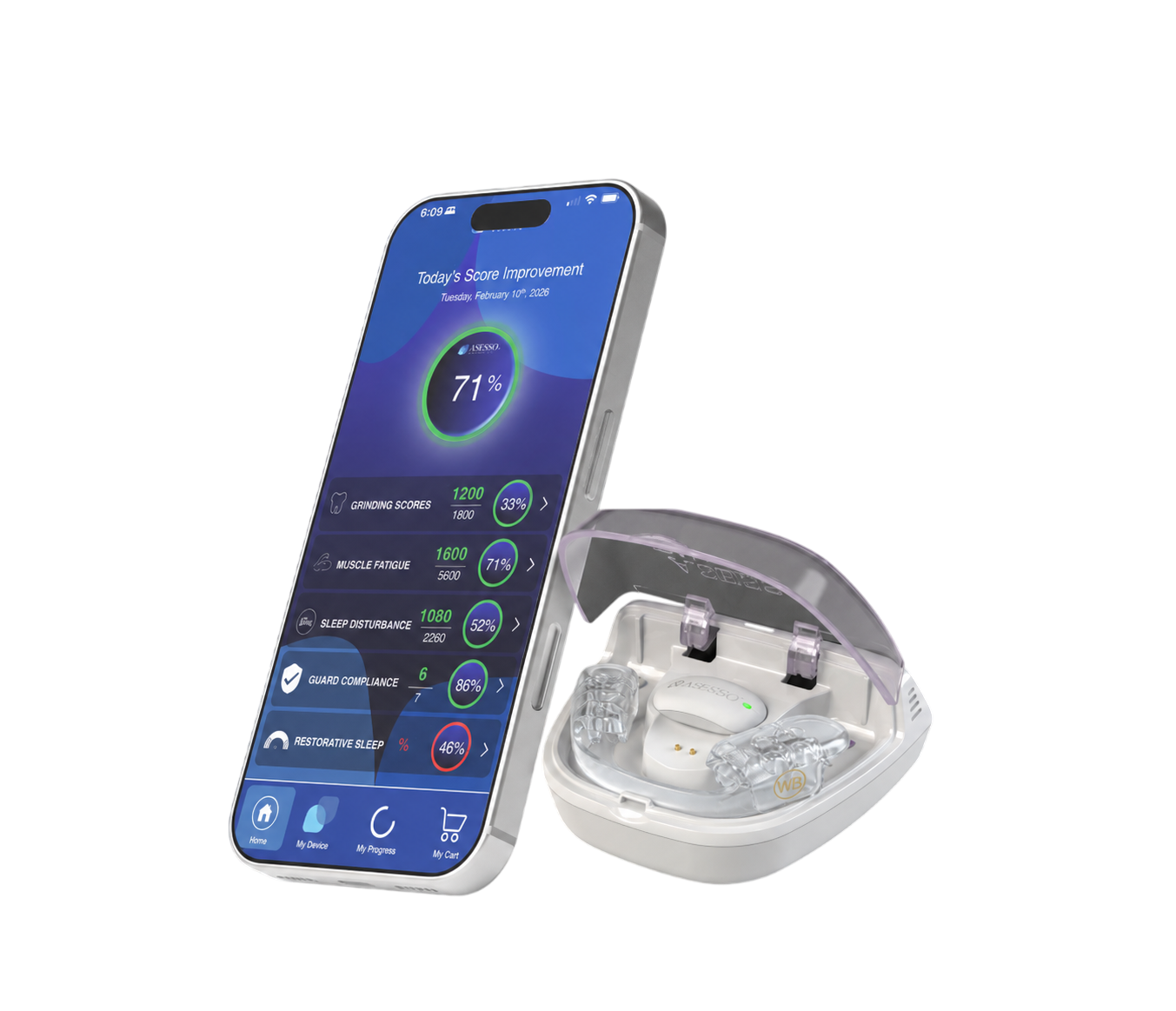
The Wakebright Grind Guard is a jaw repositioning device worn during sleep that gently holds the lower jaw in a position that reduces masseter and temporalis muscle load. Instead of allowing the jaw to rest in a closed, clenched position where the muscles remain tense, the Grind Guard supports the jaw in a slightly forward, relaxed posture. This repositioning removes the muscle tension that drives bruxism and lowers the chronic load on the jaw muscles throughout the night.
By reducing nightly muscle load, the Wakebright Grind Guard addresses the root mechanism behind lockjaw risk. Muscles that are rested and recovered maintain better resilience and coordination. The articular disc stays properly positioned when the supporting muscles are not fatigued and imbalanced. The jaw's opening range stays full. Protective muscle spasm becomes less likely because the muscles are no longer chronically inflamed and irritable. Over weeks of consistent use, jaw muscle health measurably improves, and acute locking episodes decline.
Real-world experience from thousands of users shows that consistent nightly use of the Wakebright Grind Guard significantly reduces the frequency and severity of locking episodes. Patients report fuller jaw opening within days to weeks and fewer acute spasm events. Those with existing TMJ locking find that episodes become less frequent and less severe once the underlying muscle stress is addressed. The Grind Guard does not treat acute lockjaw, but it prevents the chronic muscle stress that makes locking episodes likely in the first place, which is a fundamentally different and more durable approach than managing crises after they occur.
What You Can Do Now
Lockjaw has multiple causes: trismus (muscle-based), TMJ locking (mechanical), infection, trauma, and bruxism-driven muscle fatigue.
Chronic jaw muscle stress from bruxism is a silent risk factor that gradually increases lockjaw vulnerability over time.
Differentiating between muscle-based and mechanical locking guides treatment strategy and helps predict recovery timeline.
Emergency warning signs such as fever, swelling, and inability to swallow require immediate medical evaluation.
Preventive jaw muscle load reduction during sleep is far more effective than managing acute locking episodes after they occur.
The Wakebright Grind Guard reduces lockjaw risk by removing nightly muscle tension and supporting jaw muscle recovery.
Frequently Asked Questions
Q: What is the difference between lockjaw and trismus?
Lockjaw is a general term for jaw closure. Trismus is involuntary muscle tightness that locks the jaw shut, while TMJ locking is mechanical joint obstruction from disc displacement. Trismus is muscular; TMJ locking involves disc mechanics. Both prevent normal opening, but the treatments differ based on the cause.
Q: Can lockjaw from bruxism go away on its own?
Mild lockjaw episodes may resolve with rest and stress reduction. However, if bruxism continues unchecked, locking episodes typically recur and worsen. Addressing the underlying muscle overload through jaw repositioning during sleep prevents future episodes and allows lasting recovery.
Q: Is lockjaw a sign of tetanus?
Tetanus produces severe trismus and is a medical emergency, but it is rare in vaccinated populations. Lockjaw more commonly stems from TMD, muscle spasm, or dental infection. Fever, difficulty swallowing, or facial stiffness all suggest infection and warrant emergency evaluation.
Q: How long does lockjaw usually last?
Muscle-based trismus often improves within hours to days with rest and muscle relaxation. TMJ locking may persist longer if the disc remains displaced. Underlying conditions like bruxism-driven muscle fatigue may require weeks of consistent jaw muscle load reduction to fully resolve.
Q: Can I prevent lockjaw from happening again?
Yes. Address the root cause: if bruxism or muscle stress is responsible, reduce jaw muscle load during sleep with a device like the Wakebright Grind Guard, manage stress, adopt soft-diet habits, and correct your posture. Consistent prevention is more effective than treating acute episodes.
Q: When should I see a doctor for lockjaw?
Seek emergency care if lockjaw comes with fever, swelling, difficulty swallowing, or follows an injury. See a dentist or TMD specialist if locking episodes recur or last more than a few days, to rule out serious conditions and establish preventive strategies.
Q: Does jaw repositioning during sleep help prevent lockjaw?
Yes. Jaw repositioning devices like the Wakebright Grind Guard reduce chronic muscle load, improve muscle recovery, and restore joint health, all of which dramatically lower the likelihood of lockjaw recurrence. Consistent use addresses the underlying muscle stress that makes locking episodes likely.
WAKEBRIGHT | If lockjaw episodes are recurring or worsening, or if you grind your teeth at night, reducing chronic jaw muscle stress is your best investment in long-term jaw health. The Wakebright Grind Guard gives your jaw muscles the support they need to recover and function at their best. Learn more about how jaw repositioning during sleep can help prevent your next locking episode. This article is for educational purposes only and does not constitute medical or dental advice. Please consult a qualified healthcare provider for personalized guidance.