Waking Up Exhausted After 8 Hours of Sleep? Your Jaw Might Be Why

You did everything right lights out at a reasonable hour, a full eight hours logged, no obvious reason to feel this tired. And yet you wake up drained anyway. It's a genuinely frustrating pattern, and one possible explanation gets overlooked more than it should: your jaw might be working hard all night without you ever knowing it.
The Problem Isn't Always Duration It's Architecture
Sleep quality isn't just about how many hours you spend in bed. Your brain cycles through distinct stages each night light sleep, deep (slow-wave) sleep, and REM sleep and it's the deeper stages specifically that do most of the physical and cognitive restoration your body needs. You can technically get eight hours of "sleep" while spending disproportionately little time in the deep stages that actually leave you feeling rested. This is the concept of non-restorative sleep: adequate duration, inadequate quality.
Sleep bruxism grinding or clenching your teeth during sleep is one of the more overlooked contributors to exactly this pattern.
What Actually Happens to Your Sleep When You Grind
This isn't speculation. A controlled polysomnography study using overnight sleep-lab monitoring to directly measure sleep stages compared 90 individuals, half with sleep bruxism and half without, matched for age, sex, and body mass index. The study, evaluated against American Academy of Sleep Medicine sleep architecture standards, found statistically significant differences between the two groups: people with sleep bruxism had less total sleep time, less time in NREM stage 3 (deep) sleep specifically, altered sleep latency, lower overall sleep efficiency, and a higher index of microarousals compared to those without bruxism.
That reduction in deep sleep the stage most associated with feeling physically restored — is the piece that connects directly to waking up exhausted despite adequate time in bed. It's not that bruxism keeps you awake; it's that it appears to shift your sleep architecture away from the stages that matter most for feeling rested.
The Microarousal Connection
The mechanism behind this involves something called a microarousal a brief, partial awakening lasting just a few seconds, involving a rise in brain, heart, and muscle activity, without you becoming consciously aware of it or remembering it in the morning. According to a clinical neurology reference on sleep-related bruxism, these microarousals are a completely normal part of sleep architecture on their own, recurring naturally several times per hour throughout the night.
The connection to bruxism is specific: in people with frequent grinding episodes, research cited in the same reference found that in close to 80% of cases, the grinding activity occurs in close phase with one of these brief arousals meaning each grinding episode is tied to a small disruption in your sleep cycle, repeated many times over the course of a night. Individually, each one is brief and forgettable. Cumulatively, across a full night of frequent episodes, they add up to the kind of fragmented sleep architecture the polysomnography study documented.
An Honest Caveat: Does This Actually Make You Feel More Tired?
Here's where it's worth being careful rather than overstating the case. While lab-measured sleep architecture is clearly affected in people with sleep bruxism, the connection to subjectively feeling excessively sleepy during the day is less consistent than you might expect. A 2025 study surveying 400 participants found no statistically significant difference in excessive daytime sleepiness between people who self-reported possible bruxism and those who didn't even though the bruxism group did report worse general sleep quality and used sleep medication more frequently.
The honest interpretation: sleep bruxism does appear to measurably disrupt sleep architecture at a physiological level, but that doesn't automatically translate into everyone consciously feeling excessively drowsy during the day in a way that shows up clearly on subjective questionnaires. Fatigue is genuinely multifactorial, and if you're waking up exhausted, bruxism is a plausible contributor worth investigating not a guaranteed explanation on its own.
Could Something Else Be the Real Culprit? The Sleep Apnea Overlap
This is an important piece of the puzzle. Sleep bruxism and obstructive sleep apnea frequently occur together research has found that roughly half of adults with obstructive sleep apnea also have comorbid sleep bruxism, and a 2024 study specifically examining bruxism, microarousals, and blood oxygen levels in an apneic population found meaningful associations between the two conditions. Some researchers believe bruxism episodes may actually serve a protective function during sleep apnea, helping reopen the airway following an apnea-related arousal.
What this means practically: if you're waking up exhausted and also grind your teeth, sleep apnea is worth ruling out specifically, since it's possible that apnea not bruxism alone is the primary driver of your fatigue, with the two conditions occurring together rather than one directly causing the other.
Signs Your Fatigue Might Be Jaw-Related
Consider a jaw connection worth investigating if you notice:
- Morning fatigue despite consistently getting 7 to 9 hours in bed
- A sore or tired jaw upon waking
- A partner mentioning grinding sounds during the night
- Morning headaches, particularly at the temples
- Visible tooth wear or new sensitivity
- Heavy snoring or witnessed pauses in breathing (a sign to specifically ask about sleep apnea)
What to Do About It
If this pattern sounds familiar, a few reasonable next steps:
Get your grinding evaluated. A dentist can check for physical signs of bruxism tooth wear, jaw muscle tenderness even if you have no memory of grinding, and recommend a custom night guard to protect your teeth while you investigate further.
Ask about a sleep evaluation, particularly if you snore heavily or have any signs pointing toward sleep apnea, given how frequently the two conditions overlap and how directly apnea itself affects sleep quality and fatigue.
Address contributing factors, including stress, evening alcohol and caffeine use, and general sleep hygiene, since these affect both bruxism and overall sleep quality independently.
Track the pattern. Note whether your fatigue correlates with mornings you wake up with jaw soreness specifically, which can help you and a provider figure out how much of a role bruxism is actually playing versus other factors.
Frequently Asked Questions
Can teeth grinding really make me feel tired even after a full night's sleep?
It's a genuinely plausible contributor lab-based research has found measurable disruption to sleep architecture, including reduced deep sleep, in people with sleep bruxism. That said, self-reported daytime sleepiness hasn't consistently been shown to differ between bruxers and non-bruxers in survey-based research, so it's a reasonable factor to investigate rather than an automatic explanation.
What's the difference between sleep duration and sleep quality?
Duration is simply how many hours you spend asleep. Quality relates to how much time is spent in the deeper, more restorative sleep stages versus lighter stages you can have adequate duration with poor quality, which is essentially what non-restorative sleep means.
What is a microarousal, and is it dangerous?
A microarousal is a brief, partial awakening lasting a few seconds, involving a temporary rise in brain, heart, and muscle activity, without full consciousness or memory of it happening. They're a completely normal part of sleep on their own; the concern with bruxism is their frequency and their tie to repeated grinding episodes throughout the night.
How would I know if I'm grinding my teeth if I don't remember it?
Common indirect signs include a partner mentioning grinding sounds, morning jaw soreness or tightness, headaches concentrated at the temples, and visible tooth wear a dentist can identify during a routine exam.
Could my fatigue actually be from sleep apnea instead of bruxism?
It's genuinely possible, and worth investigating specifically sleep apnea and sleep bruxism frequently occur together, with roughly half of adults with sleep apnea also having bruxism. If you snore heavily or have witnessed pauses in breathing, a sleep evaluation is a reasonable next step regardless of bruxism.
Will a night guard fix my fatigue if bruxism is the cause?
It may help with the tooth-protection side of things and can sometimes reduce associated discomfort, but a night guard doesn't necessarily stop the underlying muscle activity or microarousal pattern, so it may not fully resolve fatigue on its own if bruxism is the primary driver.
Is it normal to have some microarousals every night?
Yes microarousals are a normal part of healthy sleep architecture, recurring naturally several times per hour. The concern with bruxism isn't that microarousals happen at all, but their specific tie to frequent grinding episodes throughout the night in some individuals.
Can stress cause both bruxism and poor sleep quality independently?
Yes, and this can make it hard to untangle which is driving which stress is a well-established contributor to both bruxism and disrupted sleep on its own, so addressing stress can potentially improve both simultaneously.
Should I get a sleep study if I think bruxism is affecting my sleep?
It's a reasonable step, particularly if you have other signs of a sleep disorder like heavy snoring, witnessed breathing pauses, or fatigue that hasn't improved despite good sleep habits a sleep study can objectively measure what's happening to your sleep architecture rather than relying on guesswork.
Does deep sleep loss from bruxism have effects beyond just feeling tired?
Deep sleep plays a role in physical restoration, memory consolidation, and overall health more broadly, so research connecting bruxism to reduced deep sleep suggests potential effects beyond daytime sleepiness alone, though this is an active area of ongoing research.
How many grinding episodes per night is considered clinically significant?
Sleep bruxism is generally defined in research as more than two events of rhythmic masticatory muscle activity per hour of sleep, though the clinical significance for an individual also depends on associated symptoms like tooth wear, jaw pain, or reported fatigue.
Can improving my sleep hygiene reduce bruxism itself?
It may help to some degree, since factors like evening caffeine and alcohol use are independently linked to bruxism, but sleep hygiene changes alone don't address every possible driver of grinding, particularly if genetics, an underlying sleep disorder, or significant stress are also involved.
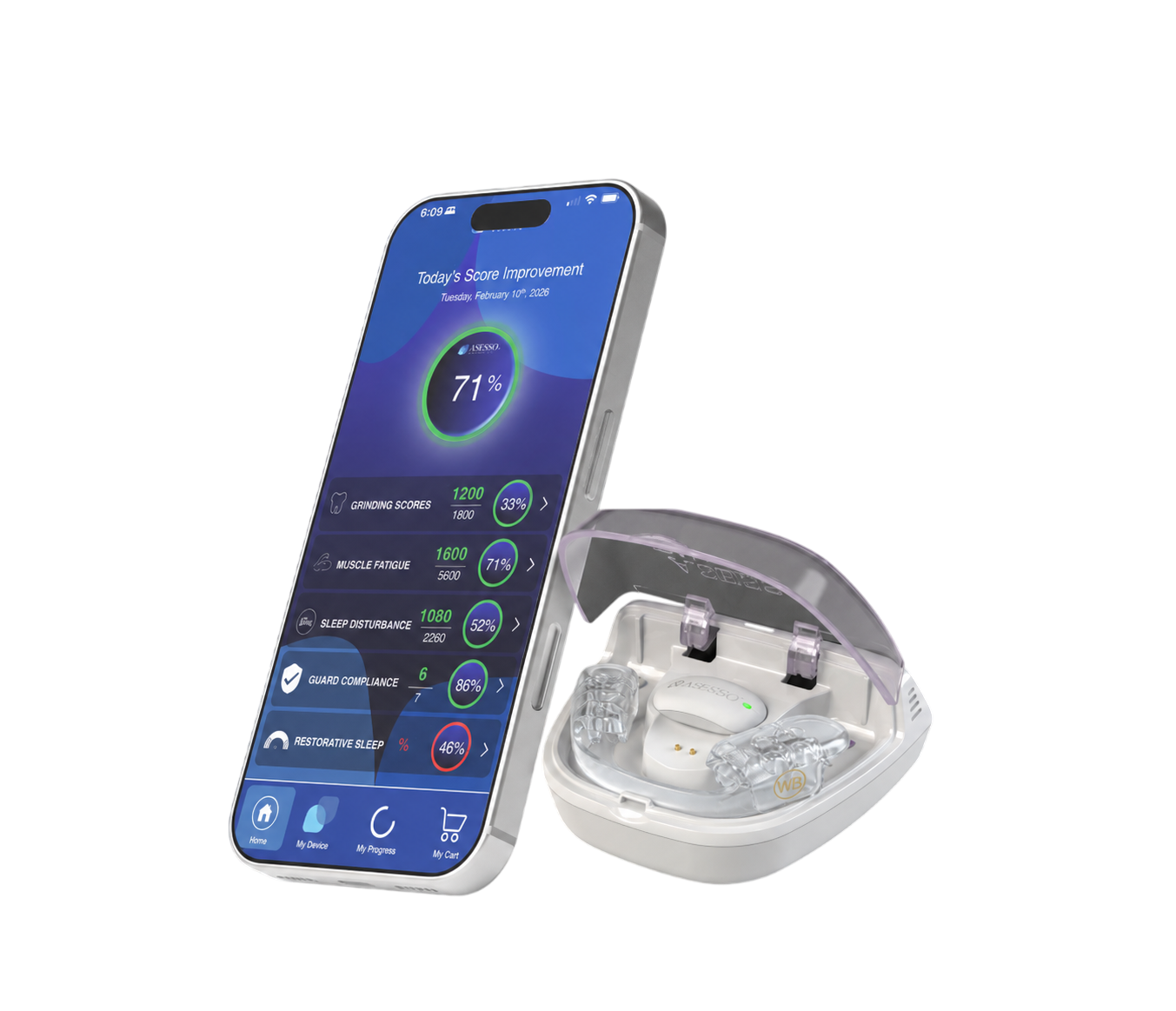
WAKEBRIGHT | If grinding is fragmenting your sleep, the Wakebright Guard protects your teeth while you and your provider investigate whether an airway or other underlying cause needs to be addressed directly.
This article is for informational purposes only and does not constitute medical advice. Consult a licensed dentist or healthcare provider for diagnosis and treatment recommendations specific to your situation.
References
- "Nocturnal sleep architecture is altered by sleep bruxism." Journal of Prosthetic and Rehabilitative Dentistry research, ScienceDirect. https://www.sciencedirect.com/science/article/abs/pii/S0003996917301358
- "Sleep-related bruxism." MedLink Neurology. https://www.medlink.com/articles/sleep-related-bruxism
- González González, A. et al. "Relational study between sleep quality, daytime sleepiness state, anxiety, stress, depression in possible bruxist and non-bruxist: cross-sectional study." Odontology, PMC, National Library of Medicine. https://www.ncbi.nlm.nih.gov/pmc/articles/PMC12795960/
- Miranda Diniz et al. "Sleep-related bruxism, microarousals and oxyhaemoglobin desaturations in sleep stages: A cross-sectional study in a large apnoeic population." Journal of Oral Rehabilitation, Wiley Online Library. https://onlinelibrary.wiley.com/doi/10.1111/joor.13813
- National Institute of Dental and Craniofacial Research. "Bruxism." nidcr.nih.gov. https://www.nidcr.nih.gov/health-info/bruxism