TMJ Headache: How to Tell If Your Jaw Is Causing Your Morning Headaches

You wake up almost every morning with a dull ache across your temples or behind your eyes. You've tried more water, less screen time before bed, a better pillow and the headaches keep coming back. There's a source that's easy to overlook: your jaw. Temporomandibular joint (TMJ) problems are a well-documented cause of headaches, especially the kind that show up first thing in the morning. Here's how to tell if that's what's happening to you.
How a Jaw Problem Turns Into a Headache
It sounds like an odd connection at first, but the anatomy explains it. Cleveland Clinic notes that the muscles powering your jaw joint work constantly throughout the day, and when they're overworked, the resulting tension can travel to other parts of your skull, producing what feels like a standard headache. Specifically, TMJ pain has been linked to both tension-type headaches, caused by strain in the muscles around your jaw and neck, and cluster-type headache patterns on one side of the head.
The National Institute of Dental and Craniofacial Research (NIDCR) formally recognizes headache as one of the three core categories of temporomandibular disorders (TMD), alongside joint disorders and muscle disorders meaning headache isn't just a side effect of TMJ problems in some cases, it's classified as one of the disorders itself.
The Timing Clue: Why Morning Matters
The timing of a headache is one of the more useful clues for sorting out whether your jaw is involved. Headaches that are worst first thing in the morning and ease as the day goes on point toward nighttime jaw activity grinding or clenching during sleep as the likely driver. A large case-control study of chronic TMD patients found that parafunctional behaviors (like clenching and grinding) and poor sleep quality were among the strongest predictors of headaches specifically attributed to jaw dysfunction.
By contrast, headaches that build gradually and worsen as the day goes on are more often linked to daytime causes prolonged screen use, poor posture, or daytime clenching during stressful moments rather than what happened overnight.
Signs Your Headache Is Jaw-Related
According to Cleveland Clinic, signs that point toward a TMJ-related headache include:
- Jaw pain or clicking/popping sounds when opening or closing your mouth
- Difficulty chewing or yawning fully
- Your jaw locking, even briefly
- Tenderness when you press on your jaw muscles or the area just in front of your ears
- Pain that seems to start in the jaw and radiate up to your temples or back toward your neck
- Other head pain showing up alongside it, like earaches or tooth pain without an obvious dental cause
The more of these that show up together with your headaches, the stronger the case that your jaw is involved rather than a separate, unrelated headache condition.
TMJ Headache vs. Tension Headache vs. Migraine
These three overlap enough that self-diagnosis is genuinely difficult, which is part of why TMJ-related headaches are so often missed. Here's a rough comparison based on typical presentation:
| Feature | TMJ Headache | Typical Tension Headache | Typical Migraine |
|---|---|---|---|
| Timing | Often worse in the morning or after jaw use | Can occur any time, often stress-related | Can occur any time; sometimes has warning signs (aura) |
| Location | Temples, jaw, in front of ears, sometimes radiating to neck | Band-like pressure across forehead/whole head | Often one-sided, behind the eye |
| Jaw symptoms | Clicking, popping, tenderness, limited opening | Usually absent | Usually absent |
| What makes it worse | Chewing, yawning, talking at length | General stress, fatigue | Light, sound, movement |
| Associated symptoms | Earache, facial tenderness, neck tension | Mild scalp/neck tenderness | Nausea, light/sound sensitivity |
Cleveland Clinic lists TMD as one of several recognized contributors to tension-type headaches, and research has found that migraine-like symptoms can also stem from jaw dysfunction, since the temporomandibular joint sits close to the trigeminal nerve the same nerve heavily implicated in migraine. This overlap is exactly why professional evaluation matters more than trying to self-diagnose from symptoms alone.
A Simple Self-Check You Can Try at Home
This isn't a diagnosis, but it can help you decide whether it's worth bringing up with a dentist:
- Place two fingers just in front of your ears, where your jaw hinges open and close.
- Open and close your mouth slowly while keeping light pressure there. Notice any clicking, popping, or grinding sensation under your fingers.
- Open your mouth as wide as comfortably possible. A healthy jaw generally opens close to the width of three stacked fingers; noticeably less than that, or pain during the movement, is worth mentioning to a provider.
- Gently press along your jaw muscles (the sides of your face, from your cheekbone down to your jawline). Tenderness or soreness in these areas, especially matching where your headaches tend to occur, supports a jaw connection.
If any of this reproduces or resembles the pain from your usual headaches, that's a meaningful sign clinicians call this "familiar pain," and it's part of how dentists formally evaluate TMD during an actual exam.
What Usually Causes This Combination
Nighttime teeth grinding and clenching (bruxism) is one of the most frequently cited drivers of TMJ-related morning headaches, since it places sustained, repetitive strain on the jaw muscles and joint for hours while you're unaware it's happening. Cleveland Clinic also lists stress and tension, poor posture (particularly the forward-head posture common with phone and computer use), jaw injury, and jaw misalignment among the common triggers.
Notably, the NIDCR specifically states that research does not support the older belief that a "bad bite" alone causes TMD so while bite alignment can be a contributing factor for some people, it's rarely the whole story, and dental correction aimed solely at "fixing" a bite isn't a first-line treatment.
When to See a Dentist vs. When to See a Doctor
Either can be a reasonable starting point, and they often end up coordinating. A dentist is well-positioned to evaluate jaw clicking, tenderness, grinding-related tooth wear, and bite issues. A doctor particularly a neurologist for recurring headaches can help rule out other headache conditions and evaluate whether medications, migraine disorders, or other neurological factors are involved. If your headaches come with jaw symptoms from the list above, starting with a dentist familiar with TMD evaluation is a reasonable first move; if jaw involvement seems unlikely after that evaluation, they can help direct you toward the right next step.
What Treatment Looks Like
Per NIDCR guidance, the safest and most effective first steps for TMD-related headaches are conservative and non-permanent:
- Behavior changes, including reducing jaw clenching and gum chewing, and being mindful of jaw position during the day
- Self-care, such as eating softer foods temporarily, and applying heat or cold to the jaw
- Over-the-counter NSAIDs for pain and inflammation
- A custom night guard, if nighttime grinding appears to be a factor though the NIDCR notes evidence for how much these directly reduce TMD pain (versus protecting teeth) is still limited
- Physical therapy or gentle jaw stretches, which Cleveland Clinic notes can improve jaw mobility and reduce muscle tension
- Stress management techniques, given how closely jaw clenching tracks with stress levels
The NIDCR is explicit that permanent procedures reshaping teeth, orthodontics aimed at "correcting" TMD, or surgery aren't well-supported by evidence and should only be considered after conservative options have been tried.
What You Can Do Now
- Morning headaches concentrated around the temples, alongside jaw soreness, are worth evaluating for a jaw-related cause
- The temporalis muscle sits directly over the temple, which is why jaw tension often produces headaches in that specific location
- Standard headache treatment often misses a jaw-related cause since dental and headache care are usually handled separately
- A dentist can check for grinding-related tooth wear and jaw muscle tenderness as part of the evaluation
Frequently Asked Questions
How do I know if my headache is from TMJ or something else?
Look for jaw-specific signs alongside the headache clicking or popping when you open your mouth, tenderness near your ears or jaw muscles, pain that gets worse when chewing or talking, or headaches that are consistently worst in the morning. The more of these that overlap with your headache pattern, the more likely your jaw is involved.
Why are TMJ headaches worse in the morning specifically?
Morning TMJ headaches are usually linked to nighttime teeth grinding or clenching, which places hours of sustained strain on the jaw muscles and joint while you sleep and are unaware it's happening.
Can TMJ cause headaches that feel like migraines?
Yes. Because the jaw joint sits close to the trigeminal nerve heavily implicated in migraine jaw dysfunction can produce migraine-like symptoms, which is part of why TMJ-related headaches are sometimes misdiagnosed as migraines.
Is it safe to self-diagnose a TMJ headache?
A self-check (like gently pressing on your jaw muscles and joint) can be a useful clue, but TMJ headaches genuinely overlap with tension headaches and migraines in ways that are hard to sort out without a professional exam, so it's best used as a reason to seek evaluation rather than a substitute for one.
Does a clicking jaw always mean I have a TMJ headache?
No. Jaw clicking or popping without pain is common and generally doesn't require treatment on its own. It only becomes significant when paired with pain, limited movement, or other symptoms.
Can poor posture really cause TMJ headaches?
Yes forward-head posture, especially from looking down at phones or hunching over a computer, is a recognized trigger, since it changes how the jaw muscles have to work and can add strain that contributes to headaches.
Will a night guard fix my TMJ headaches?
It may help if nighttime grinding is a contributing factor, since it protects your teeth and can reduce some muscle strain, but evidence for how much night guards directly reduce TMD-related pain is still limited. It's usually one part of a broader approach rather than a standalone fix.
Should I see a dentist or a neurologist first for morning headaches?
If your headaches come with jaw symptoms like clicking, tenderness, or pain when chewing, a dentist familiar with TMD is a reasonable starting point. If jaw involvement isn't confirmed, or your headache pattern doesn't fit, a neurologist can help evaluate other causes.
Can stress alone cause a TMJ headache without any jaw injury?
Yes. Stress-driven jaw clenching is one of the most commonly cited triggers, and it doesn't require any prior jaw injury or structural problem to produce real muscle strain and headaches.
How long does it take for TMJ headaches to improve with treatment?
It varies by cause and severity, but many people see improvement with conservative measures like a night guard, stress management, and jaw exercises within weeks to a few months. Persistent symptoms despite these steps warrant a follow-up evaluation.
Can children get TMJ headaches?
It's less common but possible, particularly if a child grinds their teeth heavily or has jaw clicking. A pediatric dentist can evaluate persistent jaw or headache symptoms in children.
Is jaw surgery ever needed for TMJ headaches?
Rarely, and only after conservative treatments have been tried without success. The NIDCR is explicit that permanent procedures, including surgery, carry real risks and should be a last resort reserved for clear structural joint problems.
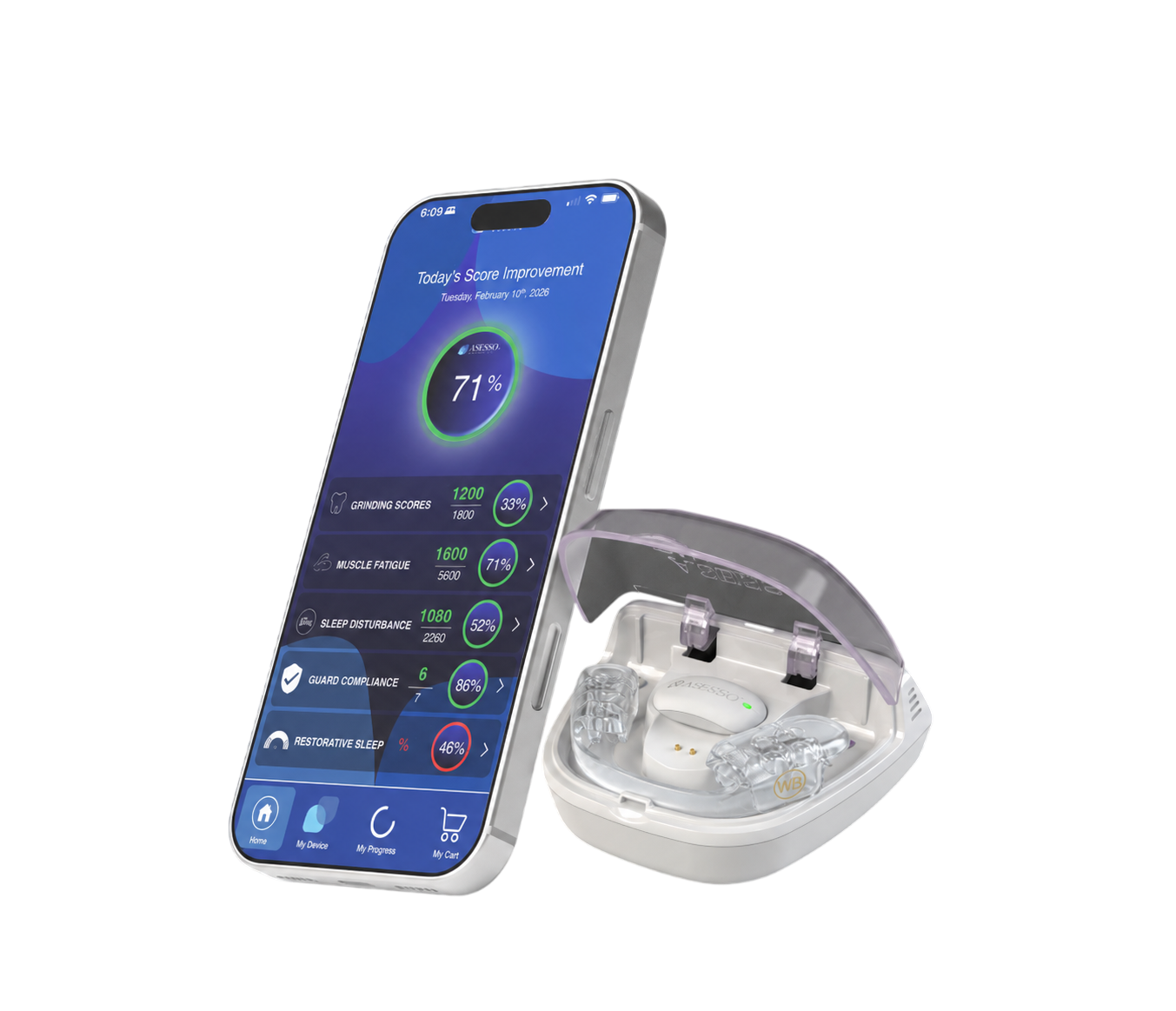
WAKEBRIGHT | If grinding is contributing to your morning headaches, the Wakebright Guard can reduce the jaw muscle strain behind them while you and your dentist address the underlying cause.
This article is for informational purposes only and does not constitute medical advice. Consult a licensed dentist or healthcare provider for diagnosis and treatment recommendations specific to your situation.
References
- National Institute of Dental and Craniofacial Research. "TMD (Temporomandibular Disorders)." nidcr.nih.gov. https://www.nidcr.nih.gov/health-info/tmd
- Cleveland Clinic. "Your Jaw May Be To Blame for Your Headaches." health.clevelandclinic.org. https://health.clevelandclinic.org/your-jaw-may-be-to-blame-for-your-migraine-headaches
- Cleveland Clinic. "Tension Headache: Symptoms & Treatment." my.clevelandclinic.org. https://my.clevelandclinic.org/health/diseases/8257-tension-headaches
- Wu, J. et al. "Headache Because of Problems with Teeth, Mouth, Jaws, or Dentures in Chronic Temporomandibular Disorder Patients: A Case–Control Study." PMC, National Library of Medicine. https://www.ncbi.nlm.nih.gov/pmc/articles/PMC8910597/
- Mayo Clinic. "TMJ disorders – Diagnosis and treatment." mayoclinic.org. https://www.mayoclinic.org/diseases-conditions/tmj/diagnosis-treatment/drc-20350945