TMD and Migraine Headaches: Untangling a Complex Connection

Why TMD and Migraine Are So Often Found Together
Temporomandibular disorder and migraine are two of the most common pain conditions affecting the head and face, and they co-occur at rates that cannot be explained by chance. Population studies consistently show that TMD patients are two to four times more likely to have migraine than people without TMD. Migraine patients, in turn, show significantly higher rates of jaw pain, clicking, and restricted jaw movement than headache-free controls.
The clinical reality this creates is a patient population that is partially treated by two different specialties, neurology and orofacial pain, neither of which fully addresses the connection. A migraine patient who never mentions jaw symptoms to their neurologist, and a TMD patient who never mentions their headaches to their dentist, receives care for only half of a single integrated problem.
What makes this particularly consequential is that each condition worsens the other. Migraine-related sleep disruption and stress increase bruxism activity. Bruxism-driven jaw muscle overload increases trigeminal sensitization. Elevated trigeminal sensitivity lowers the migraine threshold. The result is a bidirectional cycle that escalates without intervention targeting both sides.
For patients caught in this cycle, understanding the connection is the first step toward breaking it. Treatment that addresses both the jaw and the migraine simultaneously, rather than sequentially, consistently produces better outcomes than treating either alone.
How Each Condition Makes the Other Worse
Migraine worsens TMD through several pathways. During a migraine attack, the trigeminal system is in a highly activated state, and that activation increases muscle tension throughout the jaw and neck. Many migraine patients unconsciously clench their jaw during attacks, accelerating the muscle overload that drives TMD. Migraine-associated sleep disruption further reduces the restorative sleep that jaw muscles depend on for recovery.
TMD worsens migraine by keeping the trigeminal system in a sensitized state between attacks. Bruxism, the most common driver of muscular TMD, generates sustained nociceptive input from the masseter and temporalis muscles during sleep. This input does not cause a migraine by itself, but it keeps the trigeminal nucleus caudalis at an elevated level of excitability, reducing the additional stimulation needed to trigger an attack.
Stress sits at the intersection of both conditions as a shared amplifier. Psychological stress directly lowers the migraine threshold by activating the hypothalamic-pituitary-adrenal axis and altering trigeminovascular reactivity. The same stress reliably increases bruxism frequency and intensity during sleep. A stressful period therefore simultaneously raises both migraine and TMD severity through independent but converging pathways.
Think of each condition as adding weight to the same scale. A standard migraine trigger, a glass of red wine or a humid day, may not be enough weight on its own to tip the scale into a migraine. But if TMD-related trigeminal sensitization has already loaded the scale, that same minor trigger easily tips it over. Reducing TMD-related sensitization lifts some of that baseline weight, making individual triggers less likely to produce an attack.
The Diagnostic Challenge: When Conditions Overlap
Distinguishing TMD-attributed headache from migraine in a patient who has both is genuinely difficult. Both can produce unilateral head pain. Both can come with nausea, light sensitivity, and worsening with activity. Both can be triggered by stress and hormonal fluctuations. This diagnostic overlap creates uncertainty about which condition is primarily responsible for any given headache episode.
The research diagnostic criteria for TMD-attributed headache require that the headache temporally correlates with TMD: it worsens when TMD worsens and improves when TMD is effectively treated. In patients with both conditions, the clinical picture often suggests that both diagnoses are active and contributing. True migraine is present (with its characteristic prodrome, aura where applicable, and response to triptans), and TMD amplifies migraine frequency above what it would otherwise be.
Practically, this means that treating only the migraine with appropriate medications produces partial improvement. Attack severity and individual attack management may improve, but frequency stays elevated because the TMD component continues feeding sensitization. Treating only the TMD produces its own partial improvement: jaw pain resolves, but migraine attacks continue at a reduced but still elevated frequency.
The most complete improvement requires addressing both. In clinical practice, starting with conservative TMD treatment while maintaining appropriate migraine management, and adjusting both over time based on response, is the most rational and evidence-consistent approach.
An Integrated Treatment Framework
Building an integrated treatment plan for the TMD-migraine overlap requires identifying the key drivers on both sides. For the migraine side: which acute and preventive medications are appropriate, which lifestyle triggers are most modifiable, and is CGRP-pathway treatment warranted? For the TMD side: is the primary driver muscular (bruxism, clenching) or structural (disc displacement, joint changes)?
For the large majority of TMD-migraine patients whose jaw component is primarily muscular, the highest-leverage intervention is reducing overnight jaw muscle load. This directly addresses the sustained trigeminal sensitization that keeps the migraine threshold low, without adding more pharmacological burden to an already-medicated patient.
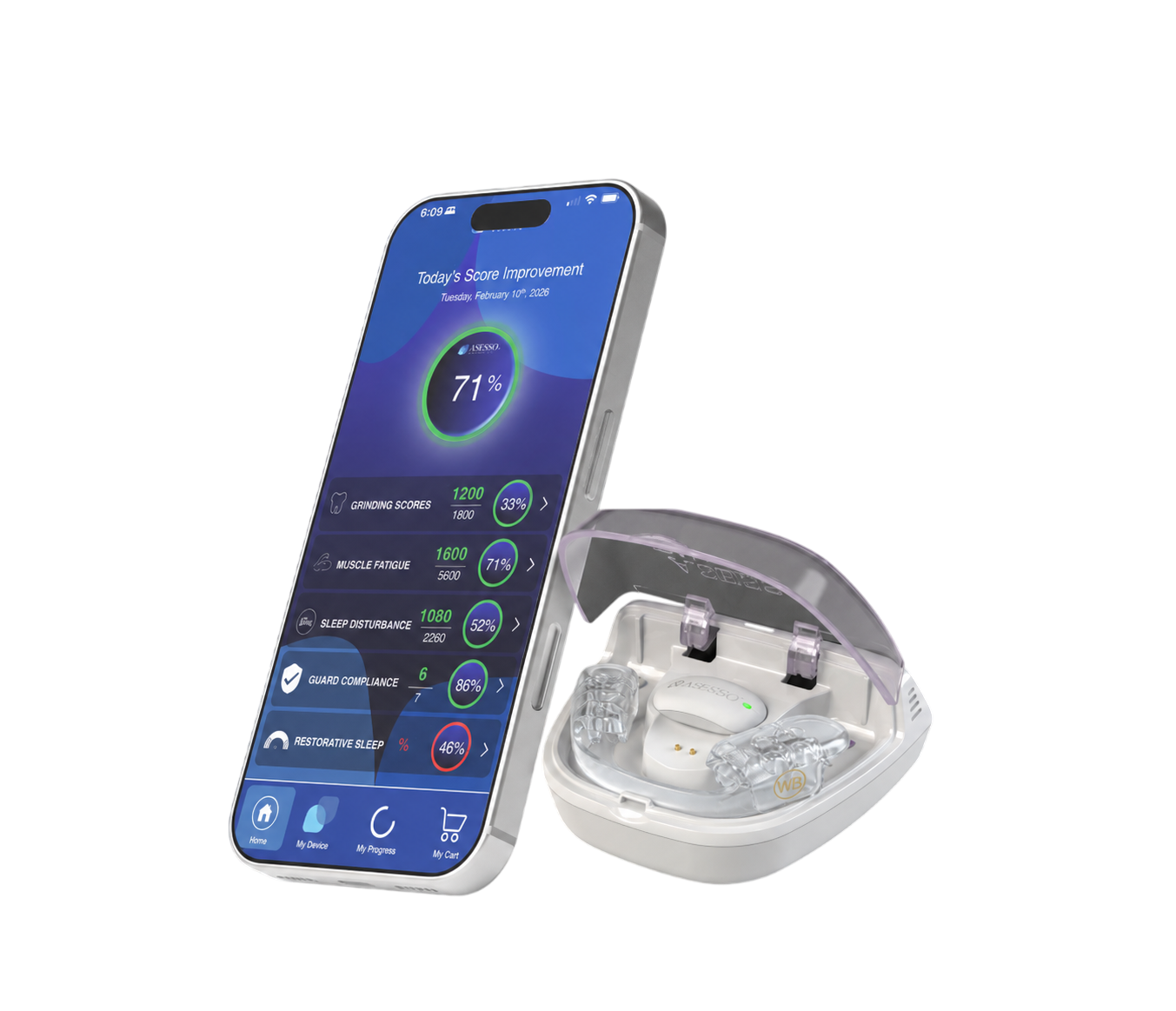
The Wakebright Grind Guard works at exactly this intersection. By repositioning the mandible during sleep, it reduces masseter and temporalis engagement, the primary source of nighttime trigeminal sensitization in bruxism patients. Consistent nightly use does not block a migraine in progress, but it systematically lowers the sensitization load that makes migraines more frequent. Patients typically notice changes in jaw symptoms within a few weeks and changes in headache frequency over six to twelve weeks.
Complementary approaches include physical therapy targeting the cervical musculature (which shares trigeminal input with the jaw), stress management to reduce the shared stress-bruxism-migraine amplification pathway, and daytime clenching awareness to lower the diurnal component of jaw muscle overload.
What You Can Do Now
If you have both TMD symptoms and migraines, document the temporal relationship between them for at least four weeks. Are your worst migraine weeks also your worst jaw weeks? Do your headaches cluster around periods of poor sleep, which is also when bruxism is most intense? This data is clinically actionable.
Present your combined picture to both your neurologist and your TMD provider. Neither can optimize treatment for the overlap without knowing about the other condition. Ask explicitly whether an integrated approach, addressing jaw muscle load alongside migraine management, has been considered for your case.
TMD and migraine co-occur at 2 to 4 times the rate expected by chance, due to shared trigeminal nerve pathways.
Each condition worsens the other through bidirectional neurological and behavioral mechanisms.
Stress is a shared amplifier of both: addressing it benefits both conditions at the same time.
Treating only one condition while ignoring the other produces incomplete and unstable relief.
Reducing overnight jaw muscle load with the Wakebright Grind Guard addresses the TMD side of the equation directly.
Integrated treatment of both conditions consistently outperforms single-condition approaches.
Frequently Asked Questions
Q: If I treat my TMD, will my migraines get better?
For patients with significant bruxism-driven TMD, conservative treatment consistently reduces migraine frequency in the published literature. The improvement reflects gradual central desensitization as sustained jaw muscle trigeminal input decreases. Changes in headache frequency typically appear at 6 to 12 weeks of consistent treatment. Most patients experience meaningful but not complete improvement, since migraine has additional drivers beyond the jaw component.
Q: Can treating migraines help my TMD?
Partially. Better migraine control reduces the stress and sleep disruption that worsen bruxism, which indirectly benefits TMD. CGRP antibodies in particular may reduce the central sensitization that amplifies TMD pain. However, migraine treatment does not directly address jaw muscle overload, so TMD management is still needed on its own merits for complete relief.
Q: Should I see a dentist or neurologist first for this overlap?
Starting with whichever provider you have the strongest relationship with is pragmatic, as long as you present the full picture: both conditions together. Ideally, an orofacial pain specialist (a dentist with advanced headache and TMD training) manages the jaw side and communicates with your neurologist. Some academic centers have integrated orofacial pain and headache clinics designed specifically for this overlap.
Q: Is the combination of TMD and migraine harder to treat?
It requires more comprehensive management than either condition alone, but it is not necessarily harder to treat successfully. The key is recognizing the bidirectional relationship and treating both conditions simultaneously rather than sequentially. Patients who approach both conditions together typically see better outcomes than those who treat one until it is resolved and then start on the other.
Q: Can stress management help both TMD and migraines?
Yes. Stress is a shared driver of both conditions. It directly lowers the migraine threshold through neurochemical pathways and directly increases bruxism intensity through muscle hyperactivation. Stress management techniques such as cognitive-behavioral therapy, mindfulness, and biofeedback produce measurable improvements in both headache frequency and jaw muscle tension when practiced consistently.
This article is for educational purposes only and does not constitute medical or dental advice. Please consult a qualified healthcare provider for personalized guidance.