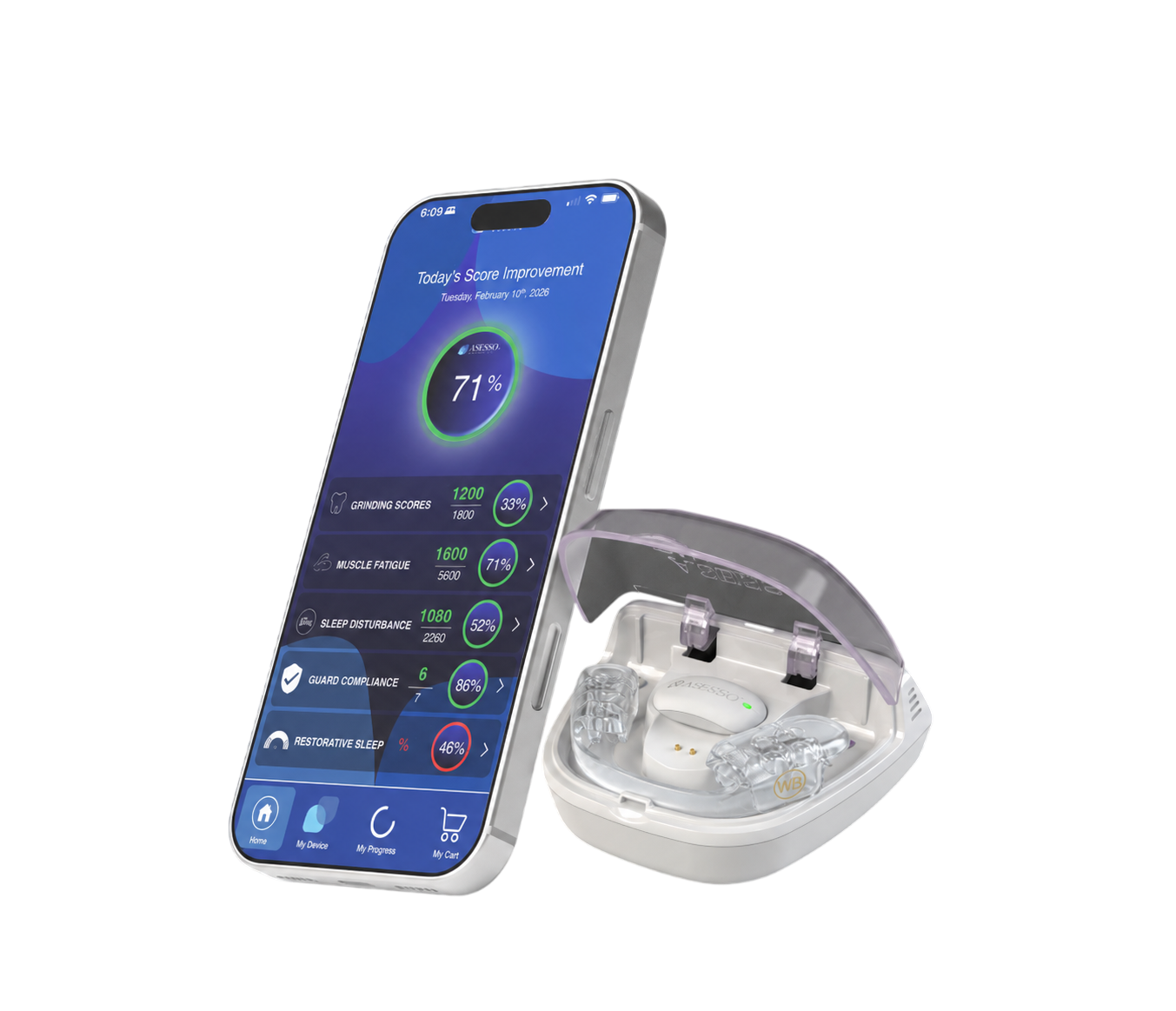
The Wakebright Grind Guard: A Non-Invasive System That Targets Jaw Muscle Stress at the Source

Most people who grind their teeth are handed a night guard and told that's the answer. Protect the enamel. Cushion the joint. Come back in six months.
Then six months pass, and they come back still waking up with a sore jaw, still fighting morning headaches, still carrying that tight, heavy feeling behind the cheekbones that has quietly settled into everyday life. The teeth are protected. The grinding is not.
The Wakebright Grind Guard was built for exactly this gap. It is not a standard night guard. It is a non-invasive grind guard system designed to do something fundamentally different: reduce the jaw muscle load that drives bruxism, rather than simply absorbing the damage that load creates.
This article explains how the Grind Guard works, why its approach stands apart, and what people who use it actually experience.
Why Standard Night Guards Are Not Enough
To appreciate what makes the Wakebright Grind Guard different, start with what conventional night guards actually do, and what they leave undone.
A standard night guard, whether bought over the counter or custom-fitted by a dentist, places a physical barrier between the upper and lower teeth. It offers a sacrificial surface for grinding forces to act on, sparing the enamel from accelerated wear. As tooth protection, this works. Beyond tooth protection, it does not.
Here is the critical limitation most patients never hear stated plainly: while wearing a conventional guard, the jaw muscles keep contracting with the same force. The clenching continues. The grinding continues. The masseter and temporalis, the powerful muscles that drive jaw movement, keep generating the same sustained load, night after night.
The guard changes where the damage lands. It does not lower the muscular activity producing the damage.
This is why so many people wear a night guard faithfully for years yet still wake up with jaw soreness. Still develop TMD symptoms. Still deal with facial tension and tension headaches that rise and fall with their sleep. The guard is doing its job. It was simply never built to do the job the person actually needs done.
The Core Mechanism: Load Reduction, Not Just Protection
The Wakebright Grind Guard operates on an entirely different principle. Instead of concentrating on what happens at the tooth surface, it targets what happens at the level of the jaw muscles themselves.
The Wakebright system is designed to mechanically limit how fully the muscles of mastication can clench. By keeping the jaw in a more relaxed, neutral position during sleep, it reduces the sustained muscular contraction that defines nocturnal bruxism.
That distinction carries enormous weight: Wakebright works upstream of the damage, not downstream of it.
Conventional guards intercept grinding forces only after the muscles have already produced them, at the tooth surface. The Grind Guard steps in at the muscle level, lowering how much sustained load the muscles generate in the first place.
The practical result feels different from anything tooth protection alone can offer. Users report more than protected teeth: their jaw muscles are genuinely less tense come morning. The soreness that used to greet them on waking starts to fade, not because the teeth were better shielded, but because the muscles truly did less work overnight.
What the Wakebright Grind Guard Is, and What It Is Not
Being clear about what the Grind Guard is sets the right expectations and helps people use it well.
The Wakebright Grind Guard is a non-invasive grind guard system. It is made for at-home use during sleep and requires no prescription, no clinical procedure, and no ongoing dental supervision to use effectively.
The Grind Guard is not a sleep disorder solution. The sleep improvements users experience are a downstream outcome of jaw muscle relaxation, not a direct treatment for sleep apnea, insomnia, or any other sleep condition.
This precision matters because it defines responsible use. Anyone with active dental problems, diagnosed sleep disorders, or significant TMD should be working with the right clinicians. Wakebright sits alongside those care pathways, supporting the muscular dimension that most professional care never directly addresses.
The Three Pillars of Wakebright's Value
People who use the Grind Guard report benefits that fall into three consistent categories, each flowing straight from the core mechanism of jaw muscle load reduction.
Jaw-Related Discomfort Support
This is where the evidence behind Wakebright is strongest and most consistent. More than 20 years of practitioner observations and user-reported outcomes reveal meaningful, repeated patterns of relief across several presentations.
Reduced jaw soreness and facial tension top the list of commonly reported experiences. The heaviness and tightness that many bruxism sufferers accept as a permanent feature of their mornings begins, over weeks of consistent use, to lift. Reduced headache-related discomfort, particularly the tension-type headaches that radiate from the jaw and temples, is another well-documented experience. Users dealing with sinus-like facial pressure and tinnitus-associated sensations also report symptomatic relief that tracks with jaw muscle relaxation.
Every one of these outcomes is framed as experience-based symptom relief rather than clinical treatment. The mechanism is straightforward: less sustained jaw muscle engagement means less downstream discomfort in all the structures the jaw muscles affect.
Support for More Restful Sleep
Sleep improvement is a secondary but meaningful part of the Wakebright experience, and it is also the part most important to understand correctly.
The sleep gains users report, better efficiency, fewer nighttime disturbances, and stronger subjective sleep continuity, do not come from Wakebright directly treating a sleep disorder. They are a downstream consequence of jaw muscle relaxation.
Nocturnal bruxism is a sleep-related movement disorder. Its rhythmic muscle contractions produce microarousals, brief partial awakenings that fragment sleep architecture even when the sleeper never consciously registers them. Over time, that fragmentation adds up to sleep that restores far less than its length would suggest.
When the Grind Guard reduces sustained jaw muscle engagement overnight, it cuts down the frequency and intensity of the bruxism episodes that trigger those microarousals. The downstream result is less fragmented, more restorative sleep. Users feel it as waking up more recovered, not because anything intervened in their sleep directly, but because the jaw muscle behavior disrupting it was dialed down.
Wakebright backs this up with sleep data derived from Apple Watch. Individual before-and-after directional tracking gives users visibility into their patterns over time, creating a concrete, measurable feedback loop that builds understanding and confidence in continued use.
Measurable Awareness and Confidence
The third pillar of Wakebright's value is measurement, and it represents something genuinely absent from every conventional guard.
A standard night guard tells you nothing. You put it in, take it out, and have zero visibility into what happened overnight. Any sense of improvement, or the lack of it, stays entirely subjective.
The Wakebright solution is built to operate inside a measurement-informed framework. Longitudinal sleep tracking reveals patterns over time: sleep duration, efficiency, disturbances, and the direction of change. This is not diagnostic data. It does not measure muscle activity or diagnose sleep disorders. But it plays a strategic role: as users watch their patterns evolve, understanding deepens, confidence grows, and adherence rises.
That feedback loop transforms a person's relationship with their jaw health from passive guessing into active, informed engagement.
How Wakebright Differs from Every Competitor
The bruxism product market is crowded, yet the competitive landscape holds one clear gap, and Wakebright occupies it uniquely.
OTC night guards are cheap and easy to get, but they deliver poor comfort, no muscle education, and no feedback. They protect teeth while leaving every other consequence of bruxism completely unaddressed.
Dentist-made custom guards bring more precision, but they cost a lot, focus entirely on the tooth surface, and often end up abandoned, with no measurement to guide or motivate continued use.
Direct-to-consumer custom guards have improved convenience and price, yet they remain dental-first in orientation, transactional in design, and silent on the muscular root cause.
No category leader currently owns jaw muscle stress as the root cause of bruxism-related suffering, or pairs a physical intervention with an educational, measurement-based feedback system. That is precisely the white space Wakebright fills.
The market treats bruxism as a dental problem. Wakebright treats it as a neuromuscular one, and builds its entire approach around that reframe.
More Than 20 Years of Real-World Evidence
Wakebright's claims rest on over two decades of real-world use, practitioner observations, and consistent user-reported outcomes. This is not peer-reviewed clinical trial data, and Wakebright is transparent about that. The evidence is practitioner-observed and user-reported: long-term patterns, consistent anecdotal alignment around jaw tension relief, and repeated confirmation that the mechanism produces genuine experiential change.
That history matters because it answers the question behind every purchase of a new wellness approach: has this worked for real people, consistently, over time?
For Wakebright, the answer is yes, presented with clear, honest framing about what that evidence is and what it is not.
Who Benefits Most from the Wakebright Grind Guard
The Grind Guard serves three primary groups, each arriving at jaw muscle care from a slightly different direction.
Pain- and discomfort-aware users live with chronic jaw tension, facial pain, recurring headaches, and the morning soreness pattern that tells them something has been happening overnight. Many have already tried conventional night guards and found them incomplete. They are ready for a solution aimed at cause rather than consequence.
Sleep-frustrated users log adequate hours yet wake unrested. They may not immediately connect sleep quality to the jaw, but the pattern fits: bruxism-driven microarousals are fragmenting their rest without their awareness. For this group, Wakebright's sleep outcome data is often the most compelling way in.
Wellness and technology-oriented users gravitate toward non-invasive tools that produce data and feedback. They prefer measurable, mechanism-led approaches over passive protection. They want to understand what is happening in their bodies, track changes over time, and decide based on evidence rather than anecdote.
If you see yourself in any of these descriptions, the Wakebright Grind Guard is likely worth understanding in depth.
What Consistent Use Actually Feels Like
The Wakebright experience develops over time rather than arriving as a dramatic overnight change. Consistent users describe a gradual shift in their morning baseline: the jaw soreness that used to be their first sensation of the day starts losing intensity. The headaches become less predictable, and then less frequent. The tight, pressured feeling behind the cheekbones softens.
Where sleep is tracked, the data tends to show directional improvement in efficiency and disturbance frequency across weeks and months. These outcomes are not guaranteed. Individual results vary, and the evidence base is user-reported rather than clinical-trial grade. But the pattern, observed over decades of use and across multiple cohorts, is consistent.
The experience is not one of a device doing something dramatic to you. It is a gradual return toward what a jaw that is not chronically overworked actually feels like.
What You Can Do Now
The Wakebright Grind Guard targets jaw muscle load reduction rather than tooth surface protection alone, which makes it fundamentally different from standard night guards.
Its core mechanism: mechanically limiting full muscle clenching while keeping the jaw in a more relaxed, neutral position during sleep.
The primary benefit is jaw-related discomfort relief, and the secondary benefit is improved sleep quality as a downstream outcome of muscle relaxation.
Wakebright is not a medical device, a dental treatment, or a sleep disorder solution. It is a non-invasive grind guard system with a real-world evidence base spanning more than 20 years.
The measurement component, longitudinal sleep tracking, creates a feedback loop that builds user understanding, confidence, and adherence over time.
Wakebright occupies white space no competitor owns: jaw muscle stress treated as the root cause, combined with a physical intervention and measurable feedback.
Frequently Asked Questions
Q: Is the Wakebright Grind Guard the same as a regular night guard?
No. A regular night guard puts a barrier between the teeth to absorb grinding forces and protect enamel. The Wakebright Grind Guard works at the muscle level, mechanically limiting how fully the jaw muscles can clench during sleep. That reduces the sustained muscular load driving the bruxism, which is something conventional guards never address.
Q: Is the Wakebright Grind Guard a medical device?
It is built to reduce jaw muscle load during sleep and supports experience-based symptom relief rather than clinical treatment of any diagnosed condition.
Q: Can I use the Wakebright system alongside my existing night guard?
Yes. For many people, pairing the Smart dock and sensor (provided by Asesso Health) with a conventional night guard may work as a complementary approach: the guard keeps protecting the tooth surface while the Asesso Smart Solution informs on your progress. If you are unsure how to combine the two, your dentist or clinician can help shape the approach.
Q: How long before I notice results with the Wakebright Grind Guard?
The experience builds gradually. Many users report meaningful changes in morning jaw soreness within two to four weeks of consistent use. Sleep-related changes, tracked through wearable data, often become directionally visible over four to eight weeks. Individual results vary.
Q: Who should not use the Wakebright Grind Guard?
The Grind Guard is designed for adults experiencing jaw muscle tension and bruxism-related discomfort. It is not intended to diagnose or treat medical or dental conditions. Anyone with significant structural TMJ pathology, active dental emergencies, or diagnosed sleep disorders should consult the appropriate clinicians before using any jaw device, including Wakebright.
WAKEBRIGHT | If you have been protecting your teeth without addressing the jaw muscle tension that drives your grinding, the Wakebright Grind Guard offers the next step. Non-invasive, mechanism-led, and backed by more than 20 years of consistent user experience, it is built for people ready to stop managing symptoms and start addressing the source. Explore the Wakebright Grind Guard and discover what jaw muscle relief actually feels like.
This article is for educational purposes only and does not constitute medical or dental advice. Please consult a qualified healthcare provider for personalized guidance.