The Bruxism Sleep Apnea Link: When Grinding Is a Breathing Problem

Teeth grinding and sleep apnea are usually talked about as separate conditions one a dental problem, the other a breathing problem. Sleep research increasingly suggests that's an oversimplification. The two overlap heavily, and in a genuinely interesting twist, some researchers believe grinding might actually be your body's way of responding to a blocked airway, not just an unrelated habit that happens to occur at the same time.
How Common Is the Overlap?
The connection is well-documented at this point. A large-scale polysomnographic study using overnight sleep-lab monitoring, the gold standard for this kind of research found that sleep bruxism is highly prevalent in adults with obstructive sleep apnea (OSA), far more common than would be expected by chance alone. Other research screening dental patients with a validated OSA risk questionnaire found bruxism episode rates were measurably higher in the group at elevated risk for OSA compared to those at lower risk.
This isn't a minor statistical footnote it's one of the more consistently replicated findings in sleep bruxism research, appearing across multiple independent polysomnographic studies using different populations and methods.
The "Protective Reflex" Theory
Here's where it gets genuinely interesting. Several researchers have proposed that sleep bruxism isn't just coincidentally associated with sleep apnea it may actually be a protective response. The theory: when your airway partially collapses during an apnea or hypopnea event, the resulting muscle activity involved in grinding may help reopen the airway and restore normal breathing, functioning as a kind of built-in rescue mechanism.
Supporting evidence for this comes from a case-control polysomnographic study, which found that sleep bruxism may act as a protective factor specifically in patients with mild OSA, and a separate study found that patients with milder OSA had more frequent bruxism episodes than those with moderate to severe OSA consistent with the idea that bruxism's protective effect may be most relevant, or most detectable, at the milder end of the severity spectrum.
More recent research has refined this further by looking at arousal threshold essentially, how easily someone wakes from sleep. A 2025 study found that people with a low arousal threshold (who wake more easily) showed higher bruxism intensity, and proposed that this specific combination easily aroused plus prone to bruxism might offer better protection against OSA complications, since the grinding response terminates the respiratory event sooner.
But the Evidence Is Genuinely Mixed
It's important not to oversimplify this into "grinding is good, actually." A more recent, larger polysomnographic study of 241 patients with mild to moderate OSA found results that directly contradict the protective-factor hypothesis: patients with sleep bruxism in this study actually had longer durations of hypopnea and apnea-hypopnea events than those without bruxism the opposite of what a protective effect would predict. The study's authors suggested that any protective properties of bruxism might be limited specifically to milder airway obstruction, or might diminish over time as OSA progresses.
The honest summary: the relationship between sleep bruxism and sleep apnea is real and consistently documented, but whether bruxism functions as a helpful protective reflex, an unhelpful bystander, or something that shifts depending on severity and individual factors is still genuinely unsettled in the research. Multiple respected studies have reached different conclusions, and researchers openly acknowledge that the underlying mechanisms connecting the two conditions aren't fully clarified.
A Possible Shared Genetic Thread
Beyond the mechanical, in-the-moment relationship, there's also emerging evidence of a shared underlying vulnerability. Research examining genetic variants in serotonin and dopamine pathways found that a specific gene variant (referred to as HTR2A rs2770304) might contribute to why sleep bruxism and OSA tend to occur together in the same individuals suggesting the connection may partly reflect a shared biological predisposition, not purely a moment-to-moment reflex response.
Why This Matters: OSA Is a Serious Condition on Its Own
Regardless of exactly how the protective-reflex question shakes out, this connection matters for a much more practical reason: obstructive sleep apnea is a significant health condition independent of any grinding it might be associated with. Research consistently identifies OSA as the most common sleep disorder independently associated with cardiovascular illness and increased mortality risk. If your bruxism is a marker of underlying, undiagnosed OSA, identifying that isn't just about the grinding it's about a condition with real, documented health stakes that benefits substantially from proper diagnosis and treatment.
Signs Your Grinding Might Be a Breathing Problem
Consider asking about a sleep evaluation if your teeth grinding occurs alongside:
- Loud, frequent snoring
- Witnessed pauses in breathing during sleep (often reported by a partner)
- Waking up gasping or choking
- Excessive daytime fatigue despite adequate time in bed
- Morning headaches
- High blood pressure, particularly if it's difficult to control
- Being overweight, or having a thick neck circumference
None of these alone confirms OSA, but this combination alongside bruxism is a reasonable basis for requesting a sleep evaluation rather than treating the grinding as an isolated dental issue.
What to Do About It
Mention grinding and any breathing-related symptoms together at both your dental and medical appointments, since this connection means each provider benefits from knowing what the other has observed.
Ask about a sleep study if you have risk factors or symptoms suggestive of OSA, since this is the only way to actually diagnose the condition and understand its severity.
Understand the treatment distinction. A standard night guard protects your teeth from grinding-related damage but doesn't treat OSA. If sleep apnea is diagnosed, treatments like CPAP (continuous positive airway pressure) or an oral appliance specifically designed for OSA sometimes a mandibular advancement device, which repositions the jaw to help keep the airway open may be recommended instead of, or alongside, standard bruxism management.
Don't assume a night guard alone solves everything if OSA turns out to be present, since addressing the underlying breathing disorder is a separate and, in many cases, more health-significant goal than managing the grinding itself.
Frequently Asked Questions
Does teeth grinding mean I definitely have sleep apnea?
No bruxism has multiple possible causes, and most people who grind their teeth don't have sleep apnea. However, given how strongly the two conditions overlap in research, it's a reasonable possibility worth considering, especially if you also have symptoms like snoring or witnessed breathing pauses.
Is grinding my teeth actually helping me breathe during sleep apnea episodes?
Some research supports this "protective reflex" theory, particularly in milder OSA cases, but other, more recent research has found the opposite bruxism associated with longer, not shorter, breathing disruption events. The research is genuinely mixed, and this isn't a settled question.
How common is it for people to have both bruxism and sleep apnea?
Very common a large-scale polysomnographic study found sleep bruxism is highly prevalent among adults with OSA, and this overlap has been replicated across multiple independent studies using objective sleep-lab measurements.
Should I get a sleep study if I know I grind my teeth?
It's a reasonable step, particularly if you also have snoring, witnessed breathing pauses, excessive daytime fatigue, or other OSA risk factors. A sleep study is the only way to actually diagnose sleep apnea, since bruxism alone isn't a reliable diagnostic indicator on its own.
Will treating my sleep apnea stop my teeth grinding?
It's possible, particularly if the grinding is functioning as a response to airway obstruction, but the research doesn't guarantee this outcome for everyone, especially since more severe OSA cases haven't shown as consistent a "protective" pattern as milder cases in some studies.
Can a regular night guard treat sleep apnea?
No a standard night guard protects your teeth from grinding damage but isn't designed to treat sleep apnea. If OSA is diagnosed, treatment typically involves CPAP therapy or, in some cases, a specifically designed oral appliance (mandibular advancement device) different from a standard bruxism night guard.
Is sleep apnea actually dangerous, or is it mostly about snoring?
It's a genuinely significant health condition research consistently links OSA to increased cardiovascular risk and mortality independent of other factors, which is part of why proper diagnosis matters beyond just addressing the grinding or snoring.
Why would some researchers think grinding helps with sleep apnea while others disagree?
Because the research findings have genuinely differed across studies some have found bruxism associated with shorter respiratory events (supporting a protective role), particularly in milder OSA, while at least one more recent, larger study found the opposite pattern. Researchers have proposed that the relationship might depend on OSA severity, individual arousal patterns, or other factors not yet fully understood.
Can children have both bruxism and sleep apnea?
Both conditions can occur in children, and research has examined similar overlaps in pediatric populations, though the specific mechanisms and treatment approaches for children differ from those for adults.
If I don't snore, does that rule out sleep apnea as a cause of my grinding?
Not entirely, though snoring is one of the more common associated symptoms. Some people with sleep apnea, particularly those with certain anatomical or physiological patterns, may not snore prominently, so its absence doesn't definitively rule out OSA on its own.
Is there a genetic reason some people get both bruxism and sleep apnea?
Some research has identified a specific gene variant related to serotonin pathway function that may contribute to why the two conditions co-occur, suggesting a possible shared biological vulnerability in addition to any moment-to-moment protective mechanism.
What should I tell my dentist and doctor if I suspect this connection?
Mention your grinding, any snoring or witnessed breathing pauses, daytime fatigue, and morning headaches to both providers, since this combination of symptoms is exactly what should prompt consideration of a sleep evaluation alongside standard dental care for the grinding itself.
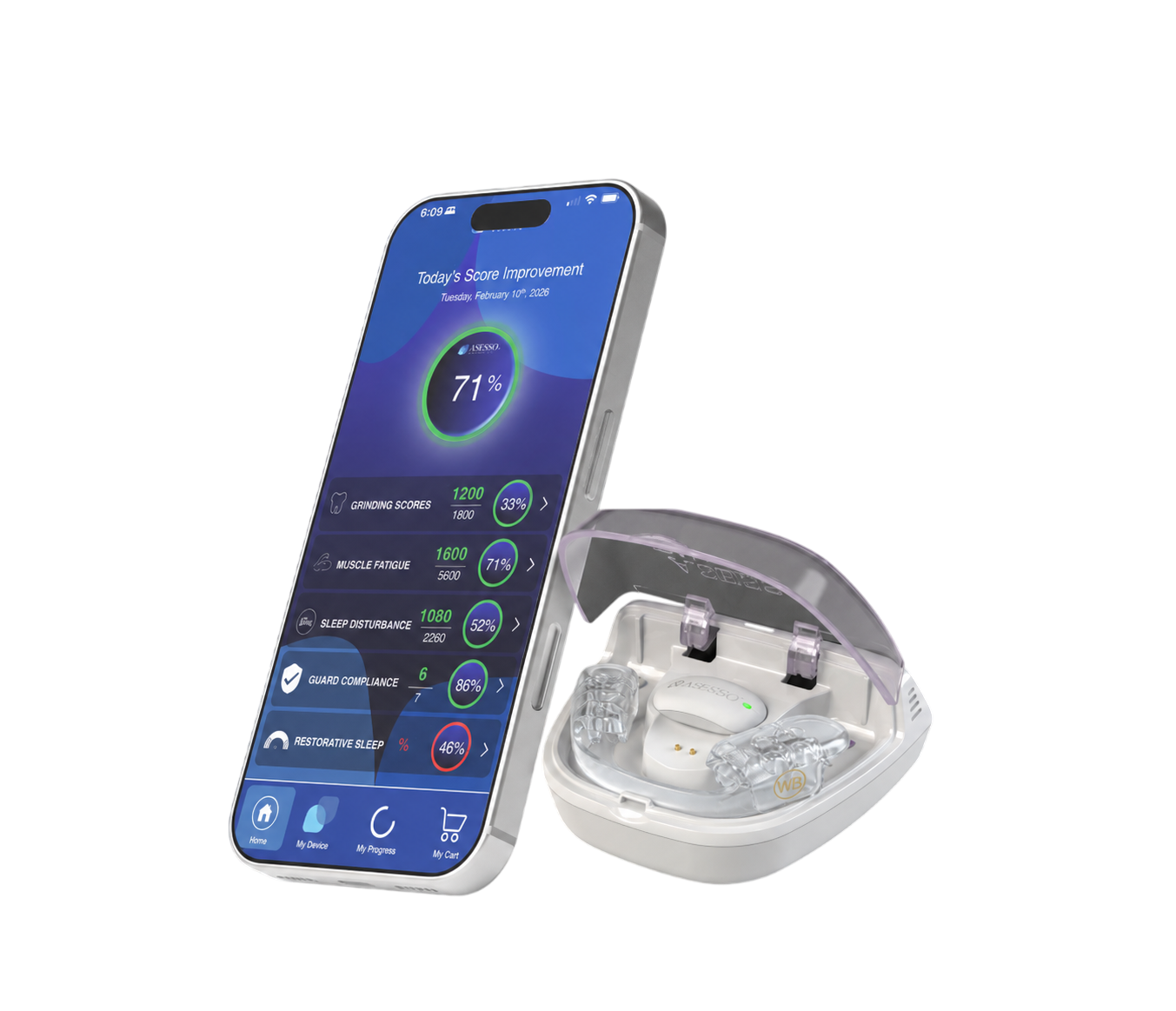
WAKEBRIGHT | If your dentist determines a standard guard is appropriate for your situation, the Wakebright Guard provides that protection and if an airway issue is identified, your dentist can guide you toward the right type of appliance for that specific need.
This article is for informational purposes only and does not constitute medical advice. Consult a licensed dentist or healthcare provider for diagnosis and treatment recommendations specific to your situation.
References
- Li, D. et al. "Sleep bruxism is highly prevalent in adults with obstructive sleep apnea: a large-scale polysomnographic study." Journal of Clinical Sleep Medicine, as cited in Research Square. https://www.researchsquare.com/article/rs-7210470/v1
- "Sleep Bruxism as a Protective Factor in the Mild and Moderate Obstructive Sleep Apnea: A Polysomnographic Study." Journal of Sleep Research, Wiley Online Library. https://onlinelibrary.wiley.com/doi/10.1111/jsr.70206
- "The effect of the arousal threshold on sleep bruxism intensity in coexisting sleep apnea and sleep bruxism: a polysomnographic study." Scientific Reports, Nature. https://www.nature.com/articles/s41598-025-01687-8
- "Is there an association between sleep bruxism and obstructive sleep apnea? A case-control polysomnographic investigation." Sleep Medicine, ScienceDirect/PubMed. https://pubmed.ncbi.nlm.nih.gov/38141521/
- Kazubowska-Machnowska, K. et al. "The Effect of Severity of Obstructive Sleep Apnea on Sleep Bruxism in Respiratory Polygraphy Study." Brain Sciences, PMC, National Library of Medicine. https://www.ncbi.nlm.nih.gov/pmc/articles/PMC9313411/