The Best Mouth Guard For Jaw Clenching

Jaw Clenching vs. Grinding: Why the Difference Matters
Jaw clenching and teeth grinding get lumped together all the time, yet mechanically they are two different problems that call for two different solutions. Clenching is a sustained, isometric contraction: the jaw muscles tighten and hold that tension while the teeth barely move against each other. Grinding involves actual movement, with the teeth sliding sideways or forward and backward. The muscle groups at work and the stress patterns they generate are not the same.
Plenty of people assume they grind simply because they hear sounds at night or wake up with a sore jaw. But clenching alone can produce clicking or faint sounds as the muscles contract. What matters clinically is identifying your specific pattern. People who clench usually wake with deep muscle soreness in the masseter and temporalis, the large muscles along the side of the jaw and the temple, while their tooth wear stays relatively mild. People who grind show the opposite picture: clearly flattened teeth, often with less jaw muscle pain but considerably more dental damage.
The Muscular Mechanism of Jaw Clenching
Clenching occurs when the muscles that close the jaw, chiefly the masseter and temporalis, contract with sustained force. These muscles run from the jawbone up to the skull and temples, so when you clench, you put this entire muscular network under intense strain. At full contraction, the masseter alone can generate up to 200 pounds of force. During sleep, especially in someone who is stressed or short on rest, these muscles can hold significant contraction for minutes or even hours at a stretch, leaving them fatigued and painful by morning.
Here is the core issue: clenching is fundamentally a muscle problem, not a tooth problem. A rigid guard sitting between your teeth does nothing about the underlying muscle tension. It will prevent tooth damage if grinding happens alongside the clenching, but it cannot relax the tight muscles that produce the clenching to begin with. Think of a shoulder muscle knotted up from stress. Strapping a protective pad over that shoulder does not release the tension; it only limits damage if the tight muscle spasms. To genuinely fix the problem, the muscle itself has to relax.
Jaw position also shapes how severe clenching becomes. If your jaw rests in a position that keeps the muscles slightly engaged even at rest, you will clench more during sleep. This explains why two people with similar stress levels can clench so differently: their jaw positioning sets their baseline muscle tension. Someone with poor jaw positioning begins every night with muscles that are already partly fatigued, which makes clenching both more likely and more intense.
Traditional Rigid Guards: Protecting Teeth Without Touching the Root Cause
Traditional hard guards, made from acrylic or resin, work by placing a protective barrier between your teeth. For intense grinders they do an excellent job of preventing tooth damage. The hard material soaks up grinding force and keeps the teeth from wearing flat, and with proper care these appliances can last for years. The downsides are real, though: they are chunky, frequently uncomfortable, and they do nothing to lower the muscle tension driving the clenching. Some people find rigid guards so unpleasant that they stop wearing them, or pull them out mid-sleep without even realizing it.
Soft guards win on comfort but fail in a different way: they compress too easily. Clench against a soft surface and it simply squashes down, letting your teeth come together almost as though nothing were there. That undermines the protective purpose entirely. Soft guards feel better but protect worse, and they do not address muscle tension either. In practice they end up as a compromise between comfort and protection that fully delivers on neither.
Rigid and soft guards also share one deeper flaw: neither one asks why you are clenching at all. They are reactive tools that respond to clenching already in progress. If jaw tension is wrecking your sleep quality, a traditional guard will not fix that. It may spare your teeth, but you will still wake with tension, soreness, and the same disrupted sleep. You are shielding a symptom while the root cause carries on untouched.
Jaw Repositioning: Going After the Root of Clenching
Jaw repositioning devices operate on a completely different principle. Rather than blocking clenching or absorbing it, they place the jaw in a position that lowers the muscle tension responsible for the clenching in the first place. With the jaw shifted slightly, the muscles can settle into a state where relaxing comes naturally, holding position takes less effort, and far less fatigue builds up overnight. This targets the mechanical root of the problem: a jaw position that breeds tension.
For people whose clenching stems from jaw positioning, the results of repositioning can be remarkable. Simply moving the jaw to where the muscles carry less baseline tension can cut clenching substantially. Picture the difference between holding your arm straight out in front of you, which exhausts you within minutes, and letting it hang at your side, which costs almost nothing. When your jaw rests where the muscles can truly relax, clenching fades on its own. Nothing is forcing your mouth open and no barrier is fighting the clenching; the mechanical reason your jaw wants to clench has simply been removed.
The benefits reach beyond clenching itself. Proper jaw positioning lifts overall sleep quality. When the jaw muscles carry less tension and fatigue, the whole night improves: sleep runs deeper, mornings feel more refreshed, and daytime jaw pain shrinks. Many people never realize how much jaw tension has been costing their sleep until they experience a night with relaxed, well-positioned jaw muscles. What they gain is not just less clenching but genuine sleep restoration.
Choosing the Right Guard: Questions to Ask Yourself
First, pin down your actual problem. Is tooth damage from grinding your main worry? Then a protective guard makes sense, either a rigid one for maximum protection or a mid-firmness option that trades a little protection for comfort. Is your main experience jaw pain, soreness, and clenching without much visible tooth wear? Then you are facing a muscle tension problem, and jaw repositioning deserves a serious look. Many people carry both issues, clenching and grinding along with jaw pain, so identifying your primary concern is what steers the decision.
Second, be honest about your lifestyle and compliance. Traditional guards demand that you remember to wear them, clean them every day, and put up with the feeling of an appliance in your mouth. If you tend to forget things or unconsciously remove them in your sleep, a guard you only need overnight may suit you better than one you constantly struggle to stick with. And if you are open to some daytime wear for extra benefit, a repositioning device can offer advantages that a nighttime-only guard cannot.
Third, work out whether muscle tension is part of your picture. Waking with sore jaw muscles, tight temples, trouble opening your mouth wide, or tension that follows you through the day all point to a significant muscle component in your clenching. In that case, a device that addresses muscle tension makes far more sense than one that merely tolerates the clenching. You would be treating the foundational problem instead of managing its consequences.
What You Can Do Now
Jaw clenching is a muscle tension problem while grinding is a tooth-wearing problem, and each one needs its own solution.
Traditional hard and soft guards prevent tooth damage but leave the jaw muscle tension behind the clenching untouched.
Jaw repositioning targets the mechanical root of clenching by placing the muscles where they relax more naturally.
Proper jaw positioning can cut clenching substantially while improving overall sleep quality at the same time.
Custom-fitted solutions outperform over-the-counter options because precise jaw positioning is what drives clenching reduction.
If jaw muscle pain and soreness accompany your clenching, addressing the tension through repositioning beats relying on a simple protective barrier.
Frequently Asked Questions
Q: Can a mouth guard stop me from clenching entirely?
No guard eliminates clenching completely when stress or sleep deprivation is driving it. A protective guard spares your teeth but does not reduce the clenching itself. A repositioning guard can lower clenching considerably by easing muscle tension, though some clenching may still occur. A substantial reduction is a realistic goal; full elimination usually requires dealing with the stress or sleep issues underneath.
Q: Should I wear a jaw clenching guard during the day too?
Most traditional guards are meant for nighttime only, and repositioning devices designed for sleep are not intended for all-day wear. That said, building daytime awareness of your clenching helps: consciously releasing your jaw during stressful moments makes a difference, and no guard is needed for that. Mindfulness alone goes a long way. If daytime clenching is severe, ask a dentist what would be appropriate.
Q: How do I know if my guard is positioned correctly for clenching?
A well-positioned guard should feel comfortable, never as though it is prying your mouth open or locking your jaw somewhere unnatural. You may notice slightly less clenching within days. A dentist or sleep specialist should confirm the positioning through functional assessment. If the guard feels wrong or makes clenching worse, it needs a positioning adjustment.
Q: Can clenching damage be reversed?
Tooth damage from grinding is permanent, though a proper guard stops it from getting worse. The muscle side of the story is more hopeful: jaw tension and soreness improve once clenching drops through better positioning or stress management. Most of what people blame on clenching, the muscle pain, tightness, and poor sleep, resolves as the clenching eases. The teeth do not heal, but the functional problems do.
Q: Is a custom-fitted guard better than over-the-counter options for clenching?
For clenching, yes, and by a wide margin, because precise positioning is what makes the difference. An over-the-counter guard is not tuned to your specific jaw mechanics. If plain tooth protection from grinding is your only concern, a store-bought guard offers basic coverage, but even then a custom fit wins on comfort and long-term effectiveness.
Q: How long before I notice clenching reduction with a repositioning guard?
Some people feel the difference within days, while others need 1 to 2 weeks before clear improvement shows. Your nervous system and muscles both need time to adapt to the new position. If two weeks pass with no change even though the guard feels comfortable, contact your provider, since the positioning may need adjustment.
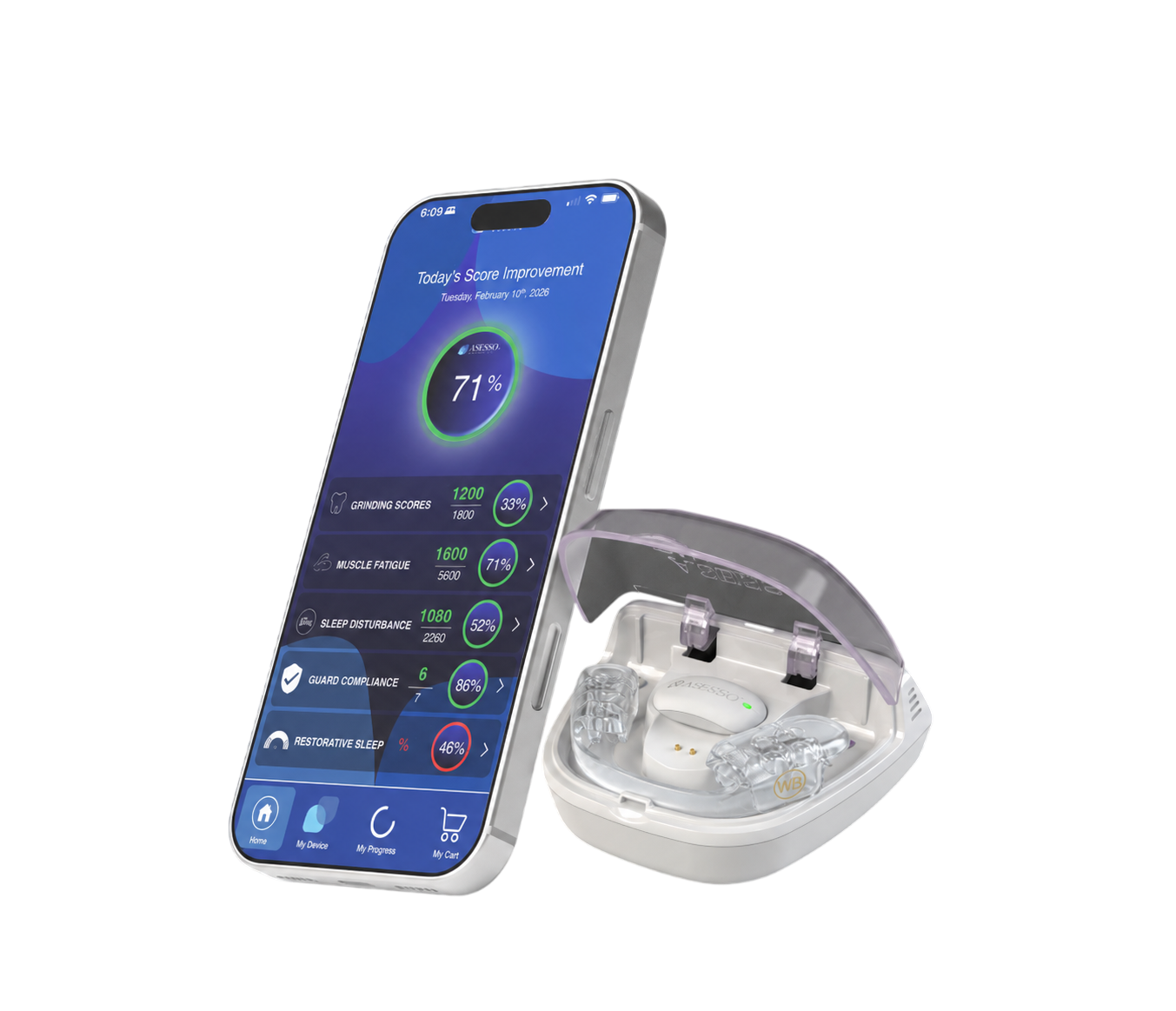
WAKEBRIGHT | If you wake up with jaw soreness, muscle tension, and clenching, a plain protective guard will never solve the root problem. The Wakebright Grind Guard repositions your jaw to reduce muscle load during sleep, targeting the mechanical foundation of your clenching. Backed by more than 20 years of real-world use, it is built specifically for the muscle tension and stress-based clenching that so many people live with. Discover how proper positioning transforms both your clenching and your sleep quality. This article is for educational purposes only and does not constitute medical or dental advice. Please consult a qualified healthcare provider for personalized guidance.