Sleep Bruxism vs. Awake Bruxism: Prevalence Data by Age and Gender

Sleep bruxism and awake bruxism get lumped together constantly both involve grinding or clenching teeth, both fall under the same diagnostic umbrella but the research shows they behave quite differently depending on who you are. Age and sex don't just shift the numbers slightly; in some cases they shift them in opposite directions for the two conditions. Here's what the data actually shows when you compare them side by side, rather than as one blended statistic.
The Baseline Numbers, Side by Side
Before breaking down age and sex, it helps to see the two conditions' overall prevalence next to each other:
- Sleep bruxism: generally estimated at 8-16% of adults using self-report methods, according to a StatPearls clinical review, though studies using objective polysomnography monitoring have found rates as high as 43% suggesting a substantial share of sleep bruxism goes unnoticed by the person experiencing it.
- Awake bruxism: estimated considerably higher, at roughly 22-31% of adults, with "about 1 in 4" being a commonly cited approximation drawn from this research.
That gap alone awake bruxism consistently outpacing sleep bruxism in reported prevalence is worth sitting with, since it runs counter to the common assumption that grinding is primarily a nighttime phenomenon. Daytime clenching, much of it unconscious, appears to be the more common of the two behaviors.
How Age Affects Sleep Bruxism
Age-related patterns for sleep bruxism are among the more consistently documented findings in this research, and they point clearly downward over the adult lifespan.
A large Dutch population study (n=1,209 adults) broke sleep bruxism prevalence down by five-year age brackets and found a clear declining trend:
| Age Group | Sleep Bruxism Prevalence |
|---|---|
| 25-34 | 20.0% |
| 35-44 | 21.0% |
| 45-54 | 16.5% |
| 55-64 | 14.5% |
| 65-74 | 8.3% |
That's roughly a two-and-a-half-fold drop from the youngest to oldest age bracket studied. A separate systematic review examining sex-specific age effects found a similar pattern in women specifically, with sleep bruxism reported in about 15% of adult women versus 9% of minors a notable reminder that the age effect isn't uniformly "declines with age" across every study; the direction and magnitude can vary depending on which age comparison is being made and which population is studied.
Childhood sleep bruxism shows its own age-related pattern, distinct from the adult decline. A large retrospective pediatric dentistry study (n=1,900) found sleep bruxism reported in:
- Ages 0-6: 20.7%
- Ages 7-11: 19.4%
- Ages 12-17: 14.6%
Combined with the adult data, the overall picture across the lifespan looks like a gradual decline from early childhood through older adulthood, with some fluctuation in the exact rate depending on developmental stage rather than one flat, age-independent number.
How Age Affects Awake Bruxism
Awake bruxism's relationship with age looks different, and the research here is less granular. The same Dutch study found awake bruxism prevalence by age bracket:
| Age Group | Awake Bruxism Prevalence |
|---|---|
| 25-34 | 6.5% |
| 35-44 | 7.8% |
| 45-54 | 4.0% |
| 55-64 | 3.2% |
| 65-74 | 3.0% |
Interestingly, this dataset shows awake bruxism peaking in the 35-44 bracket rather than declining steadily from the youngest group a somewhat different shape than the sleep bruxism age curve in the same study. A separate systematic review reported a more general finding: bruxism activity overall tends to decrease in elderly populations, with no significant sex-based difference in that specific decline. It's worth flagging that awake bruxism prevalence figures vary more across different studies than sleep bruxism figures do, which may reflect how much harder awake bruxism is to consistently self-report compared to a partner-observed nighttime behavior.
How Sex Affects Sleep Bruxism
Women report sleep bruxism somewhat more often than men across multiple studies, though the gap is generally modest rather than dramatic. The Dutch population study found this difference to be statistically significant, though it did not report as large a gap as some related conditions show.
A more pronounced sex gap shows up in temporomandibular disorders (TMD) a related but distinct condition that frequently co-occurs with bruxism. A 2025 global meta-analysis found TMD prevalence of 36.7% in women versus 26.7% in men, and U.S. data from NIDCR describes TMD as at least twice as prevalent in women. Bruxism itself doesn't show quite as dramatic a sex split as TMD does, based on current research a useful distinction, since the two conditions are often discussed interchangeably despite having somewhat different demographic patterns.
How Sex Affects Awake Bruxism
The Dutch study also found awake bruxism significantly more common in women than men, mirroring the sleep bruxism pattern in direction if not necessarily in magnitude. Beyond this, sex-specific data on awake bruxism specifically is less extensively studied compared to sleep bruxism or TMD, which is itself a notable gap in the literature awake bruxism generally receives less dedicated research attention than sleep bruxism, despite being the more prevalent of the two conditions overall.
Putting It Together: Sleep vs. Awake, Age vs. Sex
| Factor | Sleep Bruxism | Awake Bruxism |
|---|---|---|
| Overall adult prevalence | 8-16% (self-report); up to 43% (objective monitoring) | 22-31% (~1 in 4 commonly cited) |
| Age pattern | Fairly consistent decline from younger to older adults | Less consistent; one dataset shows a peak in the 35-44 range |
| Childhood pattern | Declines somewhat from early childhood through adolescence | Less well-documented in children specifically |
| Sex difference | Modestly higher in women, statistically significant in at least one large study | Also higher in women in available data, though less studied overall |
| Elderly pattern | General decline, consistent across sexes | General decline reported, though less granular data available |
Why the Two Conditions Diverge
Part of the reason these patterns differ is that sleep bruxism and awake bruxism are understood to have somewhat different underlying mechanisms. Sleep bruxism is classified as a sleep-related movement disorder, tied to brief arousals in the central nervous system during sleep a process that may naturally change as sleep architecture shifts with age. Awake bruxism is more closely tied to conscious or semi-conscious behavior during concentration, stress, and emotional states factors that don't necessarily follow the same aging trajectory as sleep physiology does. That mechanistic difference is a reasonable explanation for why the two conditions don't move in lockstep across age and sex, even though they're frequently discussed as though they're the same behavior happening at different times of day.
What This Means Practically
If you're trying to make sense of your own risk or your family's, a few takeaways are worth keeping in mind: age doesn't uniformly predict lower risk for both types the way it might seem to at first glance, sex differences exist for both types but are more firmly established for sleep bruxism and TMD than for awake bruxism specifically, and self-reported statistics for awake bruxism in particular likely understate true prevalence, given how much of daytime clenching happens without conscious awareness. None of these population patterns substitute for an individual dental evaluation, but they're useful context for understanding why a given demographic pattern doesn't automatically apply to any one person.
Frequently Asked Questions
Which is more common: sleep bruxism or awake bruxism?
Awake bruxism is generally reported as more common, at roughly 22-31% of adults (about 1 in 4), compared to sleep bruxism's 8-16% self-reported range though objective monitoring suggests sleep bruxism may be underreported.
Does bruxism decrease with age?
Sleep bruxism shows a fairly consistent decline across adulthood in available data, dropping notably from younger to older age brackets in at least one large study. Awake bruxism's age pattern is less consistent, with some data showing a peak in middle adulthood rather than a steady decline.
Are women more likely to grind their teeth than men?
Yes, modestly, for both sleep and awake bruxism according to available research, though the sex gap is more dramatic for the related condition TMD (temporomandibular disorders), where women show notably higher prevalence than men.
Why do sleep bruxism and awake bruxism have different age and sex patterns?
The two conditions are understood to have different underlying mechanisms sleep bruxism is tied to nervous system arousals during sleep, while awake bruxism relates more to conscious stress and concentration behaviors which likely explains why they don't track age and sex in exactly the same way.
Is childhood bruxism the same as adult bruxism?
It follows a somewhat different pattern childhood sleep bruxism shows a gradual decline through adolescence in available data, and much of childhood bruxism is tied to developmental windows like teething, which don't apply to adult bruxism.
Why is there less research on awake bruxism by age and sex compared to sleep bruxism?
Awake bruxism is harder to reliably self-report, since much of it happens unconsciously during the day without a partner or observer to notice it the way nighttime grinding sounds might be noticed.
Does sleep bruxism prevalence really drop by more than half from young adulthood to older age?
In at least one large population study, yes sleep bruxism prevalence dropped from around 20-21% in adults aged 25-44 to about 8% in adults aged 65-74, though this specific magnitude may not generalize to every population.
If I'm older, does that mean I'm less likely to have bruxism?
Population data suggests somewhat lower average risk with age, particularly for sleep bruxism, but this is a population-level pattern, not a guarantee for any individual bruxism can occur at any age.
Is TMD prevalence the same as bruxism prevalence?
No TMD is a related but distinct condition that frequently co-occurs with bruxism, and it shows a more pronounced sex-based prevalence gap (women affected roughly 1.4 times more than men in one meta-analysis) than bruxism prevalence data typically shows on its own.
Should I be concerned if my demographic group has lower reported bruxism rates?
Not particularly these are population averages with substantial individual variation, and self-report data likely understates true prevalence across every demographic group. A dental evaluation is a more reliable way to assess your own situation than comparing yourself to a statistical average.
What You Can Do Now
- Sleep bruxism and awake bruxism show genuinely different prevalence patterns by age and sex
- Awake bruxism is more common overall but less thoroughly studied by demographic group
- Sleep bruxism shows a clearer, more consistent decline with age in the available research
- Population patterns are useful context, not a substitute for an individual dental evaluation
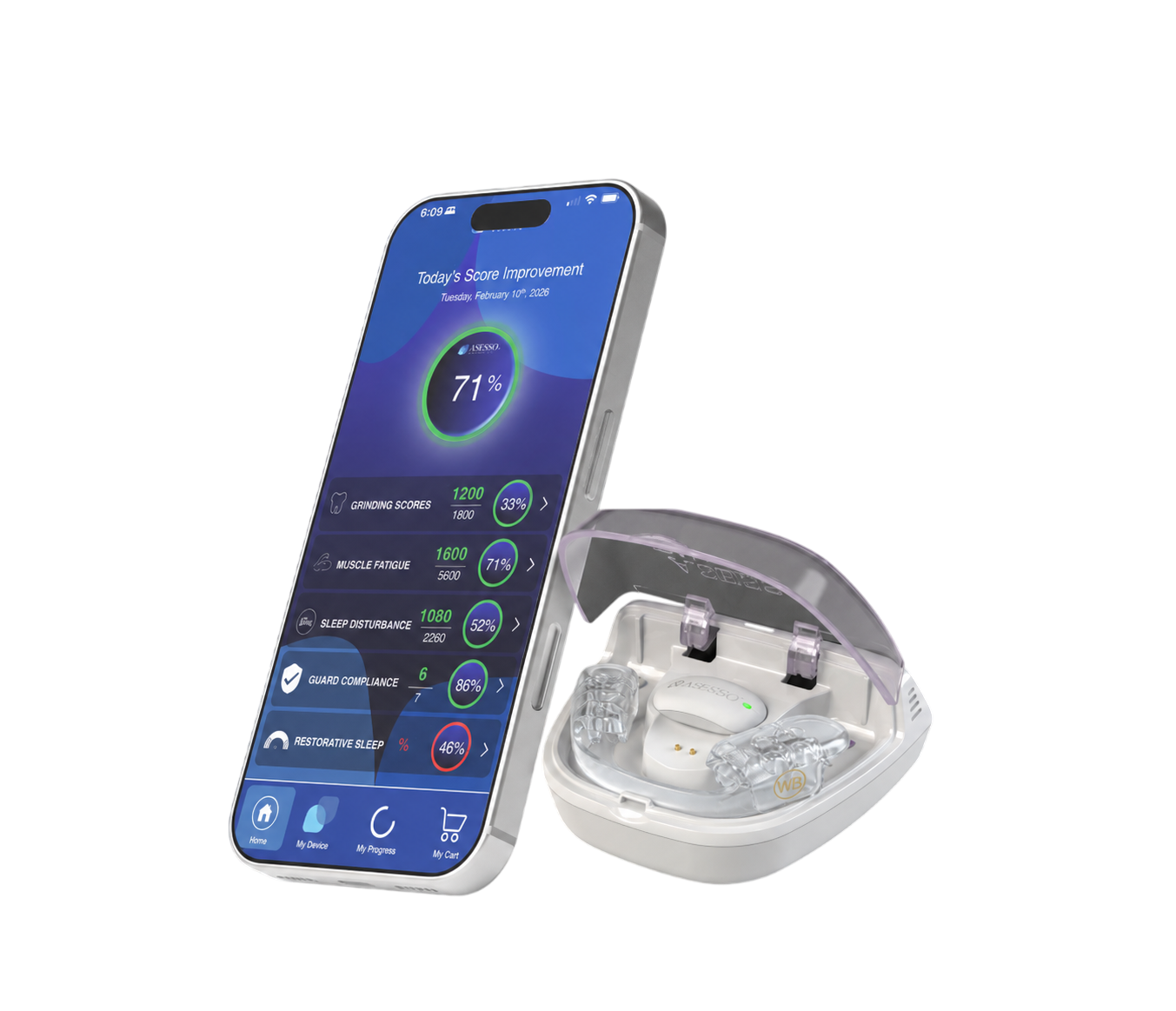
WAKEBRIGHT | Whether your grinding happens during the day, at night, or both, the Wakebright Guard is designed to reduce jaw muscle strain across either pattern. Ask your dentist which approach fits your case.
This article is for informational purposes only and does not constitute medical advice. Consult a licensed dentist or healthcare provider for diagnosis and treatment recommendations specific to your situation.
References
- Bruxism Management. StatPearls (NCBI Bookshelf). https://www.ncbi.nlm.nih.gov/books/NBK482466/
- Wetselaar, P., Vermaire, E.J.H., Lobbezoo, F., Schuller, A.A. "The prevalence of awake bruxism and sleep bruxism in the Dutch adult population." Journal of Oral Rehabilitation. PMC. https://pmc.ncbi.nlm.nih.gov/articles/PMC6849828
- Global Prevalence of Sleep Bruxism and Awake Bruxism in Pediatric and Adult Populations: A Systematic Review and Meta-Analysis. Journal of Clinical Medicine (2024). https://pmc.ncbi.nlm.nih.gov/articles/PMC11278015/
- Prevalence of Sleep Bruxism Reported by Parents/Caregivers in a Portuguese Pediatric Dentistry Service: A Retrospective Study. PMC. https://www.ncbi.nlm.nih.gov/pmc/articles/PMC9265430/
- Global prevalence of temporomandibular disorders: a systematic review and meta-analysis. Journal of Oral & Facial Pain and Headache (2025). https://www.jofph.com/articles/10.22514/jofph.2025.025
- National Institute of Dental and Craniofacial Research (NIDCR). "Prevalence of TMJD and its Signs and Symptoms." nidcr.nih.gov.