Ringing in Your Ears (Tinnitus) and TMJ: What's the Link?

If you have both tinnitus and jaw problems, you've probably wondered whether they're connected or just an unfortunate coincidence. The research says they're very likely connected the statistical association between TMD and tinnitus is one of the more consistently documented links in the orofacial pain literature. What's less settled is exactly what to do about it, and that distinction matters.
The Numbers: How Strong Is the Association?
Multiple systematic reviews have looked at this question, and while the exact numbers vary, the direction is remarkably consistent. A 2026 systematic review and meta-analysis published in BMC Oral Health found that individuals with TMD are nearly four times more likely to experience tinnitus than people without TMD. A separate systematic review found an even higher estimate an eightfold greater risk of tinnitus in TMD patients compared to controls, with tinnitus prevalence among TMD patients estimated between 30% and 37%.
An earlier, widely cited systematic review examining 25 studies found tinnitus prevalence ranging from 3.7% to 70% (median 42.3%) among TMD patients, compared to 1.7% to 26% (median 12%) in control groups without TMD a wide range reflecting differences in study populations and methods, but a consistent pattern of TMD patients reporting tinnitus considerably more often than people without TMD.
A Specific Clue: "Somatosensory" Tinnitus
This is genuinely useful, actionable information. Not all tinnitus is the same most cases are linked to hearing loss or changes in the auditory system, but a specific subset is known as somatosensory tinnitus, where the perceived sound can actually be influenced by movements of the jaw, neck, or head. According to research reviewed in a systematic analysis of TMD-related tinnitus, roughly two-thirds of tinnitus sufferers report that the volume or pitch of their tinnitus changes with somatic movements like clenching the jaw or tensing the neck muscles.
If your tinnitus gets louder, softer, or changes pitch when you clench your teeth, open your mouth wide, or tense your neck, that's a specific, recognized pattern pointing toward a jaw or musculoskeletal connection, rather than a purely inner-ear cause.
Why Might TMJ Problems Cause Tinnitus?
The proposed mechanisms overlap with the same anatomy responsible for TMJ-related ear pain, discussed in more detail in our article on earaches and the TMJ connection: the jaw joint and its surrounding muscles sit in extremely close proximity to the ear, share overlapping nerve pathways, and in some proposed models, may have a direct ligamentous connection to structures within the middle ear. Since tinnitus itself is understood to often result from changes or hyperactivity somewhere in the auditory or related sensory pathways, a jaw-related disruption to that shared neural territory is a biologically plausible contributor, alongside the cervical spine, which is also implicated in somatosensory tinnitus.
The Big Caveat: Does Treating TMJ Actually Help Tinnitus?
This is where honesty matters more than an appealing narrative. The association between TMD and tinnitus is well-documented but evidence that treating TMD reliably improves tinnitus is much weaker. The earlier systematic review of 25 studies found that of the studies examining treatment outcomes, only one provided evidence that treatment improved tinnitus symptoms compared with no treatment at all, and most of the other treatment-focused studies lacked a proper control group, making it hard to know how much of any improvement was actually due to the TMD treatment itself.
More recent research has been somewhat more encouraging on specific approaches: a systematic review of physical therapy interventions for TMD-associated tinnitus found evidence that conservative treatment including manual therapy and exercise-based approaches can improve TMD symptoms and mandibular function, with some promising signals for tinnitus specifically, though the review's authors were careful to call for more standardized research to draw firmer conclusions. A separate, more recent review specifically noted that available evidence on TMD-tinnitus therapeutic approaches remains genuinely inconsistent, even while identifying manual therapy and multidisciplinary treatment as showing potential clinical value.
The honest bottom line: if you have both TMD and tinnitus, there's a real chance they're connected, and treating your jaw is a reasonable, low-risk thing to try but current research doesn't support promising that fixing your jaw will reliably resolve your tinnitus. It's worth trying as part of addressing your TMD for its own sake, with tinnitus improvement as a possible added benefit rather than a guaranteed outcome.
Self-Check: Is Your Tinnitus Possibly Jaw-Related?
Consider a jaw connection worth discussing with a provider if:
- Your tinnitus volume or pitch changes when you clench your jaw, open wide, or move your jaw side to side
- You also have jaw clicking, popping, stiffness, or pain
- Your tinnitus seems to correlate with stressful periods when you're also more likely to clench or grind
- You have a history of teeth grinding or a diagnosed TMD
- Standard hearing-focused evaluations haven't identified a clear inner-ear cause
Quick Reference
| Finding | What It Means |
|---|---|
| TMD patients are ~4–8x more likely to have tinnitus (multiple meta-analyses) | A genuine, consistently documented statistical association |
| ~2/3 of tinnitus sufferers report changes with jaw/neck movement | A specific, checkable clue pointing toward a somatosensory connection |
| Only limited controlled evidence that TMD treatment improves tinnitus | Treating TMD is reasonable to try, but not a guaranteed tinnitus fix |
| Physical therapy shows some promising signals | An evidence-supported, low-risk approach worth considering |
What to Do If You Suspect a Connection
Get your TMD properly evaluated, regardless of the tinnitus connection, since TMD is worth treating on its own merits jaw pain, clicking, and dysfunction don't need a tinnitus link to justify addressing them.
Try the somatic modulation check described above and mention the results to your provider, since it's a specific, useful piece of diagnostic information rather than a vague symptom description.
See an audiologist or ENT for the tinnitus itself, particularly if you haven't had a hearing evaluation, since tinnitus has many possible causes and ruling out or identifying a primary auditory cause is valuable regardless of any jaw connection.
Set realistic expectations. If you pursue TMD treatment partly hoping it will resolve tinnitus, go in understanding the evidence for that specific outcome is still developing real relief for your jaw symptoms is a reasonable expectation; guaranteed tinnitus resolution isn't yet well-supported by the research.
Frequently Asked Questions
Is there really a proven connection between TMJ problems and tinnitus?
There's a well-documented statistical association multiple systematic reviews and meta-analyses have found TMD patients are several times more likely to experience tinnitus than people without TMD. However, most of the underlying research is observational, meaning it shows a strong association without definitively proving that TMD directly causes tinnitus in every case.
How can I tell if my tinnitus is related to my jaw?
A specific clue is whether your tinnitus changes in volume or pitch when you clench your jaw, open your mouth wide, or tense your neck muscles this pattern, called somatosensory tinnitus, is reported by roughly two-thirds of tinnitus sufferers and points toward a musculoskeletal rather than purely auditory connection.
Will treating my TMJ get rid of my tinnitus?
It's genuinely uncertain. The statistical association between TMD and tinnitus is strong, but evidence that treating TMD reliably resolves tinnitus is much more limited one systematic review found only a single controlled study showing treatment improved tinnitus symptoms. It's worth trying as part of treating your TMD generally, without guaranteeing tinnitus relief specifically.
What percentage of TMD patients also have tinnitus?
Estimates vary by study, ranging from under 5% to as high as 70% in different research, with commonly cited figures in the 30% to 42% range considerably higher than tinnitus prevalence in the general population, which is typically estimated around 10% to 15%.
Why would jaw problems affect something happening in my ear?
The jaw joint sits very close to the ear and shares overlapping nerve pathways and, in some proposed models, direct anatomical connections with middle ear structures similar mechanisms to those believed to cause TMJ-related ear pain, which is a related but distinct symptom.
Is somatosensory tinnitus a real, recognized medical concept?
Yes it refers to tinnitus that can be modulated by movements or contractions in areas like the jaw and neck, distinguishing it from tinnitus caused primarily by hearing loss or changes within the inner ear itself.
Should I see a dentist or an audiologist first if I have both jaw pain and tinnitus?
Both are reasonable, and ideally you'd see each at some point an audiologist or ENT can evaluate the tinnitus and rule out primary auditory causes, while a dentist can evaluate for TMD, which is worth treating on its own merits regardless of the tinnitus connection.
What treatments show the most promise for TMD-related tinnitus?
Physical therapy approaches, including manual therapy and exercise-based treatment, have shown some promising signals in recent systematic reviews, though researchers note more standardized studies are needed to draw firm conclusions about effectiveness specifically for tinnitus.
Can stress make both my TMD and tinnitus worse at the same time?
It's plausible, since stress is a well-established contributor to jaw clenching and muscle tension, and some tinnitus sufferers report their symptoms are more noticeable during stressful periods, though the specific relationship between stress, TMD, and tinnitus severity isn't fully mapped out in research.
Is it worth getting a night guard if I have tinnitus but haven't been diagnosed with TMD?
A night guard is specifically for managing bruxism (grinding), so it's most appropriate if you have signs of grinding or a TMD diagnosis, rather than purely for tinnitus. A dental evaluation can determine whether a night guard or other TMD treatment is actually indicated for your situation.
Does age affect the TMD-tinnitus connection?
Tinnitus prevalence generally increases with age in the broader population, while TMD is most commonly diagnosed in younger and middle-aged adults, so the overlap and its significance may vary somewhat depending on age, though research hasn't fully clarified how this affects the specific TMD-tinnitus relationship.
If my tinnitus doesn't change with jaw movement, does that rule out a TMJ connection?
Not entirely, but it makes a direct somatosensory connection less likely. Tinnitus can still be associated with TMD through other proposed mechanisms even without a clear movement-related modulation pattern, so it's still reasonable to mention both conditions to your providers even if this specific test is negative.
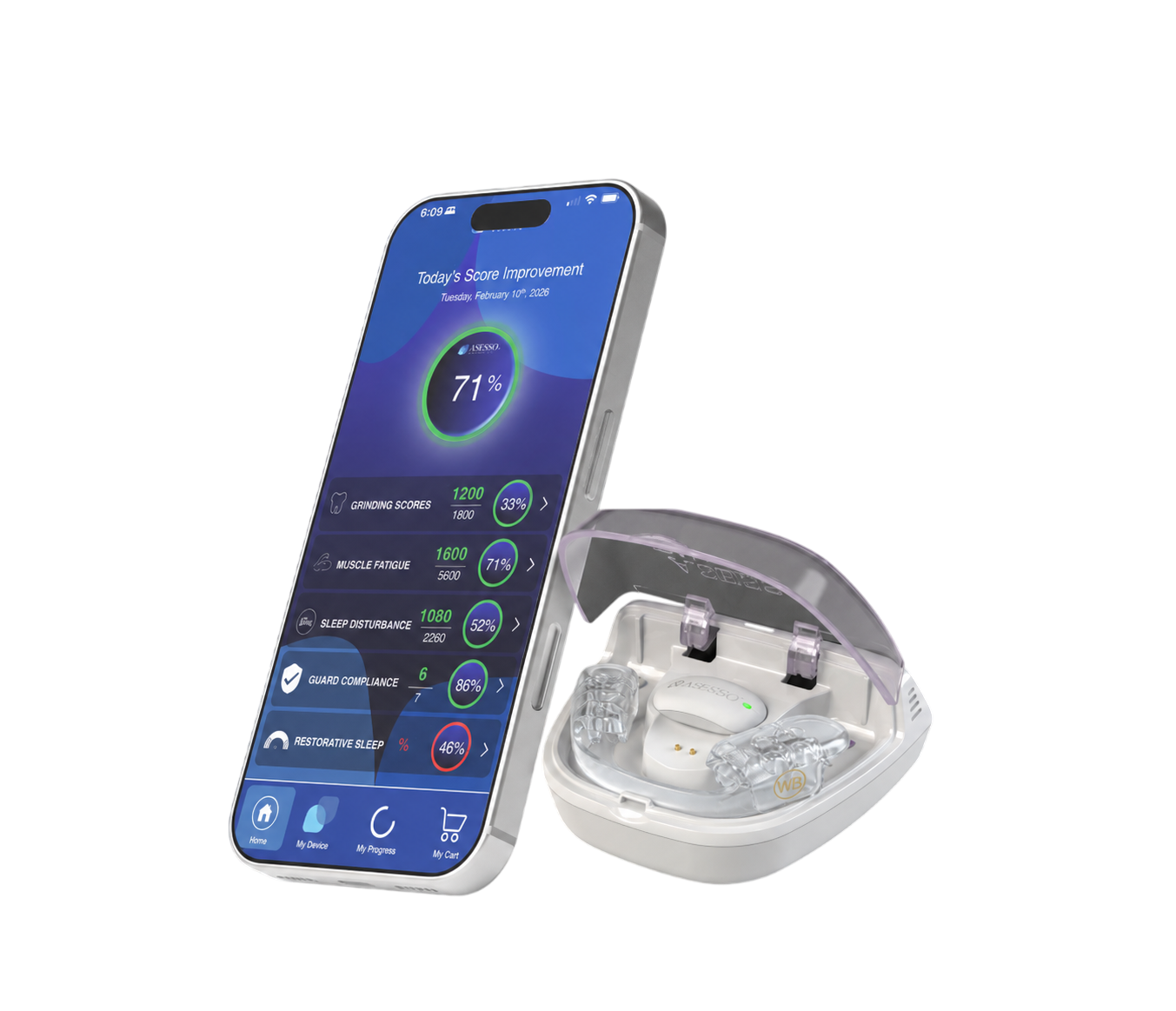
**WAKEBRIGHT | **If TMJ-related muscle tension is contributing to your tinnitus, the Wakebright Guard can help address that jaw strain as part of a broader treatment approach.
This article is for informational purposes only and does not constitute medical advice. Consult a licensed dentist or healthcare provider for diagnosis and treatment recommendations specific to your situation.
References
- "Temporomandibular joint disorders and tinnitus: a systematic review and meta-analysis." BMC Oral Health, Springer Nature Link. https://link.springer.com/article/10.1186/s12903-026-07898-3
- Mottaghi, A. et al. "Tinnitus in Temporomandibular Disorders patients: any clinical implications from research findings?" Evidence-Based Dentistry, Nature. https://www.nature.com/articles/s41432-019-0012-y
- "The Association Between Temporomandibular Disorders and Tinnitus: Evidence and Therapeutic Perspectives from a Systematic Review." PMC, National Library of Medicine. https://www.ncbi.nlm.nih.gov/pmc/articles/PMC11818186/
- "Effectiveness of Physical Therapy Interventions for Temporomandibular Disorders Associated with Tinnitus: A Systematic Review." PMC, National Library of Medicine. https://www.ncbi.nlm.nih.gov/pmc/articles/PMC10342521/