Mouth Guards for TMJ and Teeth Grinding: Finding the Right Fit for Real Relief

Browse the oral appliance market and you will find dozens of options for people dealing with TMJ pain and teeth grinding: soft guards, hard guards, dual-laminate guards, custom-fitted guards, and over-the-counter kits. The variety is overwhelming, and for something you wear while unconscious, the choice matters more than most people realize.
Not all mouth guards for TMJ and bruxism are designed around the same goal. Some protect tooth enamel. Some reposition the jaw. Some attempt to reduce clenching forces. And some, the cheap one-size-fits-all variety, may worsen jaw positioning while providing a false sense of protection.
Understanding what these devices are designed to do, and what they do not address, is essential for making a choice that genuinely helps.
Why Jaw Muscle Stress Is the Central Problem
Before evaluating types of guards, it helps to establish what the core problem actually is. TMJ pain and bruxism share a common driver: sustained, excessive activation of the jaw muscles. When these muscles are in sustained, forceful contraction, as they are during bruxism episodes that can persist for hours, the consequences extend well beyond the teeth.
The jaw joint is subjected to significantly increased compressive forces, contributing to disc displacement and joint irritation. The muscles accumulate fatigue and tension that manifests as morning soreness, facial tightness, and limited jaw opening. That tension refers upward into the temples and forehead as headaches. Elevated muscular activity during sleep is also associated with microarousals that fragment sleep architecture.
An effective mouth guard for TMJ and bruxism must therefore do more than separate tooth surfaces. It must address the muscular load, either by reducing how hard the muscles can clench, repositioning the jaw to require less muscular effort, or both.
Types of Mouth Guards: What Each Offers
Soft Night Guards
Made from pliable thermoplastic materials, soft guards are the most commonly available over-the-counter option. They are relatively comfortable and easy to adapt to, which is their primary advantage. The downside is that the yielding nature of soft materials may actually invite clenching. The proprioceptive feedback of biting into a soft surface can raise jaw muscle activation in some users. Soft guards are generally more appropriate for mild bruxism without significant jaw muscle involvement or headache symptoms.
Hard Acrylic Guards (Stabilization Splints)
Custom-made from rigid acrylic by dentists, hard guards provide precise jaw positioning and excellent durability. They are the standard of care for TMD management and offer better bite control than soft options. Their effectiveness for jaw muscle pain depends significantly on how they are designed. A guard that positions the jaw to reduce peak muscle contraction and minimize clenching triggers can be meaningfully effective for both dental protection and symptom management.
Anterior Bite Guards (NTI-Tense)
These small, front-tooth-only guards prevent full molar contact, which reduces the clenching potential of the masseter muscles (most powerfully engaged during molar-to-molar contact). Research has shown they can be effective for reducing bruxism intensity and associated headaches. They require careful professional fitting and carry some risks if used without professional monitoring, so they are not appropriate for unsupervised use.
Mechanism-Led Grind Guard Systems
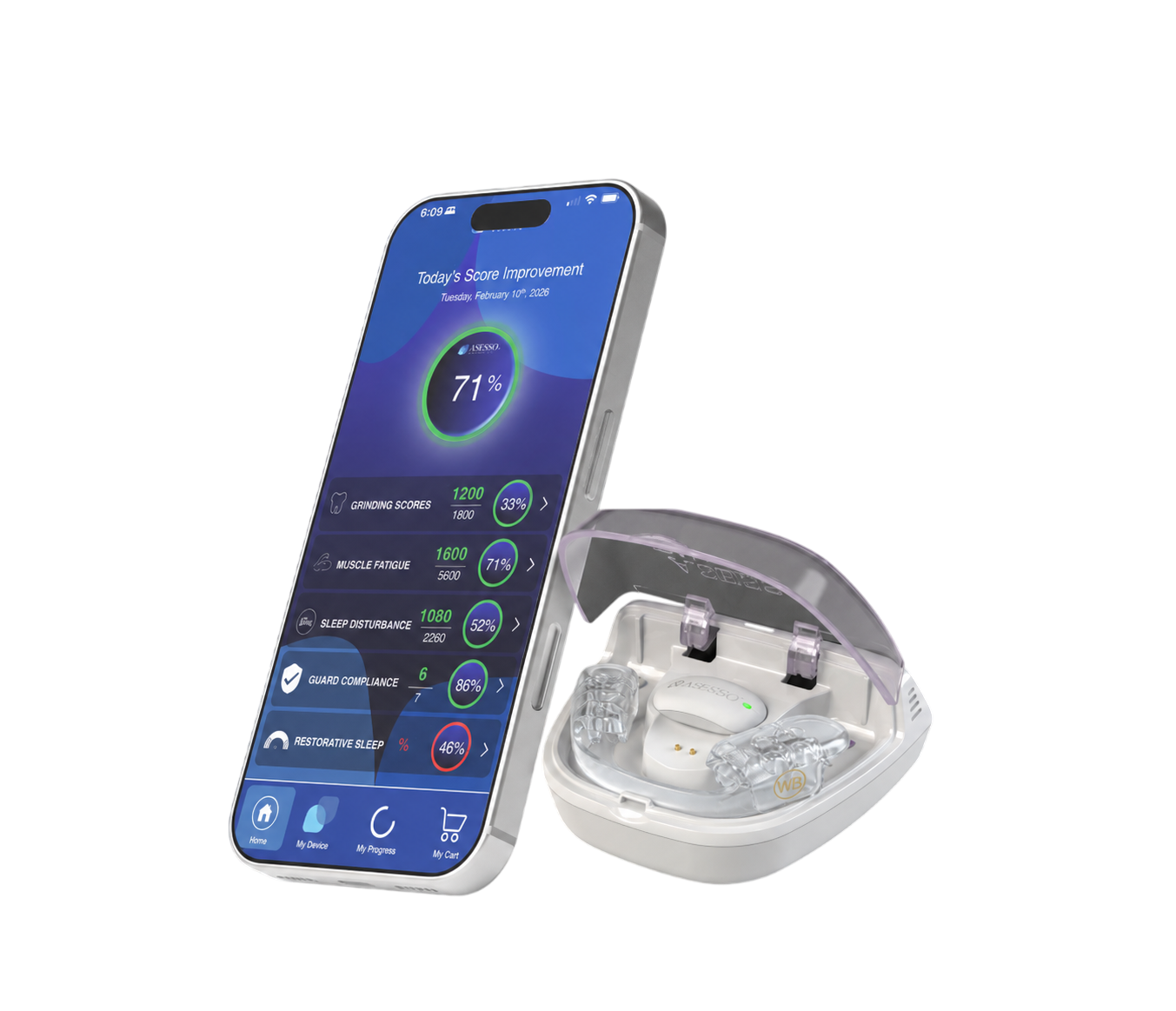
The most sophisticated approach addresses the problem from a muscle-physiology perspective: designing the guard to mechanically limit the range and force of the clenching motion, reducing the sustained muscular load rather than simply absorbing it. The goal shifts from protective cushioning to active load reduction. This design philosophy is where Wakebright's approach sits, a system built around reducing what the jaw muscles can do, not just what they contact.
Custom vs. Over-the-Counter: Why It Matters
The fit of a mouth guard is not a minor detail. An improperly fitting guard can alter jaw positioning in ways that increase muscle activation rather than reduce it, cause or worsen bite-related discomfort, become loose during the night, and for people with existing TMJ symptoms, contribute to joint stress rather than relieving it.
Custom-fit guards, made from precise impressions and designed by a dental professional with knowledge of your bite and symptom profile, provide significantly better jaw positioning control and durability. For people with significant TMD or bruxism symptoms, the investment in a custom-fit approach typically delivers meaningfully superior outcomes.
What You Can Do Now
Assess your current guard honestly. Have headaches, jaw soreness, and sleep quality improved since you started using it? If not, the design philosophy may not be addressing your primary complaint.
Ask your dentist about jaw positioning. Not all guards are designed with muscle-load reduction in mind. The question "Is this guard designed to reduce muscle clenching or primarily to protect my teeth?" opens an informative conversation.
Track outcomes over weeks. Keep daily morning scores of jaw pain and headache, and use wearable sleep data if available. Objective tracking reveals whether your current guard is working.
Consider whether the muscle is being adequately addressed. If headaches and jaw soreness persist despite splint use, the muscular load may not be sufficiently reduced by your current appliance's design.
Get your guard professionally adjusted regularly. As your bite changes over time, guards need calibration to maintain their therapeutic bite contact relationships.
Do not mix up athletic mouth guards with night guards. Athletic guards are designed to protect against impact, not to manage occlusal forces during sleep. Using one as a night guard is not appropriate and may worsen jaw muscle activity.
Frequently Asked Questions
Q: What is the difference between a night guard and a mouth guard?
In the context of TMJ and bruxism, these terms are often used interchangeably. "Mouth guard" is a broader term that also covers sports guards and other applications. "Night guard" or "occlusal splint" are more specific to the appliances worn during sleep for bruxism and TMD management. All night guards are mouth guards, but not all mouth guards are night guards.
Q: Can a mouth guard make TMJ worse?
A poorly fitted or incorrectly designed guard can, yes. A guard that positions the jaw unfavorably, creates uneven tooth contacts, or is too bulky can increase muscle fatigue and joint stress. This is one reason professional assessment and custom fitting matter for people with existing TMD symptoms. An OTC guard that shifts the jaw can be riskier than no guard at all for some presentations.
Q: How do I clean a mouth guard for TMJ?
Rinse immediately after removal with cool (not hot) water. Brush gently with a soft toothbrush and mild soap rather than toothpaste, which can scratch the surface and harbor bacteria in the grooves. Store in a vented case when not in use, and avoid leaving the guard in hot environments like a car dashboard. Bring it to dental appointments for inspection and adjustment.
Q: Is a mouth guard enough to treat TMJ disorders?
A well-designed mouth guard is an important component of TMD management, but it works best as part of a multimodal approach. Physical therapy addressing the jaw muscles, stress management reducing the clenching drivers, and appropriate medical care for the pain component all contribute to more complete and lasting outcomes. A guard alone is rarely sufficient for chronic, severe TMD.
Q: How long should I wear a mouth guard for TMJ each night?
A TMD mouth guard should be worn throughout the entire sleep period, put in as you get into bed and removed on waking. Partial-night use significantly reduces the cumulative benefit. The jaw muscles need consistent mechanical guidance through the full sleep period to progressively adapt and reduce their activity level.
WAKEBRIGHT | The Wakebright grind guard system was built around a recognition that became clear through years of real-world use: the most significant improvements in headache, jaw soreness, and sleep quality come not from cushioning the teeth but from reducing the load the jaw muscles generate during sleep. For anyone who has worn a night guard for months or years without meaningful improvement in symptoms beyond dental protection, the question of whether the muscle is being addressed, not just the tooth, is worth asking. Visit wakebrightguards.com to explore the Wakebright approach. This article is for educational purposes only and does not constitute medical or dental advice. Please consult a qualified healthcare provider for personalized guidance.