Morning Headaches: The Jaw-Related Cause Most Doctors Miss

If you've been through the usual headache workup imaging that came back clean, a migraine diagnosis that doesn't quite fit, maybe a round of antibiotics for a "sinus" problem that never really resolved and you're still waking up with head pain, there's a source that gets overlooked more often than you'd expect: your jaw. This isn't a fringe theory. It's documented in mainstream family medicine literature, written about by physicians describing their own diagnostic blind spots. Here's why it happens and what to do about it.
The Diagnostic Gap: Why TMJ Falls Through the Cracks
Temporomandibular disorder (TMD) sits in an awkward place in the healthcare system. It's not squarely "medical" or "dental" it involves a joint and muscles (traditionally a medical domain) that happen to be part of the jaw and bite (traditionally a dental one). The result, as family medicine literature has noted, is that patients often cycle between primary care, neurology, and ENT without anyone examining the jaw itself, since no single specialty consistently "owns" the condition.
A 2017 letter published in American Family Physician the peer-reviewed journal of the American Academy of Family Physicians put this plainly. A physician with 17 years of urgent care experience described routinely seeing patients with long histories of recurrent "sinus infections," "ear infections," or migraines whose symptoms didn't actually match those diagnoses on closer exam. Once he examined the jaw specifically, TMD was frequently the more likely explanation including in patients who'd been treated with repeated courses of antibiotics for presumed infections that weren't actually there.
The Numbers Behind the Miss
This isn't an isolated anecdote. A 2023 evidence review in the same journal, written to guide family physicians on TMD, reported that headache is the single most common symptom among people with TMD, present in 79% of cases more common even than pain at the jaw joint itself (54%). TMD overall affects an estimated 5% to 12% of the population, with a second, less commonly discussed peak in the early 50s in addition to the more familiar younger-adult peak, and it's about three times more common in women than men.
Put simply: the majority of people with a jaw disorder experience it primarily as a headache, not primarily as jaw pain. That mismatch between the underlying problem and the presenting symptom is a big part of why it gets missed.
Why the Pain Doesn't "Look Like" a Jaw Problem
TMD pain has an unusually wide referral pattern meaning the pain shows up somewhere other than where the actual problem is. A review published in a peer-reviewed dental journal, drawing on research examining referred pain patterns in TMD patients, found that up to 85% of people with TMD report referred pain in the cheek, ear, or forehead, and roughly a quarter describe their primary complaint as "headache" rather than jaw pain at all.
This is the mechanical reason the connection gets missed in a standard medical visit: if a patient's chief complaint is "I get headaches," and the jaw isn't hurting in any way the patient would think to mention, a jaw exam simply isn't the obvious next step even though the jaw may be exactly where the problem originates.
What a Standard Headache Workup Usually Checks (and Doesn't)
| Typical Headache Workup | Jaw-Focused (TMD) Evaluation |
|---|---|
| History of headache pattern, triggers, and family history | History of jaw clicking, clenching, grinding, or chewing-related pain |
| Neurological exam | Palpation of jaw joint and chewing muscles for tenderness |
| Imaging (CT/MRI) if red flags are present | Assessment of jaw range of motion and opening width |
| Migraine or tension-type headache criteria | Check for clicking, popping, or locking with jaw movement |
| Medication trial (triptans, preventives, etc.) | Screening for nighttime grinding or daytime clenching habits |
Neither list is wrong — they're evaluating different things. The issue is that most headache visits never cross over into the second column unless a patient specifically raises jaw symptoms, or a clinician happens to have a particular interest in orofacial pain.
Signs Worth Raising With Your Doctor Even If Your Jaw Doesn't Hurt
Because TMD headaches often show up without obvious jaw pain, it's worth mentioning any of the following at your next visit, even if you wouldn't otherwise connect them to your jaw:
- Headaches that are consistently worse in the morning
- Any jaw clicking, popping, or a feeling of the jaw catching, even without pain
- A history of teeth grinding, or a partner who's mentioned hearing it
- Waking up with a tired or tight jaw
- Headaches that seem to correlate with chewing, gum use, or long conversations
- Ear-related symptoms (fullness, ringing, or discomfort) without a confirmed ear infection
None of these guarantee a jaw connection, but per the AAFP's own guidance, physicians are specifically advised to consider TMD in the differential when a patient has headache, sinus pain, or ear pain that isn't otherwise well explained so raising these details can genuinely help point a workup in the right direction.
How to Bridge the Gap Yourself
Given that the healthcare system doesn't automatically connect these dots, a few practical steps help:
- Mention jaw symptoms explicitly, even minor ones, rather than waiting to be asked. "I also notice my jaw clicks" is a small sentence that can meaningfully change what gets examined.
- Ask directly whether TMD could be a contributing factor, particularly if previous workups for headache, sinus, or ear symptoms haven't turned up a clear cause.
- See a dentist alongside your physician, especially one comfortable evaluating TMD this is squarely within a dentist's scope and doesn't require waiting for a medical referral.
- Track your pattern for a couple of weeks: time of day, whether it's worse after chewing or talking, and any jaw sounds or soreness. Specific patterns are more useful to a clinician than "I get headaches a lot."
What Evidence-Based Treatment Actually Looks Like
One reassuring part of this story: once TMD is correctly identified, the recommended treatment is conservative, not dramatic. The AAFP's 2023 evidence review and the American Dental Association's own "Choosing Wisely" guidance both explicitly advise against irreversible procedures like surgery, occlusal equilibration, or permanent restorations as a first-line approach to TMD, because the evidence doesn't support them as effective starting points and they carry real risk of making symptoms worse.
Instead, well-supported first steps include patient education and self-management (posture, sleep habits, avoiding jaw-clenching triggers), a properly fitted occlusal splint or night guard, and, when needed, short-term medication such as naproxen. For most people, symptoms improve with this kind of conservative approach the research review notes TMD often resolves over time even without aggressive intervention, though chronic or severe cases benefit from referral to a specialist.
Frequently Asked Questions
Is it really common for doctors to miss a jaw-related cause of headaches?
It's documented in the family medicine literature itself. A 2017 physician-authored letter in American Family Physician described this exact pattern based on years of clinical experience, and the specialty's own 2023 evidence review explicitly notes that headache not jaw pain is the most common presenting symptom of TMD, occurring in about 79% of cases.
Why would a jaw problem cause a headache instead of jaw pain?
TMD pain has a well-documented tendency to refer to other areas research has found up to 85% of TMD patients experience referred pain in the cheek, ear, or forehead, and about a quarter describe their main complaint as headache rather than jaw pain, which is exactly why the jaw connection gets overlooked.
How common is TMD, really?
Estimates place it at roughly 5% to 12% of the population, with a higher prevalence in women (about three times more common than in men) and two typical age peaks, one in the early 20s and another around age 50.
Should I ask my primary care doctor about TMD, or go straight to a dentist?
Either is reasonable. Mentioning jaw symptoms to your physician can help redirect a stalled headache workup, while a dentist can directly examine your jaw joint and bite without needing a referral. Many people end up seeing both.
What should I say to my doctor to raise this possibility?
Be specific: mention any jaw clicking, popping, morning jaw soreness, a history of grinding, or headaches that seem tied to chewing or talking even if these feel minor. These are the details that point a workup toward a jaw evaluation.
If imaging came back normal, does that rule out TMD as a headache cause?
Not necessarily. The AAFP's guidance notes that TMD diagnosis is based primarily on history and physical examination of the jaw, not imaging imaging is reserved mainly for cases where the diagnosis is unclear or conservative treatment hasn't worked. A normal CT or MRI for headache doesn't rule out a jaw-related cause.
Can TMD cause headaches without any jaw pain at all?
Yes this is actually a well-recognized pattern. A meaningful share of TMD patients report headache as their primary or only symptom, without jaw pain being a significant complaint, which is a major reason the condition is underdiagnosed.
Is surgery ever the right first step for TMD-related headaches?
No both the AAFP and the American Dental Association specifically recommend against irreversible procedures like surgery as an initial treatment. Conservative approaches (self-care, a night guard or splint, short-term medication) are the recommended starting point.
How long does it typically take to get relief once TMD is properly identified?
It varies, but many patients improve with conservative treatment, and the condition frequently improves over time even without aggressive intervention. Chronic cases (lasting more than three months) may need referral to a specialist for a more tailored plan.
Can a family doctor treat TMD, or do I need a specialist?
Family physicians can manage many cases with patient education, self-care guidance, and medication when appropriate, per current evidence-based guidelines. A dentist is typically needed for a splint or night guard, and referral to oral and maxillofacial surgery is reserved for cases that don't improve with conservative care.
Why do TMD headaches happen more in the morning specifically?
Morning TMD headaches are commonly linked to nighttime teeth grinding or clenching, which places hours of sustained strain on the jaw muscles and joint while you're asleep and unaware of it happening.
Is this connection something dentists have known about longer than doctors?
Both fields have documented the connection, but because TMD symptoms often present as headache, ear, or sinus complaints rather than jaw pain, patients are statistically more likely to see a physician first which is exactly why raising jaw symptoms explicitly, regardless of which type of provider you see first, matters.
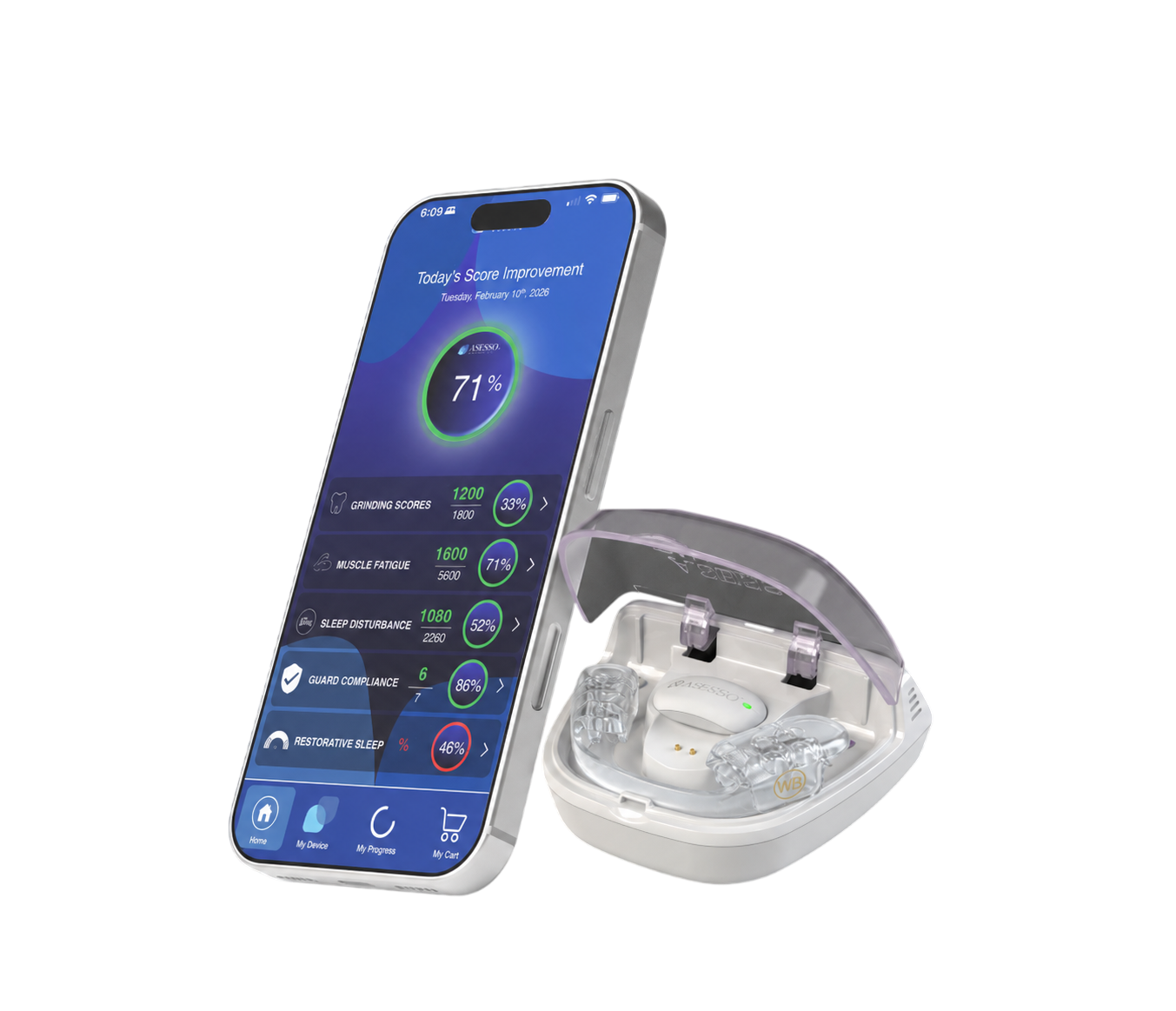
WAKEBRIGHT | If your dentist confirms grinding is behind your morning headaches, the Wakebright Guard is designed to reduce that overnight muscle strain at its source.
This article is for informational purposes only and does not constitute medical advice. Consult a licensed dentist or healthcare provider for diagnosis and treatment recommendations specific to your situation.
References
- Matheson, E.M. et al. "Temporomandibular Disorders: Rapid Evidence Review." American Family Physician, American Academy of Family Physicians. https://www.aafp.org/afp/2023/0100/temporomandibular-disorders
- Spotts, P.H. "Temporomandibular Disorder: An Underdiagnosed Cause of Headache, Sinus Pain, and Ear Pain." American Family Physician, American Academy of Family Physicians. https://www.aafp.org/pubs/afp/issues/2017/0201/p142.html
- National Institute of Dental and Craniofacial Research. "TMD (Temporomandibular Disorders)." nidcr.nih.gov. https://www.nidcr.nih.gov/health-info/tmd
- Wright, E.F. "Referred craniofacial pain patterns in patients with temporomandibular disorder," as cited in "TMD diagnosis–What should general dentists and orthodontists know?" ScienceDirect. https://www.sciencedirect.com/science/article/pii/S107387462400001X
- Cleveland Clinic. "Your Jaw May Be To Blame for Your Headaches." health.clevelandclinic.org. https://health.clevelandclinic.org/your-jaw-may-be-to-blame-for-your-migraine-headaches