Mixed Bruxism Episodes More Common in Migraine and Temporomandibular Disorders

The Clinical Triad: Bruxism, Migraine, and TMD
Research reveals a striking pattern: people with migraines have significantly higher bruxism prevalence than the general population, and those with bruxism have elevated migraine rates. Similarly, TMD sufferers often report both migraines and bruxism. These three conditions form a clinical triad. They frequently coexist, share overlapping pathophysiology, and appear to drive each other through vicious cycles.
This is not mere coincidence or unrelated conditions happening to overlap. The triad relationship is neurologically rooted. All three conditions activate shared pain pathways, trigger common nervous system mechanisms, and respond to overlapping interventions. Understanding the triad illuminates why treating one condition often improves the others.
The triad dynamic means that addressing jaw muscle load, particularly during sleep when bruxism occurs, can simultaneously improve bruxism severity, reduce migraine frequency, and alleviate TMD symptoms. A single intervention targeting the shared mechanism of jaw muscle overload and stress can produce compound benefits across all three conditions.
People experiencing this triad often feel trapped in a self-perpetuating cycle: migraines trigger stress, stress triggers grinding, grinding causes TMD pain and further stresses the nervous system, the pain lowers the migraine threshold, migraines increase stress, and the cycle intensifies. Breaking even one point in the cycle can interrupt the entire pattern.
Mixed Bruxism: Types and Their Role in the Triad
Bruxism occurs in two forms: sleep bruxism (involuntary grinding during sleep) and awake bruxism (daytime clenching and grinding). Many people experience both. Mixed bruxism refers to episodes of each type. Research shows that people with migraines and TMD experience mixed bruxism at higher rates than those without these conditions.
Sleep bruxism during nocturnal grinding creates repetitive, forceful jaw muscle contractions and joint impacts. These grinding episodes generate microarousals, brief neural activations, that fragment sleep. In people prone to migraines, these arousals lower the migraine threshold, making migraines more likely in the hours following heavy grinding nights.
Awake bruxism (daytime clenching) builds muscle tension progressively through the day. People with migraine or TMD often unconsciously tighten the jaw during stress, concentration, or anxiety. By evening, they have accumulated substantial jaw muscle fatigue and tension. This fatigued, tense baseline persists into sleep, predisposing to grinding and holding the nervous system in a stress-responsive state.
The combination of sleep and awake bruxism creates continuous muscle stress with no genuine recovery period. Unlike someone who grinds only at night, people with mixed bruxism carry the jaw muscles under load around the clock. This chronic overload explains why they develop higher TMD rates and experience more frequent migraines: their nervous system never fully relaxes.
Shared Neurological Pathways in the Triad
The trigeminal nerve, which processes sensation from the jaw and face, connects extensively with the brainstem regions that generate migraines. This anatomical overlap means that pain and sensory input from the jaw directly affects migraine-generating circuits. Intense grinding or TMD pain sends amplified trigeminal signals to these brainstem regions, lowering the migraine threshold and triggering episodes in susceptible people.
Stress response pathways also overlap across all three conditions. Stress triggers jaw clenching and grinding (the bruxism component). Stress activates migraine-generating pathways directly. Stress aggravates TMD pain and raises muscle tension. The trigeminal nerve itself has bidirectional connections with stress-processing brain regions: a person stressed about migraines or pain clenches harder, the clenching increases pain input, and the pain increases stress. The cycle feeds on itself.
Central sensitization, meaning increased nervous system sensitivity to pain, characterizes all three conditions. In central sensitization, pain processing is amplified, normal sensations feel painful, and pain spreads from one region to others. Bruxism contributes to central sensitization through repeated pain signals from grinding; central sensitization increases migraine susceptibility; and migraine-related central sensitization increases pain sensitivity in the jaw region, amplifying TMD pain. All three conditions reinforce the underlying sensitization.
The shared pathway is the key insight: treating the jaw component by reducing bruxism and muscle load lowers overall trigeminal and central pain activation. This benefits the migraine component, the TMD component, and the overall stress responsiveness that drives bruxism. It is why addressing jaw muscle load often produces benefits across all three conditions at the same time.
How Bruxism Triggers Migraines and Worsens TMD
The mechanism by which bruxism triggers migraines is increasingly well understood. Each grinding episode creates mechanical stress on the joint and muscles, metabolic stress from muscle contraction, and neural activation through trigeminal input. In someone with migraine susceptibility, this amplified neural input crosses the migraine threshold, triggering an episode. The person may never consciously remember grinding, yet they experience a full migraine hours later.
Bruxism worsens TMD through direct mechanical and muscular pathways. Grinding subjects the jaw joint to repetitive, forceful impacts. Over time these impacts irritate joint tissues, wear down cartilage surfaces, and displace the articular disc. Simultaneously, grinding fatigues the jaw muscles. Fatigued muscles cannot maintain proper joint stabilization, which allows abnormal joint motion and pain. The grinding-induced muscle fatigue perpetuates and amplifies TMD symptoms.
The cumulative effect is striking: people with mixed bruxism, meaning both sleep and awake clenching, often report that their TMD pain dramatically worsens after nights of heavy grinding, and their migraines follow within 24 hours. This tight temporal relationship confirms the direct mechanistic link. When grinding is reduced or eliminated, both TMD pain and migraine frequency typically improve.
What makes this particularly challenging is that bruxism often intensifies during high-stress periods, exactly when people are already vulnerable to migraines for stress-related reasons. A person experiences work stress, starts grinding more, the grinding triggers migraines, and the migraines add more stress, creating a catastrophic cycle. Breaking this requires reducing the grinding component specifically during sleep, when conscious prevention is impossible.
Why Conventional Treatments Often Miss the Connection
Many people with this triad seek help separately for each condition: a neurologist for migraines, a dentist for tooth wear from grinding, and a TMJ specialist for jaw pain. Each provider treats their domain but does not necessarily recognize or address the shared mechanism of jaw muscle overload. The result is partial treatment of symptoms without touching the root driving force.
Migraine treatment often focuses on medications that prevent or abort episodes but does not address the bruxism that may be triggering half of them. TMD treatment typically emphasizes pain management, muscle relaxation, or joint care, but does not address the nighttime grinding that perpetuates muscle fatigue. Bruxism treatment such as a night guard protects teeth but does not address the stress or jaw muscle load that drives the grinding.
This fragmented approach is frustrating because progress stalls. Someone might take a migraine preventive medication, see temporary improvement, and then find migraines return when nighttime grinding intensifies during a stressful period. Treating the jaw muscle component, meaning reducing the load that nighttime grinding creates, would address the trigger directly.
The paradigm shift needed is recognizing that jaw muscle load is the central hub connecting all three conditions. Reducing that load through nighttime jaw support specifically designed to decrease muscle stress during grinding addresses the shared mechanism. This explains why single-point interventions targeting jaw muscle load often produce benefits across all three conditions.
Integrated Management: Addressing the Triad
Effective management of the bruxism-migraine-TMD triad requires addressing multiple levels. Stress management is foundational: practices like meditation, exercise, yoga, and therapy reduce the stress that triggers grinding and lowers the migraine threshold. Reducing daytime stress decreases grinding intensity and migraine vulnerability at the same time.
Sleep quality optimization is crucial. Improving sleep duration, consistency, and architecture reduces bruxism and improves migraine control. A consistent sleep schedule, a well-set sleep environment, and the removal of sleep-disrupting factors all support both sleep quality and bruxism reduction. Better sleep quality also improves migraine control independently.
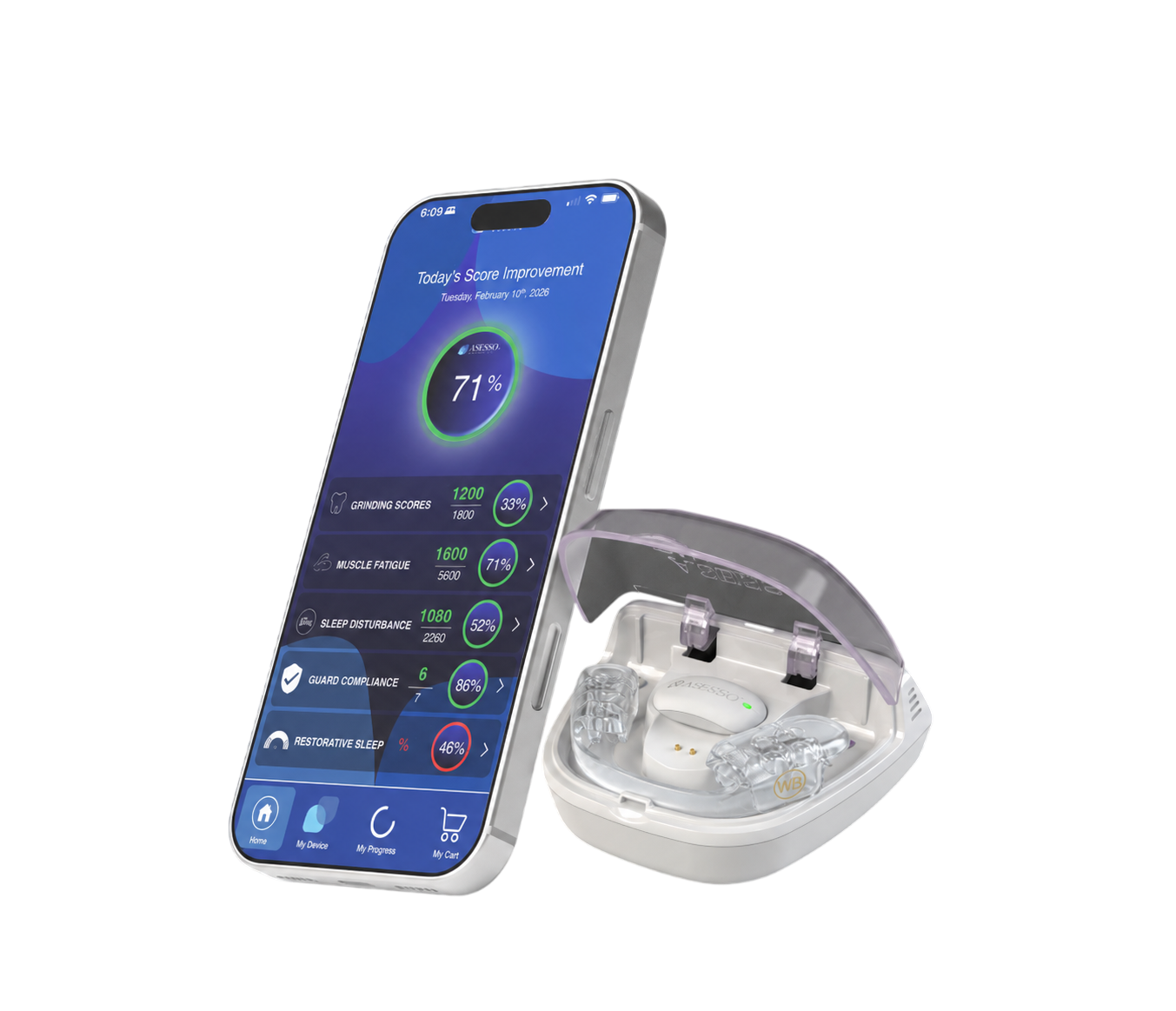
Nighttime jaw support specifically designed to reduce jaw muscle load during sleep directly interrupts the grinding-induced stress and fatigue. Unlike standard night guards that merely protect teeth, devices designed to support jaw positioning and reduce muscle effort address the mechanism driving bruxism and its downstream effects on migraines and TMD.
Daytime awareness and muscle relaxation address awake bruxism and accumulated muscle tension. Periodic checks for jaw clenching through the day, conscious relaxation when tension is noticed, and deliberate muscle relaxation practices reduce the muscle tension baseline that persists into sleep. Physical therapy specific to the jaw muscles can improve muscle balance and reduce tension.
What You Can Do Now
Bruxism, migraine, and TMD form a clinical triad. They frequently coexist and share underlying neurological pathways.
Jaw muscle overload is the central mechanism connecting all three conditions through trigeminal nerve activation.
Stress triggers the entire cascade: increased clenching and grinding, amplified migraine susceptibility, and worsening TMD pain.
Sleep bruxism directly triggers migraines in susceptible people by creating intense trigeminal nerve activation.
Reducing jaw muscle load during sleep addresses the shared mechanism and often improves all three conditions simultaneously.
Frequently Asked Questions
Q: Why do people with migraines grind their teeth more?
Migraines and bruxism share neurological pathways through the trigeminal nerve. Stress triggers both conditions. Additionally, migraines lower the pain threshold, pain increases stress responsiveness, and stress increases grinding. Many migraine sufferers unconsciously clench or grind during or around migraine episodes.
Q: How does bruxism trigger migraines?
Grinding creates intense trigeminal nerve activation through mechanical and metabolic stress. In migraine-susceptible people, this amplified input crosses the migraine threshold. Grinding also fragments sleep and raises stress hormone levels, both of which lower the migraine threshold. The result is that migraines often follow heavy grinding nights.
Q: Can treating bruxism improve migraines?
Often, yes. Reducing grinding intensity decreases trigeminal activation, improves sleep quality, and lowers stress hormone elevation. For many people, addressing the bruxism component significantly improves migraine frequency and severity. Benefits often appear within 2 to 4 weeks of effective bruxism reduction.
Q: Do people with TMD and migraines have more bruxism?
Yes. Research shows a strong correlation. People with both TMD and migraines have significantly higher bruxism rates. All three conditions share trigeminal nerve connections and stress-response pathways, creating a clinical triad where each condition amplifies the others.
Q: How does jaw muscle tension connect migraines to TMD?
Tense jaw muscles increase trigeminal pain signaling, which directly activates migraine pathways. At the same time, muscle tension causes TMD pain. Jaw muscle overload therefore affects both conditions simultaneously, and reducing that load improves both.
Q: What's the difference between sleep and awake bruxism?
Sleep bruxism is unconscious grinding during sleep; awake bruxism is daytime clenching. Many people have mixed bruxism, meaning both forms. Awake bruxism builds muscle fatigue through the day, while sleep bruxism creates acute stress overnight. Combined, they produce continuous muscle overload with no recovery period.
Q: Why don't standard night guards fully solve bruxism-related migraines?
Standard night guards protect teeth from damage but do not reduce jaw muscle load or stress. They do not prevent grinding; they only guard against its dental consequences. Devices specifically designed to reduce jaw muscle load during sleep address the mechanism directly.
WAKEBRIGHT | If you experience the triad of bruxism, migraines, and TMD, addressing jaw muscle load during sleep, when grinding causes the most uncontrolled stress, can transform your symptoms. The Wakebright Grind Guard reduces nighttime jaw muscle fatigue and stress precisely when you need it most. This article is for educational purposes only and does not constitute medical or dental advice. Please consult a qualified healthcare provider for personalized guidance.