Migraine and Temporomandibular Disorders: The Overlooked Link

How Common Is the Migraine-TMD Overlap?
Research consistently shows that migraine and temporomandibular disorders (TMD) co-occur at rates far above chance. Studies report that between 50 and 75 percent of TMD patients also experience migraine or migraine-like headaches. Conversely, people with migraine are significantly more likely to have signs of TMD, including jaw clicking, facial pain, and restricted opening, than headache-free controls.
This overlap is not coincidental. Both conditions involve the trigeminal nerve system, the most complex cranial nerve in the body, which innervates the face, jaw, teeth, scalp, and the pain-sensitive membranes surrounding the brain. When one part of this system becomes sensitized or overloaded, the threshold for the other condition drops.
Despite this well-documented connection, the two conditions are rarely managed together. Neurologists treat migraine; dentists or orofacial pain specialists treat TMD. Patients often move between these providers without anyone connecting the dots, getting partial relief from each rather than addressing the shared underlying driver.
Understanding the migraine-TMD link matters clinically because it changes the treatment calculus. Patients who address both conditions simultaneously, rather than sequentially or in isolation, tend to report more complete and lasting relief.
Shared Trigeminal Pathways: The Anatomy of Co-occurrence
The trigeminal nerve (cranial nerve V) has three divisions: the ophthalmic, maxillary, and mandibular branches. The mandibular branch innervates the lower jaw, the temporomandibular joint, the masseter muscle, and surrounding structures. This is the same nerve system whose central nucleus, the trigeminal nucleus caudalis, is the primary pain-processing hub for migraines.
When the jaw muscles are chronically overloaded through bruxism or sustained clenching, they generate a continuous stream of nociceptive input into the trigeminal system. Over time, that input sensitizes the central trigeminal neurons, a process called central sensitization, making the entire system more reactive. In a sensitized state, inputs that would normally sit below the pain threshold now trigger a response.
Think of the trigeminal nucleus caudalis as a switchboard. Under normal conditions it routes sensory signals efficiently and without alarm. Under chronic overload from jaw muscle activity, the switchboard itself becomes over-reactive, and a migraine, which requires activation of this same switchboard, becomes easier to trigger and harder to stop.
This is why some migraine patients find their attacks reliably preceded by jaw pain or facial tightness. The jaw is not a separate problem; it is an input to the same system that generates migraine pain.
Why Treating Only One Condition Produces Incomplete Relief
A patient who takes a triptan for migraine and sees improvement has addressed the trigeminovascular activation, but if the jaw muscles kept generating sensitizing input overnight, the system returns to a hair-trigger state within days. The migraine medication works on the acute attack; it does not prevent the next round of sensitization from building.
Conversely, a patient who gets a dental splint for TMD may notice reduced jaw clicking and less morning soreness, but if that standard flat-surface splint does not actually reduce jaw muscle load, the bruxism-related trigeminal input continues. The splint protects teeth without interrupting the sensitization pathway.
This is a common treatment gap in both fields. Neurologists are generally not trained to assess jaw muscle load as a migraine trigger. Dentists are not always aware of migraine physiology. The result is that many patients with the migraine-TMD overlap keep experiencing both conditions at a level they would not if both were addressed at the same time.
An analogy: if you have a leaking roof and a wet floor, mopping the floor repeatedly gives some relief, but the problem continues until the leak is fixed. Treating migraine without addressing TMD, or vice versa, is the clinical equivalent of mopping without patching.
The Role of Bruxism in the Migraine-TMD Triad
Bruxism, meaning habitual jaw clenching and grinding typically occurring during sleep, sits at the intersection of both conditions. It is both a cause of TMD (through sustained muscle overload and joint stress) and a migraine trigger (through trigeminal sensitization). Patients who have all three, namely bruxism, TMD, and migraine, are dealing with a tightly interlocked triad.
Sleep bruxism is particularly relevant because it occurs during the hours when the nervous system is supposed to be in a recovery state. Instead of resting, the jaw muscles generate sustained force, sometimes for hours, feeding the trigeminal system with nociceptive input precisely when it should be decompressing. The result is that patients wake with already-elevated trigeminal sensitivity, making a morning migraine significantly more likely.
Studies of bruxism prevalence in migraine populations show rates of 30 to 50 percent, compared with roughly 8 to 15 percent in the general population. This striking difference strongly suggests that bruxism is not merely a comorbidity; it is likely an active driver of migraine frequency in a meaningful subset of patients.
Addressing bruxism is therefore a point of leverage that affects both conditions simultaneously. Reducing overnight jaw muscle load lowers the trigeminal input that drives TMD symptoms and, at the same time, raises the migraine threshold by reducing the central sensitization load.
An Integrated Treatment Approach
Managing the migraine-TMD overlap well requires coordination that the current specialty-siloed healthcare model does not naturally provide. The most effective approach combines a migraine-focused strategy (appropriate acute and preventive medications, lifestyle stabilization) with a jaw-focused strategy (muscle load reduction, heat therapy, stress management) implemented at the same time.
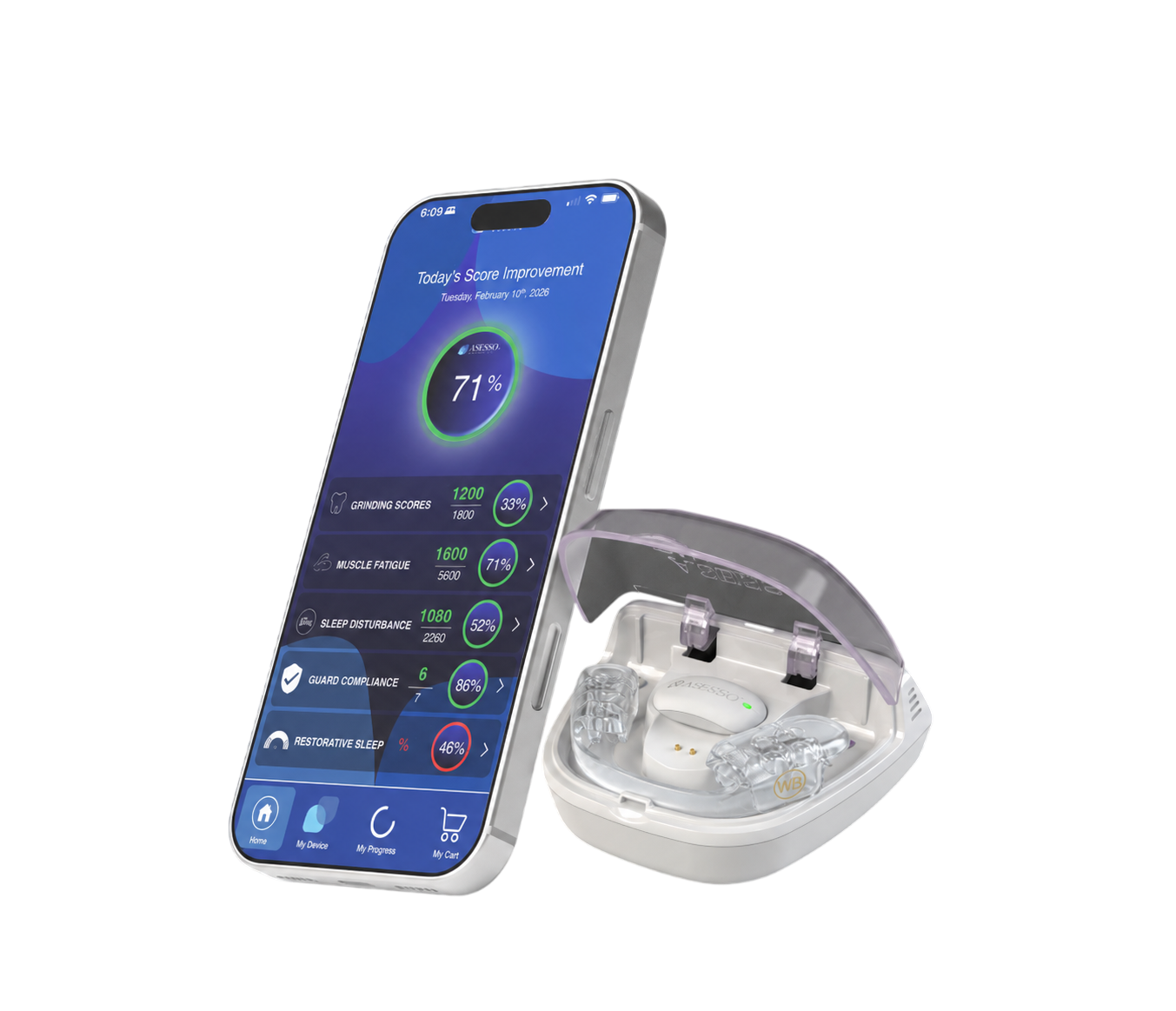
The Wakebright Grind Guard contributes specifically to the jaw-muscle side of this equation. By gently repositioning the mandible during sleep, it reduces masseter and temporalis muscle engagement, lowering the overnight trigeminal input that sustains sensitization in both TMD and migraine. It is a non-pharmacological intervention that addresses a driver neither migraine medications nor standard dental splints typically reach.
Patients who begin consistent overnight jaw muscle management often notice improvements in both their jaw symptoms and their migraine frequency over weeks to months. This timeline reflects the gradual process of central desensitization: the nervous system requires sustained reduction in nociceptive input before its reactivity decreases.
This is not a quick fix, and it is not a replacement for appropriate medical care. It is a foundational intervention that makes other treatments more effective by removing a sustained, modifiable trigger from the shared system.
What You Can Do Now
If you have both migraines and jaw symptoms, bring both to the attention of each provider you see. Ask your neurologist whether jaw muscle load has been considered in your migraine management. Ask your dentist or TMD specialist whether your migraine history is relevant to your jaw treatment.
Track your migraine days alongside your jaw symptoms for four to six weeks. Note whether attacks correlate with nights of poor sleep, high stress, or waking jaw soreness. This data is clinically useful and often reveals the jaw-migraine connection that neither provider has formally observed.
Migraine and TMD co-occur at rates of 50 to 75 percent, far above chance, due to shared trigeminal nerve pathways.
Bruxism drives both conditions simultaneously and sits at the center of the triad.
Treating only one condition while ignoring the other typically produces partial and unstable relief.
Central sensitization from jaw muscle overload lowers the migraine threshold.
Integrated care addressing both jaw muscle load and migraine pathways produces more complete outcomes.
The Wakebright Grind Guard targets overnight jaw muscle load, a shared driver of both TMD and migraine.
Frequently Asked Questions
Q: Can TMD cause migraines?
TMD does not directly cause migraine the way a virus causes infection, but it strongly contributes by feeding nociceptive input into the trigeminal system. That input sensitizes the central pain-processing neurons, lowering the threshold at which a migraine is triggered. For many patients, treating TMD reduces migraine frequency, which is indirect evidence of this causal relationship.
Q: Why do I have both TMJ problems and migraines?
Both conditions involve the trigeminal nerve system, so they share a vulnerability pathway. People prone to migraine often have a more reactive trigeminal system, which also makes them more sensitive to jaw muscle overload. Bruxism, which is very common in migraine patients, simultaneously drives both conditions, creating a self-reinforcing cycle.
Q: Should I see a neurologist or a dentist for my jaw and headache problems?
Ideally both, and they should communicate with each other. A neurologist manages the migraine side; a TMD specialist or orofacial pain dentist manages the jaw side. If your neurologist is unaware of your TMD or your dentist is unaware of your migraines, both are working with incomplete information. Bringing both providers up to speed is essential for integrated care.
Q: Does treating TMD help migraines?
For patients with significant TMD-related trigeminal input, yes. Treating TMD can reduce migraine frequency by lowering the sensitization load. Studies show that TMD treatment, including conservative approaches like jaw muscle load reduction, is associated with fewer headache days in patients with the migraine-TMD overlap. The improvement typically unfolds over weeks to months.
Q: Is there a single treatment that addresses both TMD and migraine?
No single intervention resolves both completely, but jaw muscle load reduction, particularly targeting overnight bruxism, comes closest to a shared intervention point. It reduces the trigeminal input that drives both conditions. Botox injections around the jaw and temples are another shared intervention, since they reduce both jaw muscle activity and peripheral migraine triggers at the same time.
WAKEBRIGHT | If you have both jaw symptoms and migraines, your treatment plan may be missing the connection between them. The Wakebright Grind Guard addresses overnight jaw muscle overload, the shared driver that standard migraine medications and dental splints both leave untouched. By reducing the trigeminal input that sensitizes the migraine system, consistent nightly use may help raise the threshold that keeps your attacks coming. Learn more at wakebrightguards.com. This article is for educational purposes only and does not constitute medical or dental advice. Please consult a qualified healthcare provider for personalized guidance.