Interdisciplinary TMD Care: Why Your Jaw Problem Isn't Just a Dental Problem

You've probably been told your jaw pain is a "TMJ problem," as if that explains everything. It doesn't. Temporomandibular disorders TMD, the umbrella term for conditions affecting the jaw joint and surrounding muscles are now understood as complex conditions shaped by joint mechanics, muscle function, nervous system sensitivity, posture, stress, and sometimes other chronic pain conditions elsewhere in the body. Treating that with a single appliance from a single provider often falls short. A growing body of research, along with a 2020 national report that documented widespread gaps in TMD care, points toward the same conclusion: the patients who do best are usually the ones whose care involves more than one type of provider working together.
What TMD Actually Covers
TMD isn't one condition it's a category covering more than 30 different musculoskeletal and neuromuscular issues affecting the jaw joint, the chewing muscles, and the surrounding structures. Broadly, these fall into two groups: problems centered in the joint itself (like disc displacement or osteoarthritis) and problems centered in the muscles that move the jaw (myofascial pain). Many patients have a combination of both.
Common symptoms include jaw pain or tenderness, clicking or popping when opening or closing the mouth, difficulty or discomfort chewing, locking of the jaw, and pain that radiates to the ear, temple, or neck. TMD is genuinely common: U.S. data from the National Institute of Dental and Craniofacial Research puts the prevalence at roughly 5-12% of the population, and it's about twice as common in women as in men. Global estimates that use broader diagnostic criteria run considerably higher.
Why "Just Dental" Undersells What's Going On
For decades, TMD was approached primarily as a bite or joint alignment issue something a dentist could fix with an appliance, an adjustment, or in some cases surgery. That framework hasn't held up well. Current research describes TMD as biopsychosocial in nature, meaning biological factors (joint anatomy, muscle tension, inflammation), psychological factors (stress, anxiety, depression), and social/behavioral factors (posture, sleep, clenching habits, coping style) all interact to determine who develops symptoms and how severe they become.
That's borne out clinically. TMD frequently overlaps with other conditions that aren't dental at all fibromyalgia, chronic headache and migraine, irritable bowel syndrome, and neck and back pain are all more common in people with TMD than in the general population. A dentist can diagnose and treat the jaw joint itself, but addressing muscle tension patterns that extend into the neck and shoulders, or the anxiety that's driving daytime clenching, typically falls outside a single dental appointment's scope.
How a Coordinated Diagnosis Typically Works
Because TMD can stem from so many different combinations of factors, a thorough evaluation looks well beyond the joint itself. A dentist assessing TMD will typically check jaw range of motion, listen for joint sounds, palpate the chewing and neck muscles for tenderness, and review your bite but a coordinated evaluation also asks about sleep quality, stress levels, posture and screen habits, any history of jaw injury, and whether you have other chronic pain conditions like migraines or fibromyalgia. Imaging (X-rays, or MRI in more complex cases) is used selectively, not as a routine first step, since many TMD cases are diagnosed clinically without it.
This broader intake is what allows a provider to flag, early on, whether a case looks purely muscular (a strong candidate for physical therapy and behavioral strategies), primarily joint-based (where an appliance and possibly imaging make more sense), or clearly tied to a stress or psychological driver (where a referral for CBT or counseling adds real value). Skipping that broader picture is part of how patients end up cycling through treatments that only address one piece of a multi-part problem.
The Cost of Treating It in Isolation
This isn't just a theoretical concern. A landmark 2020 report from the National Academies of Sciences, Engineering, and Medicine reviewed the state of TMD care in the U.S. and found a system marked by a persistent divide between medical and dental care, inconsistent diagnostic standards, and for a subset of patients cycles of ineffective or even harmful treatment before they found the right combination of care.
Part of the problem is structural: dentistry and medicine are trained, licensed, and reimbursed separately, which makes coordinated care harder to arrange than it should be for a condition that routinely spans both fields. The report's core recommendation is straightforward even if the fix isn't: patients need care that's coordinated across disciplines from the start, rather than a referral chain that only forms after a first approach fails.
What Interdisciplinary Care Actually Looks Like
Interdisciplinary TMD management means multiple types of providers contributing to one coordinated plan, rather than a patient bouncing between disconnected specialists. Depending on the case, that team can include:
- Dentists / orofacial pain specialists diagnosis, oral appliances (splints or night guards), management of any dental contributors like bite issues, and coordination of the overall plan
- Physical therapists manual therapy, posture correction, and targeted jaw and neck exercises to restore mobility and reduce muscle strain
- Psychologists or behavioral health providers cognitive-behavioral therapy (CBT), biofeedback, and stress-management strategies, particularly valuable since stress and muscle tension are closely linked in TMD
- Physicians evaluation for systemic contributors such as arthritis, or management of pain medication when appropriate
- Oral and maxillofacial surgeons reserved for a small minority of cases that don't respond to conservative care
Research scoping reviews on combined dental-and-physical-therapy treatment for TMD have found that this combined approach measurably improves pain and reduces disability compared with single-discipline treatment, particularly for muscle-driven TMD. That's a meaningful finding given how often TMD is muscular rather than purely structural.
Comparing Approaches to TMD Care
| Approach | What It Addresses | Limitation When Used Alone |
|---|---|---|
| Dental appliance / splint only | Protects teeth, may reduce clenching-related joint load | Doesn't address muscle tension, posture, or stress driving the clenching |
| Physical therapy only | Muscle tension, jaw mobility, posture, neck involvement | Doesn't address dental/joint structural issues or psychological drivers |
| Medication only | Short-term pain and inflammation control | Doesn't resolve underlying mechanical or behavioral causes; not a long-term standalone strategy |
| Surgery | Structural joint problems unresponsive to conservative care | Appropriate for very few cases; overused historically, per National Academies findings |
| Interdisciplinary care | Joint mechanics, muscle function, posture, stress, and behavioral contributors together | Requires more coordination and often more than one provider/visit type |
The Conservative-First Approach
One point of strong agreement across TMD research and clinical guidelines: treatment should start conservative and reversible, not invasive. The American Academy of Orofacial Pain and multiple clinical practice guidelines recommend beginning with patient education, self-management strategies, physical therapy, behavioral approaches like CBT, and reversible oral appliances reserving irreversible dental work (permanent bite adjustments) or surgery for the small number of cases that don't respond.
That's not just caution for its own sake. Longitudinal studies following TMD patients for two to ten years have found that the large majority achieve meaningful symptom relief through conservative treatment alone, with most reaching stable improvement within six to twelve months. Starting with the least invasive, most reversible options isn't a lesser standard of care for most patients, it's the more effective one.
What This Means If You're Dealing With Jaw Pain
If you've been treated for TMD with one approach and it hasn't fully resolved your symptoms, that doesn't necessarily mean you need a more aggressive dental intervention it may mean the plan is missing a piece. Questions worth raising with your dentist:
- Is muscle tension or posture (not just the joint itself) contributing to my symptoms?
- Would physical therapy or a referral to one make sense alongside dental treatment?
- Is stress or a diagnosed anxiety condition likely playing a role, and would behavioral support help?
- Are my TMD symptoms overlapping with another condition, like frequent headaches or neck pain, that a coordinated plan should account for?
A dentist experienced in TMD care should be comfortable discussing and where appropriate, coordinating referrals to physical therapy, behavioral health, or a physician rather than treating the jaw in isolation.
Frequently Asked Questions
What's the difference between "TMJ" and "TMD"?
TMJ refers to the temporomandibular joint itself — the hinge connecting your jaw to your skull. TMD (temporomandibular disorder) refers to the disorders that can affect that joint and the surrounding muscles. People often say "TMJ" colloquially to mean what's technically TMD.
Why would I need physical therapy for a jaw problem?
Because TMD frequently involves the muscles of the jaw, neck, and shoulders, not just the joint. Physical therapy can address posture, muscle tension, and mobility in ways an oral appliance alone can't.
Is TMD really connected to stress and anxiety?
Yes. Psychological factors like stress and anxiety are established contributors to TMD, often through increased muscle tension and clenching. That's part of why behavioral approaches like cognitive-behavioral therapy are included in interdisciplinary care.
Will I need surgery for my TMJ pain?
Most people won't. Clinical guidelines consistently recommend starting with conservative, reversible treatments, and the large majority of patients see meaningful improvement without surgery. Surgery is reserved for a small subset of cases that don't respond to conservative care.
How do I know if my jaw pain needs more than just a night guard?
If symptoms persist despite an appliance, if you have significant muscle tenderness or neck involvement, or if you notice a clear stress connection, that's a sign a broader, coordinated plan may help more than a splint alone.
Can TMD be connected to other health conditions I have?
It can. TMD has documented overlap with conditions like fibromyalgia, chronic headache, and irritable bowel syndrome. If you have one of these alongside jaw pain, it's worth mentioning to your dental provider.
Who typically leads interdisciplinary TMD care?
It varies, but a dentist or orofacial pain specialist often coordinates the overall plan, bringing in physical therapy, behavioral health, or medical specialists as the case requires.
Is TMD more common in women?
Yes data from the National Institute of Dental and Craniofacial Research shows TMD is roughly twice as prevalent in women as in men.
How long does treatment usually take to work?
For patients on a conservative treatment path, studies show most reach stable symptom improvement within six to twelve months, though timelines vary based on severity and how many contributing factors are involved.
What questions should I ask my dentist about TMD care?
Ask whether muscle tension, posture, or stress could be contributing to your symptoms, and whether a referral to physical therapy or behavioral health alongside dental treatment might be appropriate for your case.
What You Can Do Now
- TMD involves the joint, muscles, posture, and nervous system stress response together, not just the jaw itself
- Care coordinated across more than one discipline tends to outperform any single approach used alone
- If dental treatment alone hasn't resolved your jaw pain, ask whether another discipline should be part of your plan
- A dentist experienced in TMD care should be comfortable coordinating referrals, not just treating the joint in isolation
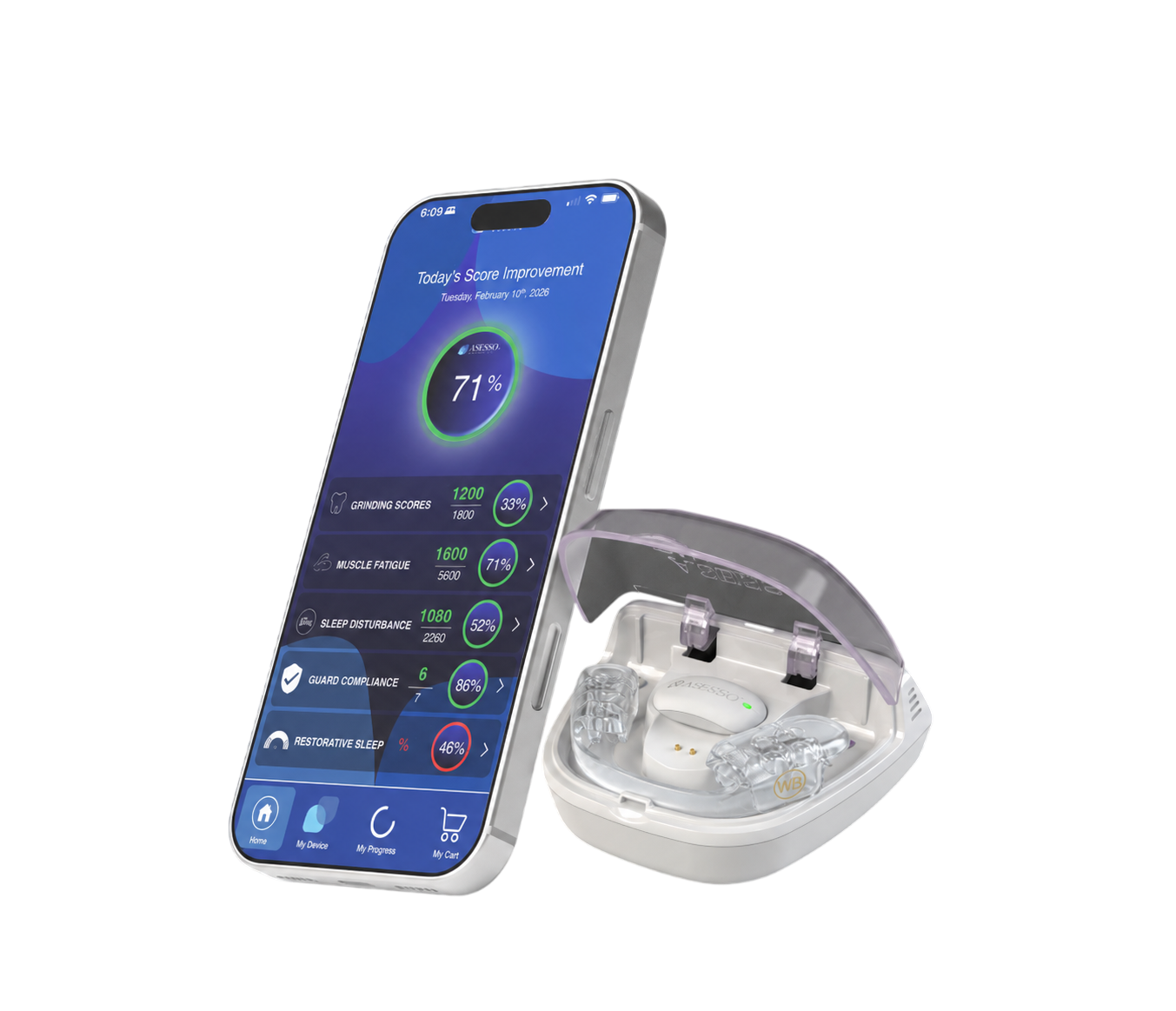
WAKEBRIGHT | As part of a broader TMD care plan, the Wakebright Guard can help manage jaw muscle load while you and your care team address the other contributing factors.
This article is for informational purposes only and does not constitute medical advice. Consult a licensed dentist or healthcare provider for diagnosis and treatment recommendations specific to your situation.
References
- National Institute of Dental and Craniofacial Research (NIDCR). "Prevalence of TMJD and its Signs and Symptoms." nidcr.nih.gov. https://www.nidcr.nih.gov/research/data-statistics/facial-pain/prevalence
- National Academies of Sciences, Engineering, and Medicine (2020). "Temporomandibular Disorders: Priorities for Research and Care." National Academies Press. DOI: 10.17226/25652. https://www.ncbi.nlm.nih.gov/books/NBK557986/
- Cleveland Clinic. "TMJ Disorders: Symptoms, Treatment & Prevention." my.clevelandclinic.org. https://my.clevelandclinic.org/health/diseases/15066-temporomandibular-disorders-tmd-overview
- Mayo Clinic. "TMJ disorders — Symptoms and causes." mayoclinic.org. https://www.mayoclinic.org/diseases-conditions/tmj/symptoms-causes/syc-20350941
- Effects of an Interdisciplinary Approach in the Management of Temporomandibular Disorders: A Scoping Review. PMC. https://pmc.ncbi.nlm.nih.gov/articles/PMC9956386/
- Temporomandibular Joint Disorders: Functional and Conservative Treatment. PMC. https://pmc.ncbi.nlm.nih.gov/articles/PMC10381711/
- Conservative vs Invasive Interventions for Temporomandibular Disorders – An Executive Summary of the Clinical Practice Guideline. Cranio / Taylor & Francis. https://www.tandfonline.com/doi/full/10.1080/19424396.2025.2588942
- Global prevalence of temporomandibular disorders: a systematic review and meta-analysis. Journal of Oral & Facial Pain and Headache. https://www.jofph.com/articles/10.22514/jofph.2025.025
- NIDCR. "TMD IMPACT." nidcr.nih.gov. https://www.nidcr.nih.gov/grants-funding/research-funded-by-nidcr-extramural/tmd-impact