How to Relax Your Jaw: 7 Techniques You Can Do Tonight

If you're reading this with your jaw clenched, you're not alone and you probably didn't even notice until now. A tight jaw is one of those tension patterns that hides in plain sight: it builds quietly through the day (or overnight, if you grind), and most people only catch it once the ache, headache, or sore feeling behind the ears shows up. The good news is that jaw tension responds well to simple, low-effort techniques you can start using tonight, no equipment required.
Why Your Jaw Gets Tense in the First Place
The jaw is closed by some of the strongest muscles in your body the masseter, temporalis, and pterygoids and they're wired closely to your body's stress response. When you're anxious, concentrating hard, or under physical strain, those muscles tend to contract without you deciding to clench them. Over time, that unconscious tension can contribute to jaw soreness, headaches, and temporomandibular disorder (TMD) symptoms like clicking or restricted movement.
None of the techniques below are a substitute for a dental evaluation if your jaw pain is frequent, severe, or affecting your ability to eat and speak normally. But for everyday tension the kind that builds up after a stressful day or a night of unconscious grinding these are genuinely useful, low-risk tools.
1. The Relaxed Jaw Position ("N" Rest)
Start with where your jaw sits when it's actually relaxed, because most people get this wrong without realizing it. Say the letter "N" out loud notice where your tongue naturally lands: resting gently against the roof of your mouth, just behind your upper front teeth. Keep your tongue there, let your teeth come apart slightly, and let your lips rest together without pressing.
That's the resting position your jaw is built for. Teeth aren't meant to be in contact except briefly during chewing and swallowing if you catch yourself with teeth touching throughout the day, that's usually a sign of clenching, even if it doesn't feel like "clenching" in the moment. Practice returning to this position any time you notice tension, especially during focused or stressful moments (working at a screen is a classic trigger).
One honest caveat: some research on tongue posture has found that pressing the tongue actively against the palate can slightly increase activity in certain jaw muscles rather than reduce it, so the goal is a light, resting contact not pressing upward with effort.
2. Diaphragmatic Breathing
Jaw tension and breathing are more connected than most people expect. Shallow, chest-based breathing keeps your nervous system in a low-grade stress state, which shows up physically as muscle tension jaw included. Mayo Clinic-referenced guidance for jaw-related discomfort recommends slow breathing exercises specifically for this reason: inhaling for a count of five to ten, then exhaling slowly.
To do it properly, place one hand on your chest and one on your abdomen. Breathe in slowly through your nose so that your abdomen not your chest rises. Exhale slowly through your mouth. A few minutes of this, done consistently, can measurably reduce the muscle guarding that keeps your jaw braced throughout the day.
3. Warm Compress
Heat is one of the simplest and most effective tools for tight muscle tissue anywhere in the body, and the jaw is no exception. Applying moist heat increases blood flow to the area and helps muscle fibers relax.
Soak a clean washcloth in warm, not hot water, wring it out, and hold it against your jaw, roughly where your back teeth meet, for 10-15 minutes. A microwaveable heat pack or a hot water bottle wrapped in a towel works just as well. This is a good technique to pair with the self-massage below, since warming the muscle first makes massage more effective.
4. Masseter Self-Massage
The masseter the muscle you can feel bulge when you clench your back teeth is one of the most common sites of jaw tension, and it responds well to direct, gentle massage.
To locate it, place your fingers on your cheek just in front of your ear and clench your teeth briefly to feel the muscle. Release the clench, then use two or three fingers to apply gentle, circular pressure, working slowly from the top of the muscle down toward the angle of your jaw. Thirty seconds to a minute per side is enough to notice a difference, and it's safe to repeat multiple times a day.
5. The Goldfish Exercise
This is a genuinely well-studied jaw exercise, not just a relaxation trick it's designed to improve range of motion while keeping the surrounding muscles relaxed rather than strained.
With your tongue resting on the roof of your mouth (the same position from technique #1), slowly and gently open your mouth partway, then close it. Keep the movement slow and controlled, and stop well short of any pain. This can be repeated for 5-10 repetitions, and a fuller-opening version exists for people who've been cleared for more active jaw mobility work but partial opening is the safer starting point if you're dealing with active soreness.
6. Progressive Muscle Relaxation for the Jaw
Progressive muscle relaxation (PMR) is a well-established relaxation technique that works by deliberately tensing a muscle group and then releasing it, which trains your body to recognize and let go of tension it's otherwise holding automatically.
Applied to the jaw: gently clench your back teeth for about five seconds not hard, just enough to feel the muscle engage then release completely and let your jaw hang loose for 10-15 seconds, noticing the contrast. Repeat this two or three times. PMR pairs well with the breathing technique above and is often used as part of broader stress-reduction routines precisely because jaw tension is such a common physical manifestation of stress.
7. Resisted Opening Stretch
Once acute soreness has settled down, a gentle resisted stretch can help build support around the jaw joint without over-straining it. Place your thumb under your chin and apply light upward pressure while slowly trying to open your mouth against that resistance. Hold for a few seconds, then release. This is typically done for 5-10 repetitions and is best introduced after not during a flare-up of jaw pain.
Comparing the Techniques
| Technique | Best For | Time Needed |
|---|---|---|
| Relaxed jaw position ("N" rest) | Ongoing awareness throughout the day | Ongoing, no set time |
| Diaphragmatic breathing | Stress-driven clenching | 2-5 minutes |
| Warm compress | General muscle tightness, evening wind-down | 10-15 minutes |
| Masseter self-massage | Localized soreness near the jaw hinge | 1-2 minutes per side |
| Goldfish exercise | Restricted jaw mobility | 1-2 minutes |
| Progressive muscle relaxation | Whole-body tension that includes the jaw | 5-10 minutes |
| Resisted opening stretch | Building jaw support after acute soreness resolves | 1-2 minutes |
When to See a Dentist Instead of Just Self-Managing
These techniques are genuinely useful for everyday tension, but they're not a substitute for professional evaluation if you notice:
- Jaw pain that persists for more than a couple of weeks despite self-care
- Clicking, popping, or locking of the jaw
- Pain severe enough to interfere with eating, speaking, or sleeping
- Signs you're grinding your teeth at night a partner noticing sounds, flattened teeth, or waking with a sore jaw
- Jaw pain following an injury
A dentist can assess whether something more is going on such as bruxism needing a night guard, or a temporomandibular disorder that would benefit from a broader, coordinated treatment plan rather than symptoms you should keep managing on your own indefinitely.
Frequently Asked Questions
How often should I do jaw relaxation exercises?
Most of these techniques are safe to do daily, and several like the relaxed jaw position and diaphragmatic breathing work best as ongoing habits rather than one-time fixes.
Can jaw relaxation techniques stop teeth grinding?
They can reduce the daytime clenching and overall muscle tension that contributes to bruxism, but they generally don't fully resolve nighttime grinding on their own, since that happens during sleep and outside conscious control. A night guard is usually still the most reliable protective measure for sleep bruxism.
Is it normal for my jaw to be sore after trying these exercises?
Mild, temporary soreness after a new stretch or exercise can be normal, similar to any unfamiliar muscle activity. Sharp pain, or soreness that worsens or persists, is a sign to stop and check in with a dentist.
Why does my jaw hurt more in the morning?
Morning jaw soreness is a common sign of nighttime clenching or grinding (sleep bruxism), which happens unconsciously and often goes unnoticed until symptoms appear on waking.
Can stress really cause jaw pain?
Yes. Stress and anxiety are well-established contributors to jaw clenching and muscle tension, which is part of why relaxation and breathing techniques are genuinely effective tools for jaw discomfort, not just general wellness advice.
Should I use heat or ice for jaw tension?
Heat is generally better for muscle-based tension and tightness, since it increases blood flow and helps muscles relax. Cold is more suited to inflammation or joint-related pain. If you're unsure which you're dealing with, heat is the safer default for everyday tension, and a dentist can advise further if symptoms persist.
Where exactly is the masseter muscle?
It's the muscle you feel bulge on your cheek, just in front of your ear, when you clench your back teeth. It's one of the primary muscles responsible for chewing and a very common site of jaw tension.
Can chewing gum make jaw tension worse?
Yes frequent or prolonged gum chewing keeps the jaw muscles working more than they need to and can aggravate existing tension, so it's worth cutting back if you're actively dealing with jaw soreness.
Is it bad if my teeth touch throughout the day?
Teeth are only meant to touch briefly during chewing and swallowing. If you notice them in contact much of the day, that's usually a sign of clenching rather than a neutral resting position.
What's the difference between jaw tension and TMD?
Everyday jaw tension is common and usually resolves with self-care. TMD refers to a diagnosed disorder of the jaw joint or muscles that may involve clicking, locking, or persistent pain, and generally needs professional evaluation and a more structured treatment plan.
WAKEBRIGHT
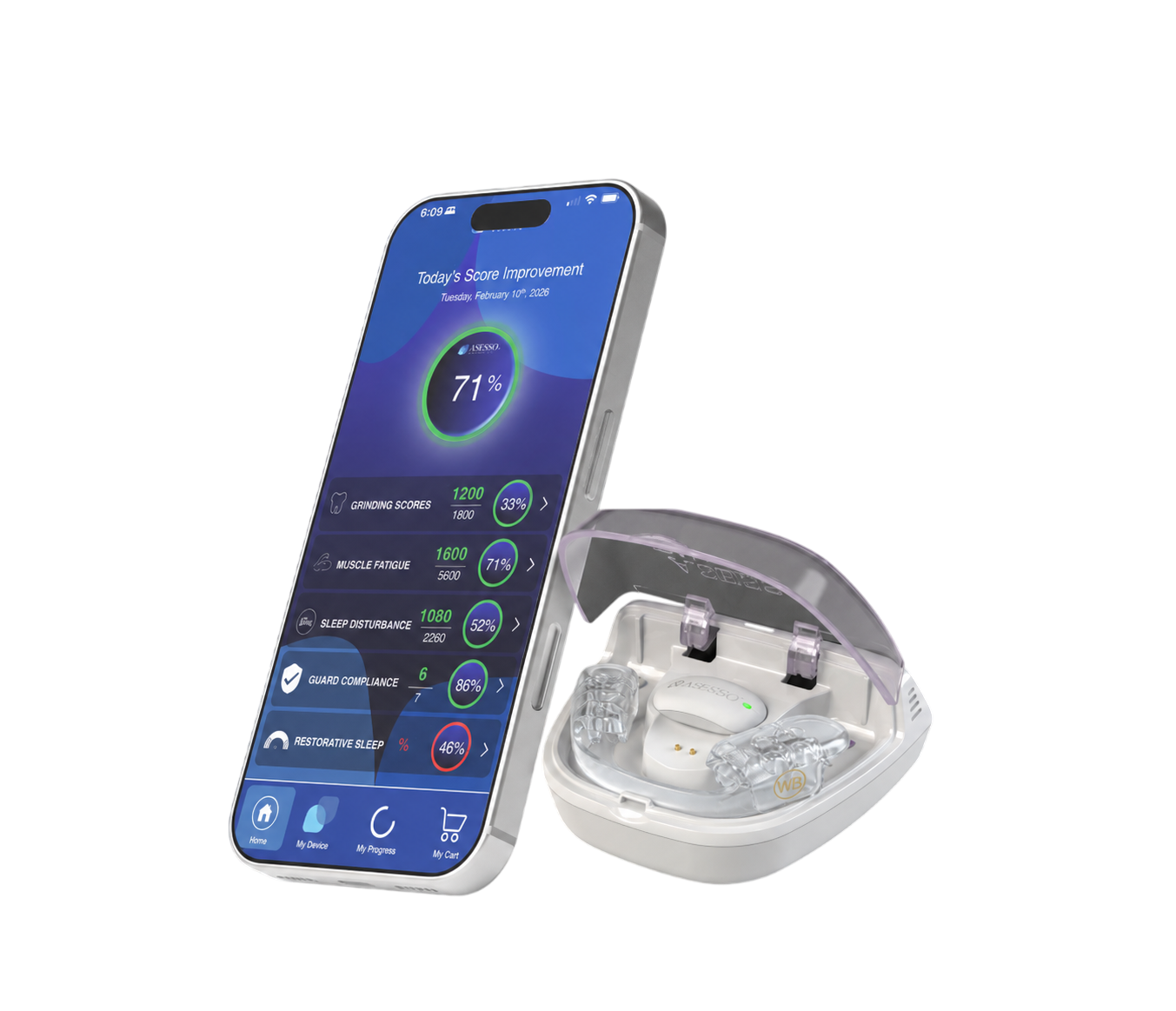
Pairing these relaxation techniques with the Wakebright Guard at night can address both the daytime tension and the nighttime clenching that often go hand in hand.
This article is for informational purposes only and does not constitute medical advice. Consult a licensed dentist or healthcare provider for diagnosis and treatment recommendations specific to your situation.
References
- Cleveland Clinic. "TMJ Massage Techniques for Quick Pain Relief." health.clevelandclinic.org. https://health.clevelandclinic.org/tmj-massage
- Colgate. "TMJ Exercises For Pain Relief" (citing Mayo Clinic breathing guidance). colgate.com. https://www.colgate.com/en-us/oral-health/temporomandibular-disorder/tmj-exercises-for-pain-relief
- Sarasota Regional Health. "9 Exercises for TMJ Pain Relief." sarh.org. https://www.sarh.org/services/rehabilitation-services/9-exercises-for-tmj-pain-relief
- The effects of tongue position on mandibular muscle activity. Journal of Orofacial Pain (PubMed). https://pubmed.ncbi.nlm.nih.gov/9656904/
- TMJ & Sleep Solutions. "4 Exercises to Help with TMJ Flare-ups." tmjandsleepsolutions.com. https://tmjandsleepsolutions.com/2025/08/01/four-exercises-to-help-with-tmj-flare-ups/
- JawSpace. "Heat, ice, and self-massage for TMD relief & recovery." jawspace.com. https://www.jawspace.com/heat-ice-self-massage