How Sleep Apnea and Teeth Grinding Damage Your Dental Work: What You Need to Know

If you've invested in crowns, veneers, or implants, there's a specific risk worth understanding that most general bruxism advice glosses over: when sleep apnea and teeth grinding occur together, they don't just threaten your natural teeth they put real, mechanical stress on restorative work in ways that are different from ordinary wear. Understanding that overlap changes both how your dentist should be approaching your care and what questions are worth asking before or after major dental work.
The Sleep Apnea Bruxism Connection, Briefly
Research has found that sleep bruxism is notably more common in people with obstructive sleep apnea (OSA) than in the general population, with the leading theory being that rhythmic jaw movement may function as a protective reflex the mouth muscles activating to help reopen an airway that's narrowing during an apnea event. The relationship isn't fully settled scientifically, and the two conditions can occur independently, but the overlap is common enough that it changes how dental work should be planned for patients who have both.
The practical implication: if you have unmanaged OSA and you're also grinding, the grinding may be more frequent, more forceful, or harder to control with dental measures alone than grinding driven by stress or habit because a mechanical driver (airway narrowing) keeps triggering it regardless of what's happening with your teeth.
Why Restorations Face a Different Kind of Risk
Natural teeth have a built-in shock absorber: the periodontal ligament, a thin layer of tissue between the tooth root and the jawbone that cushions biting and grinding forces. Restorative work doesn't always have that same cushioning, and the risk profile changes depending on what type of restoration you have.
Dental Implants
This is where the biology matters most. A dental implant fuses directly to the jawbone through a process called osseointegration there's no periodontal ligament, no built-in cushion. Every unit of grinding force travels straight from the crown into the implant post and the surrounding bone.
This creates two distinct risk windows:
- During healing. Grinding or clenching while an implant is still integrating can cause micro-movements at the bone-implant interface, which may interfere with successful fusion. This is the period where excess force is most consequential.
- After healing. Once integrated, an implant is genuinely strong, but the crown, the abutment (the connector piece), and the screws holding it together can still crack, loosen, or fracture under sustained excess force.
It's worth being precise about the evidence here, because clinical caution sometimes outpaces proof: a widely cited review on implant prostheses and bruxism notes that while occlusal overload is commonly implicated in implant complications, there is no confirmed causal relationship established between bruxism specifically and implant failure. That's part of why many dentists take a cautious, protective approach anyway the mechanical logic is sound even where the causal data isn't airtight but it's a genuinely different situation from a definitively proven risk.
Veneers and Crowns
Porcelain veneers and crowns are more straightforward: they're brittle relative to grinding forces, and repeated pressure can chip, crack, or fracture them over time, particularly at thin edges. This is why material choice matters some dentists recommend more fracture-resistant materials like zirconia over standard porcelain specifically for patients with a known grinding pattern, since it handles repetitive force better.
Fillings and Bridges
Existing fillings can loosen or fail under sustained grinding force, and bridges which rely on the teeth on either side for support put extra load on those anchor teeth when grinding is active, potentially accelerating wear on teeth that are already doing extra structural work.
Why an Unmanaged Airway Complicates the Fix
Here's where this genuinely differs from ordinary bruxism management: the standard protective tool a night guard isn't automatically the right answer if OSA is present and unmanaged.
Occlusal splints (the general category night guards fall into) have been flagged in the literature as a potential contraindication in patients with unmanaged obstructive sleep apnea, since a guard can restrict jaw movement in a way that may worsen airway obstruction rather than just protecting teeth. This doesn't mean people with OSA can never wear a night guard but it does mean the standard order of operations changes: airway status needs to be part of the conversation before defaulting to a guard, rather than an afterthought.
For patients being treated for OSA with a mandibular advancement device (MAD) an oral appliance that repositions the lower jaw forward to keep the airway open there's an additional layer worth knowing. Longer-term studies of MAD use have found measurable dental and bite changes over time: reduced overbite, changes in tooth alignment, and in some patients, the development of a posterior open bite (where back teeth no longer make full contact) after years of use. These changes are often at least partially reversible if the device is discontinued, though permanent changes requiring orthodontic correction can occur in rare cases. This is a separate consideration from grinding damage, but it's relevant to the same patients and the same restorative work, and it's worth discussing directly with whichever provider manages your OSA appliance.
Comparing Restoration Types and Their Specific Risks
| Restoration Type | Primary Risk from Grinding | Added Complexity if OSA Present |
|---|---|---|
| Dental implants | Osseointegration disruption (during healing); crown/abutment fracture (after healing) | No confirmed causal proof of implant failure from bruxism, but mechanical logic still supports caution |
| Veneers/crowns | Chipping, cracking, fracture, especially at thin edges | Material selection (e.g., zirconia) matters more if grinding is frequent |
| Fillings | Loosening, failure under repeated force | Same general risk, no OSA-specific complication |
| Bridges | Extra load on anchor teeth | Anchor teeth already under added stress; grinding compounds this |
| MAD (for OSA, not a restoration but relevant) | N/A | Can independently cause bite changes over years of use, separate from grinding |
A More Coordinated Approach
If you have dental restorations and either diagnosed or suspected sleep apnea, a few things are worth bringing to your dentist proactively, rather than treating them as separate issues:
- Disclose both conditions up front, especially before new restorative work like implants. A dentist who knows about unmanaged OSA can plan around it different material choices, closer monitoring during implant healing, or coordinating timing with your sleep treatment.
- Ask whether a standard night guard is appropriate for your specific situation, given your airway status, rather than assuming it's the automatic answer.
- If you're using a MAD for OSA, mention any new dental work to that provider too, and vice versa both directions of communication matter, since the appliance and any new restorations can interact.
- Get your OSA evaluated and treated if you haven't already, particularly if grinding is severe or restorations keep failing despite reasonable protective measures treating the underlying airway issue can reduce the mechanical driver behind the grinding itself.
When to Raise This With Your Dentist
This coordinated conversation is worth having specifically if:
- You're considering dental implants and have diagnosed or suspected sleep apnea
- You have existing restorations that have failed, chipped, or loosened more than once without an obvious cause
- You use a CPAP, MAD, or other OSA treatment and haven't discussed it with your dentist
- You've been told you grind your teeth and also snore, wake up gasping, or have unexplained daytime fatigue
Frequently Asked Questions
Can teeth grinding actually cause a dental implant to fail?
It's a commonly cited risk factor and a reasonable mechanical concern, but current evidence hasn't established a confirmed causal relationship between bruxism specifically and implant failure. Many dentists still take a cautious, protective approach given the underlying mechanical logic, even where the direct causal proof is incomplete.
Is it safe to wear a regular night guard if I have sleep apnea?
Not automatically occlusal splints have been flagged as a potential concern in patients with unmanaged obstructive sleep apnea, since restricting jaw movement can sometimes worsen airway obstruction. This is a conversation to have with your dentist, ideally with your airway status factored in before assuming a standard guard is the right fit.
Should I tell my dentist if I use a CPAP or oral appliance for sleep apnea?
Yes, definitely, especially before any new restorative work like implants, crowns, or veneers. Your airway status can affect material choices, healing precautions, and whether a standard night guard is appropriate.
Can a mandibular advancement device for sleep apnea change my bite over time?
Yes longer-term studies have found changes like reduced overbite and, in some patients, a posterior open bite after years of MAD use. These changes are often at least partially reversible if the device is stopped, though permanent changes are possible in rare cases.
Are veneers or crowns more likely to break if I grind my teeth?
Yes porcelain veneers and crowns are relatively brittle and can chip or crack under repeated grinding force, which is why some dentists recommend more fracture-resistant materials like zirconia for patients with a known grinding pattern.
If I already have a failing implant, could undiagnosed sleep apnea be a factor?
It's worth raising with your dentist as one possible contributing factor, particularly if you also have signs of sleep apnea like snoring or daytime fatigue, though implant failure can have multiple causes and a full evaluation is needed to identify the actual reason.
Does treating my sleep apnea reduce my grinding?
It's plausible, given the association between the two conditions, though the research hasn't fully established a direct causal fix. Addressing an unmanaged airway issue is a reasonable step regardless, both for grinding and for your broader health.
What should I ask my dentist before getting implants if I have sleep apnea?
Ask whether your airway status affects material selection, whether extra precautions are needed during the healing period, and what protective plan makes sense post-healing given both your grinding and your OSA status.
Is bridge work at higher risk from grinding than a single crown?
Potentially, since a bridge relies on the teeth on either side for support, and grinding adds extra load to those anchor teeth on top of their existing structural role.
How do I know if my restoration problems are related to grinding, sleep apnea, or something else?
This usually requires your dentist's direct evaluation they can assess wear patterns, check the restoration itself, and factor in your reported symptoms and any sleep apnea history to identify the most likely contributing cause.
What You Can Do Now
- Sleep apnea and grinding together put unique mechanical stress on dental restorations, especially implants
- A standard night guard isn't automatically appropriate if sleep apnea is unmanaged
- Disclose both conditions to your dentist before new restorative work, and keep your sleep-apnea provider in the loop
- Coordinated care between dentistry and sleep medicine changes the plan, not just the paperwork
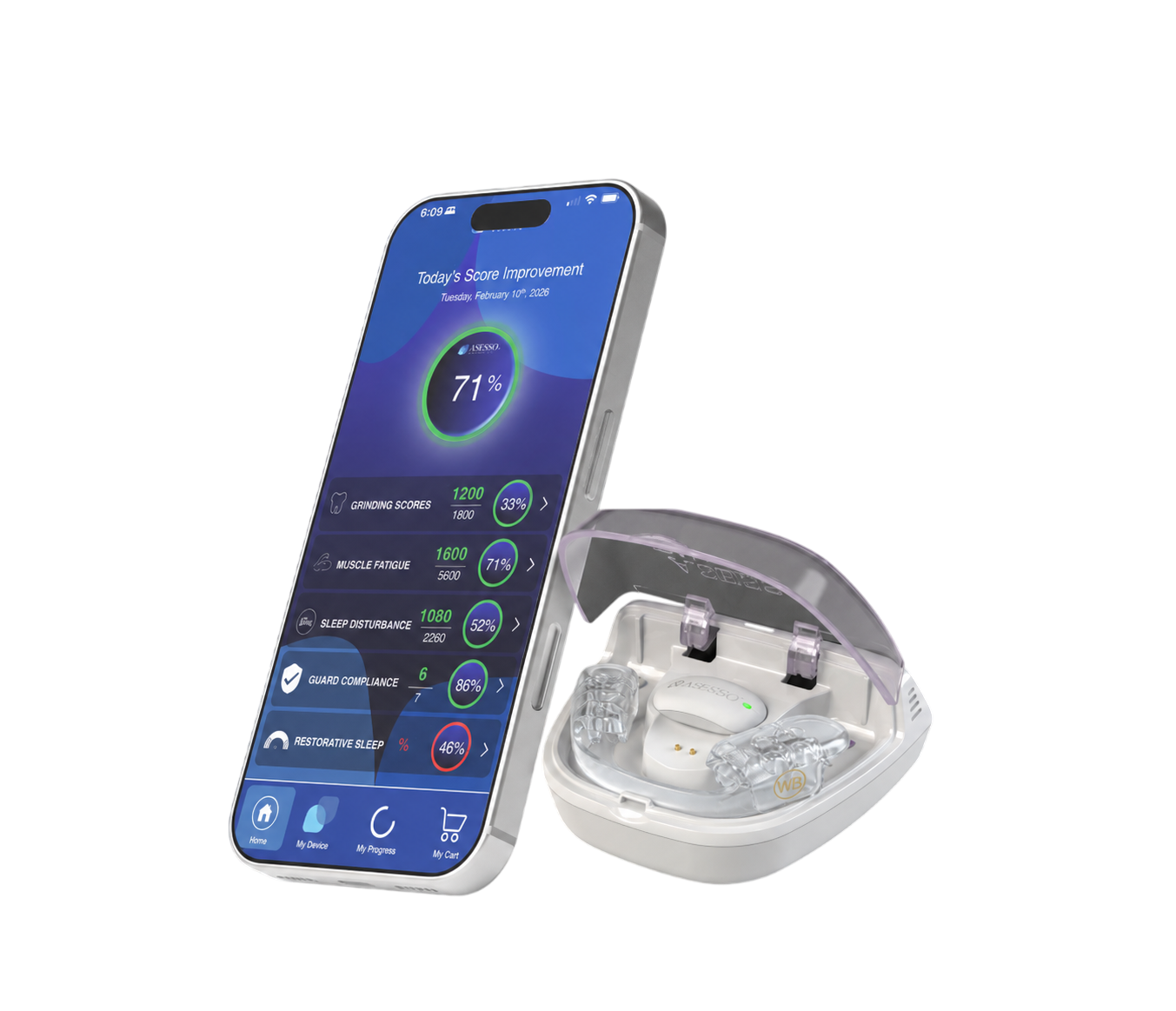
WAKEBRIGHT If you have both grinding and sleep apnea, ask your dentist whether the Wakebright Guard's design is appropriate for your specific airway situation before committing to any appliance.
This article is for informational purposes only and does not constitute medical advice. Consult a licensed dentist or healthcare provider for diagnosis and treatment recommendations specific to your situation.
References
- Clinical Management of Implant Prostheses in Patients with Bruxism. PMC. https://www.ncbi.nlm.nih.gov/pmc/articles/PMC3373074/
- Sleep Foundation. "The Connection Between Sleep Apnea and Teeth Grinding (or Bruxism)." sleepfoundation.org. https://www.sleepfoundation.org/sleep-apnea/link-between-sleep-apnea-and-teeth-grinding
- Oral appliances in the treatment of obstructive sleep apnea in adults. UpToDate (clinical reference, bite-change data). https://www.uptodate.com/contents/oral-appliances-in-the-treatment-of-obstructive-sleep-apnea-in-adults/print
- Dental and Skeletal Side Effects of Oral Appliances Used for the Treatment of Obstructive Sleep Apnea and Snoring in Adult Patients A Systematic Review and Meta-Analysis. PMC. https://www.ncbi.nlm.nih.gov/pmc/articles/PMC8949347/
- Cleveland Clinic. "Oral Appliances for Sleep Apnea: Benefits and How They Work." my.clevelandclinic.org. https://my.clevelandclinic.org/health/treatments/21129-oral-appliance-therapy-for-sleep-apnea