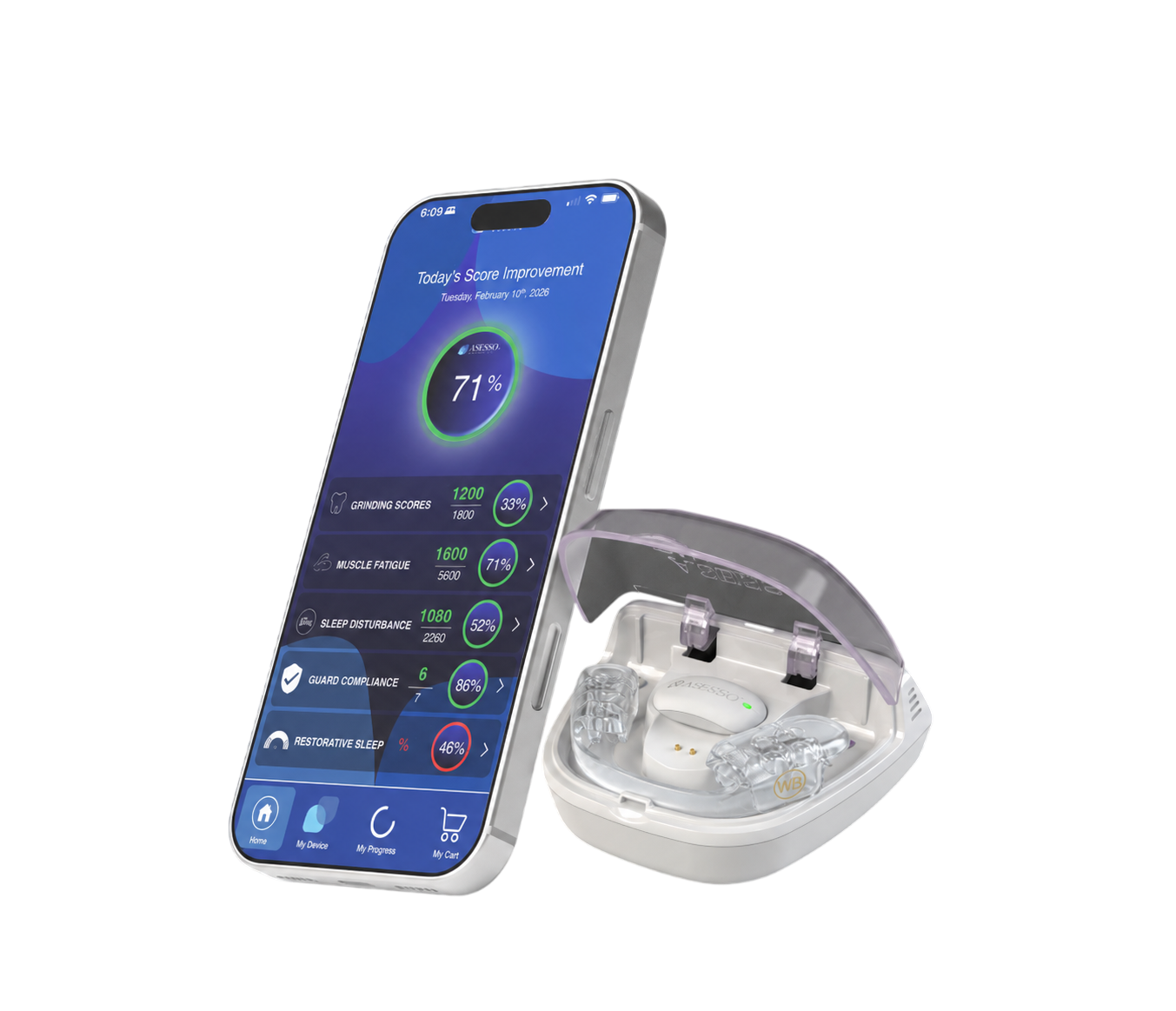
How Jaw Muscle Tracking Is Changing Bruxism Diagnosis

For most people, a bruxism diagnosis still comes down to a dentist noticing worn teeth or a partner mentioning grinding sounds useful, but indirect. The actual gold standard, overnight polysomnography, is accurate but expensive, inconvenient, and limited to a single night in an unfamiliar lab bed. A newer approach portable electromyography (EMG) devices that track jaw muscle activity directly, worn at home over multiple nights is starting to change that equation, and the validation research behind it is genuinely worth understanding.
The Old Gold Standard, and Its Limits
Polysomnography (PSG) comprehensive overnight sleep monitoring that tracks brain waves, muscle activity, breathing, and more remains the most accurate way to formally diagnose sleep bruxism, particularly when combined with audio-video recording for the clearest possible picture. But it comes with real practical limitations: it's costly, requires a sleep lab and trained technicians, and typically captures just one night of data. Since bruxism activity is known to vary night to night, a single lab-night snapshot may not fully represent someone's typical pattern.
What Portable EMG Tracking Actually Measures
Portable EMG devices use sensors often placed on the masseter muscle, the primary jaw-closing muscle to detect and record the electrical activity associated with muscle contraction. Worn at home during normal sleep, these devices can track jaw muscle activity across multiple consecutive nights without requiring a lab visit, capturing a more representative picture of someone's actual bruxism pattern than a single night can offer.
How Accurate Is This Compared to the Gold Standard?
This is where it's worth looking at the actual validation data rather than taking accuracy claims at face value. A systematic review and meta-analysis specifically evaluating portable EMG devices against polysomnography found that portable devices showed high sensitivity and specificity for diagnosing sleep bruxism meaning they're generally good at correctly identifying both people who have bruxism and people who don't, when checked against the lab-based standard. However, the review's authors were careful to grade the certainty of this evidence as very low, due to a high risk of bias and considerable heterogeneity meaning study quality and methods varied enough that the results should be interpreted with genuine caution rather than taken as settled.
Earlier, foundational research supports the basic premise: an older validation study found 100% agreement between portable EMG recordings and clinical evaluation for recognizing that a bruxism episode had occurred at all. Interestingly, the same study found much lower agreement around 62% to 63% between different scorers when it came to classifying the specific type of episode (phasic, tonic, or mixed muscle activity patterns), suggesting portable EMG is more reliable at detecting that grinding happened than at characterizing precisely what kind of muscle activity occurred.
A Genuine Limitation: The Sleep Apnea Confound
This is a real, documented complication worth knowing about, particularly given how often bruxism and obstructive sleep apnea (OSA) co-occur. A comparative study specifically examining portable EMG accuracy in a population with suspected OSA found that a final burst of muscle activity often occurs right after an apnea episode ends and this post-apnea muscle activity can be difficult for portable EMG devices to distinguish from a true bruxism episode. Other sleep-related mouth and facial movements, like snoring, lip sucking, and swallowing, can further complicate automatic analysis. This is a meaningful limitation: for someone with both conditions, a portable EMG reading alone may not cleanly separate "bruxism events" from "muscle activity related to breathing disruptions," which is part of why formal PSG remains valuable for complex cases involving suspected OSA.
The Multi-Night Advantage
Despite these limitations, one advantage of portable tracking is hard to dismiss: research on sleep bruxism has specifically noted its time-variant nature, meaning how much someone grinds can genuinely differ from night to night. A single-night PSG study, however accurate for that specific night, may not represent someone's typical pattern the way data collected across several nights can. Validation research on a specific portable single-channel EMG device (marketed as GrindCare) established diagnostic cutoff thresholds based on multiple nights of monitoring roughly 18 to 19 EMG events per hour, averaged across three to five nights reflecting an approach built around capturing a fuller pattern rather than a single snapshot.
What This Means for Diagnosis in Practice
Practically, portable jaw muscle tracking offers a genuinely useful middle ground: more objective than relying purely on self-report or a dentist's visual exam, more accessible and less expensive than a full lab-based PSG study, and capable of capturing multiple nights of real-world data rather than one night in an unfamiliar setting. For straightforward cases confirming that bruxism is occurring and getting a rough sense of its frequency this can be a genuinely useful tool. For complex cases, particularly where sleep apnea is also suspected, the research suggests formal polysomnography still has real, distinct value that portable EMG alone can't fully replace.
What It Doesn't Replace
It's worth being clear-eyed about the boundaries here. Portable EMG tracking measures muscle activity; it doesn't assess tooth wear, jaw joint health, bite alignment, or the broader clinical picture a dentist evaluates during an exam. It's a genuinely useful data source, not a standalone diagnostic replacement for clinical evaluation. And given the very-low-certainty evidence rating from the systematic review above, it's reasonable to treat portable EMG findings as one meaningful data point among several, rather than a definitive, final answer on their own.
Frequently Asked Questions
How accurate are portable EMG devices for diagnosing bruxism?
Research has found they show high sensitivity and specificity compared to polysomnography, the gold-standard lab test, but the overall quality of the supporting evidence has been rated very low due to inconsistency and bias risk across studies meaning the results are promising but shouldn't be treated as fully settled.
What is the actual gold standard for diagnosing sleep bruxism?
Polysomnography (PSG), ideally combined with audio-video recording, remains the most accurate diagnostic method, since it comprehensively monitors sleep stages alongside muscle activity, though it's costly, requires a sleep lab, and typically captures only one night of data.
Can a portable EMG device be worn at home instead of going to a sleep lab?
Yes that's the core advantage of these devices, allowing multi-night monitoring in a person's normal sleep environment rather than a single night in an unfamiliar lab setting.
Is one night of monitoring enough to diagnose bruxism accurately?
Not necessarily research has found sleep bruxism activity varies from night to night, which is part of why multi-night portable monitoring can offer a more representative picture than a single-night lab study, despite the lab study's higher per-night accuracy.
Can EMG devices tell the difference between bruxism and sleep apnea-related muscle activity?
This is a documented challenge: research in populations with suspected sleep apnea found that muscle activity occurring right after an apnea episode can be difficult for portable EMG to distinguish from true bruxism, which is a real limitation for people with both conditions.
What is GrindCare, and how does it work?
It's a specific portable, single-channel EMG device used to monitor jaw muscle activity over multiple nights; validation research has established diagnostic activity thresholds based on averaging results across three to five nights of monitoring.
Does a portable EMG device replace a dental exam for diagnosing bruxism?
No it measures muscle activity specifically, not tooth wear, jaw joint health, or the broader clinical factors a dentist evaluates during an exam. It's best understood as one useful data source alongside, not instead of, clinical evaluation.
Can portable EMG tracking tell me what type of bruxism I have?
It's more reliable at detecting that a grinding episode occurred than at classifying the specific type of muscle activity pattern involved older research found much lower agreement between analysts when it came to distinguishing between episode subtypes.
Is portable EMG tracking available to regular patients, or only in research settings?
Some devices are commercially available and used in clinical practice, though availability and whether a specific practice offers this varies it's reasonable to ask your dentist directly whether they use or can recommend this kind of monitoring.
Why would my dentist want multiple nights of data instead of just checking my teeth for wear?
Tooth wear reflects cumulative damage over a long period but doesn't tell your dentist how frequently or intensely you're currently grinding, whereas multi-night muscle activity tracking can offer a more current, detailed picture of your actual bruxism pattern.
If I have both suspected sleep apnea and bruxism, should I get a portable EMG test or a full sleep study?
Given the documented difficulty portable EMG has distinguishing bruxism from apnea-related muscle activity, a full polysomnography study is generally more appropriate for a case involving suspected sleep apnea, so that both conditions can be assessed with the more comprehensive gold-standard method.
How is this technology likely to develop going forward?
Given the current very-low-certainty evidence rating, future research with more standardized methodology is likely to help clarify exactly how reliable these devices are and refine diagnostic thresholds further, following the pattern of ongoing validation research already published on specific devices.
WAKEBRIGHT | Whatever your specific muscle activity pattern turns out to be, the Wakebright Guard is designed to reduce jaw muscle strain broadly — ask your dentist how your symptom pattern should shape your treatment approach.
This article is for informational purposes only and does not constitute medical advice. Consult a licensed dentist or healthcare provider for diagnosis and treatment recommendations specific to your situation.
References
- "Instrumental assessment of sleep bruxism: A systematic review and meta-analysis." Sleep Medicine Reviews, ScienceDirect/PubMed. https://pubmed.ncbi.nlm.nih.gov/38295573/
- "Diagnostic Accuracy of a Portable Electromyography and Electrocardiography Device to Measure Sleep Bruxism in a Sleep Apnea Population: A Comparative Study." PMC, National Library of Medicine. https://www.ncbi.nlm.nih.gov/pmc/articles/PMC10660473/
- Abe, Y. et al. "Diagnostic accuracy of ambulatory polysomnography with electroencephalogram for detection of sleep bruxism-related masticatory muscle activity." Journal of Clinical Sleep Medicine. https://jcsm.aasm.org/doi/10.5664/jcsm.10344
- "Diagnostic validity of the use of a portable single-channel electromyography device for sleep bruxism." Sleep and Breathing, Springer Nature Link. https://link.springer.com/article/10.1007/s11325-015-1283-y
- National Institute of Dental and Craniofacial Research. "Bruxism." nidcr.nih.gov. https://www.nidcr.nih.gov/health-info/bruxism