Facial Tension and Jaw Tightness: Causes and Relief That Actually Works

A tight, tense feeling across your jaw and face is one of those symptoms that's easy to live with and hard to shake. Before trying yet another remedy that may or may not do anything, it's worth knowing what the actual research says works because the evidence here is better than you might expect, and some of the popular advice doesn't hold up nearly as well.
What Causes Facial Tension and Jaw Tightness
A few overlapping factors are usually behind it:
Jaw clenching, often stress-related. Daytime clenching is one of the most common drivers of facial and jaw tension, frequently tied to stress and anxiety, and it can happen without much conscious awareness.
Temporomandibular disorder (TMD). Beyond simple clenching, an actual disorder of the jaw joint or surrounding muscles can produce a persistent tight or fatigued feeling, sometimes with clicking, popping, or pain.
Neck and shoulder tension. Research has found that jaw and neck muscles are closely linked, both mechanically and neurologically tension in one area frequently shows up in or contributes to tension in the other, which is part of why jaw-focused treatment alone doesn't always fully resolve facial tightness.
Posture, particularly forward-head posture from prolonged phone or screen use, changes how your jaw and neck muscles have to work to support your head.
What Actually Works: The Evidence on Relief Methods
This is where it's worth being more rigorous than most general advice articles, because TMD research has actually produced some genuinely strong evidence in recent years a rarity in a field that's often short on high-quality studies.
Manual therapy has real, well-graded evidence behind it. A systematic review of 20 randomized controlled trials, using the GRADE framework to assess evidence quality, found high- and moderate-quality evidence that manual therapy provides real additional benefit for reducing pain intensity in TMD, with effects holding up at both short-term and longer-term follow-up. This is a notably strong evidence rating for a musculoskeletal treatment, and includes techniques like myofascial release and guided manual mobilization of the jaw.
Jaw exercises are effective, and comparably good to a splint in at least one trial. A randomized controlled study comparing jaw exercises, a stabilization appliance (splint), and no treatment found that jaw exercises were effective at reducing pain intensity, headache, and pain medication use in patients with masticatory myofascial pain and were also found to be cost-effective compared to splint therapy. This doesn't mean exercises should replace a night guard if grinding is damaging your teeth, but it does mean exercise therapy has genuine, trial-tested value for the tension and pain side of things specifically.
Jaw-opening exercises specifically improve mobility and pain. A pilot randomized controlled trial found that structured jaw-opening exercises performed up to the point of pain onset — measurably improved pain-free mouth opening and reduced pain during jaw movement and chewing over the course of the study.
Neck-focused exercises help too, not just jaw-focused ones. A randomized controlled trial specifically testing neck motor control training against manual therapy and a placebo condition in women with TMD found the neck exercise group showed significantly better pain and jaw function outcomes than placebo, with benefits still present at three-month follow-up reinforcing that treating the neck, not just the jaw, is a legitimate and evidence-supported part of relief.
Exercises With Real Evidence Behind Them
Based on the research above, a few specific approaches are reasonable to try:
Controlled jaw-opening exercise. Slowly open your mouth as wide as comfortable, approaching but not exceeding the point where pain begins, hold briefly, then slowly close. This mirrors the approach used in the jaw-opening exercise trial, which found benefit specifically from exercising up to not past the pain threshold.
Gentle self-massage of the jaw and temple muscles. Using your fingers, apply light circular pressure to your masseter (jaw) and temporalis (temple) muscles, an approach broadly consistent with the manual therapy techniques shown to have real evidence for pain reduction, even in a simplified self-administered form.
Neck-focused motor control exercises. Given the demonstrated benefit of neck-targeted exercise in the RCT above, incorporating gentle neck mobility and postural exercises not just jaw-specific stretches is a reasonable and evidence-supported addition, particularly if your tension seems to extend into your neck and shoulders.
Heat application. While the research base specifically for heat therapy in TMD is less rigorously studied than manual therapy or exercise, it's a low-risk, commonly recommended approach that improves blood flow to tense muscles and is reasonable to combine with the exercise-based approaches above.
What Doesn't Have Strong Evidence
It's worth being honest about where the evidence runs thin, particularly since jaw exercise devices are heavily marketed for a completely different purpose: facial contouring. A case report examining a commercially available jaw exerciser, used for approximately three months by two individuals for jawline slimming and facial contouring, found no noticeable change in jaw appearance, and a broader literature review found limited evidence supporting these devices' ability to reduce a double chin, enhance jawline definition, or tighten facial skin. The muscles targeted by these exercises simply don't have a direct effect on submental fat or skin elasticity.
This is a genuinely important distinction: exercises aimed at reducing TMD-related pain and tension have real trial support, as covered above. Exercises marketed for cosmetic jawline sculpting are a different claim entirely, and the evidence for that specific outcome is weak to nonexistent.
When Self-Care Isn't Enough
If you've tried consistent jaw and neck exercises along with self-massage and heat for several weeks without meaningful improvement, or if your tension comes with jaw locking, significant pain, or clicking that's worsening, it's worth bringing this to a dentist or a physical therapist experienced in TMD. Given the strength of the manual therapy evidence specifically, professional-level treatment may offer more benefit than self-administered techniques alone, particularly for more persistent or severe cases.
Frequently Asked Questions
Do jaw exercises actually work for jaw tension, or is that just folk wisdom?
There's real randomized controlled trial evidence supporting jaw exercises for TMD-related pain and tension one trial found jaw exercises effective for reducing pain, headache, and medication use, and comparably beneficial to a stabilization splint while being more cost-effective.
What's the difference between jaw exercises for TMD and "jawline exercises" for facial slimming?
They're different claims entirely. TMD-focused jaw exercises have genuine trial support for reducing pain and improving jaw function. Exercises or devices marketed for jawline slimming or facial contouring have little to no supporting evidence a case study found no noticeable change in jaw appearance after months of use.
Is manual therapy or massage actually effective for jaw tension?
Yes a systematic review using rigorous evidence-grading found high- and moderate-quality evidence that manual therapy provides real additional benefit for TMD pain, with effects lasting into longer-term follow-up, which is a notably strong evidence rating for this type of treatment.
Can neck exercises really help with jaw tension?
Yes, and this is genuinely supported by research a randomized controlled trial found neck-focused motor control exercises significantly improved pain and jaw function in women with TMD compared to a placebo, with benefits still present three months later.
How long should I try self-care before seeing a professional about jaw tension?
If consistent jaw and neck exercises, self-massage, and heat haven't led to noticeable improvement after a few weeks, or if you have worsening symptoms like locking or significant pain, it's reasonable to seek a dental or physical therapy evaluation rather than continuing indefinitely on your own.
Is it safe to do jaw exercises if I have pain when opening my mouth?
Research on jaw-opening exercises specifically used the point of pain onset as a guide exercising up to but not past that point, rather than avoiding movement entirely or pushing through significant pain. It's reasonable to follow a similar approach, but check with a dentist if you're unsure given your specific symptoms.
Does heat or ice work better for jaw tension?
Both are commonly recommended and considered reasonably low-risk: heat is generally used to relax tense muscles and improve blood flow, while cold is more often used to reduce inflammation and numb acute pain. Evidence for either specifically in TMD is less robust than for manual therapy or exercise, but both are safe to try.
Can stress alone cause facial tension without any jaw disorder present?
Yes stress-driven jaw clenching is a common cause of facial tension even without a diagnosed TMD, since the physical tension response to stress often specifically involves the jaw and facial muscles.
Will a night guard help with facial tension?
It may help if nighttime grinding or clenching is a contributing factor, since it can reduce some of the associated muscle strain, though it's generally most directly aimed at protecting your teeth rather than resolving daytime facial tension on its own.
Should I see a dentist or a physical therapist first for jaw tension?
Either is reasonable a dentist can evaluate for TMD, grinding, and bite-related factors, while a physical therapist experienced in orofacial or TMD care can provide manual therapy and guided exercise programs, which have some of the strongest evidence discussed here.
Can poor posture alone cause jaw tightness without any clenching?
It's a contributing factor rather than usually a sole cause forward-head posture changes how your jaw and neck muscles work together, which can add to tension, but it typically combines with other factors like stress or clenching rather than acting entirely in isolation.
Is it normal for jaw tension to come and go?
Some fluctuation tied to stress levels, sleep quality, or other daily factors is common. Tension that's persistent, worsening, or increasingly frequent especially with jaw locking or significant pain is worth having evaluated rather than assumed to be a passing issue.
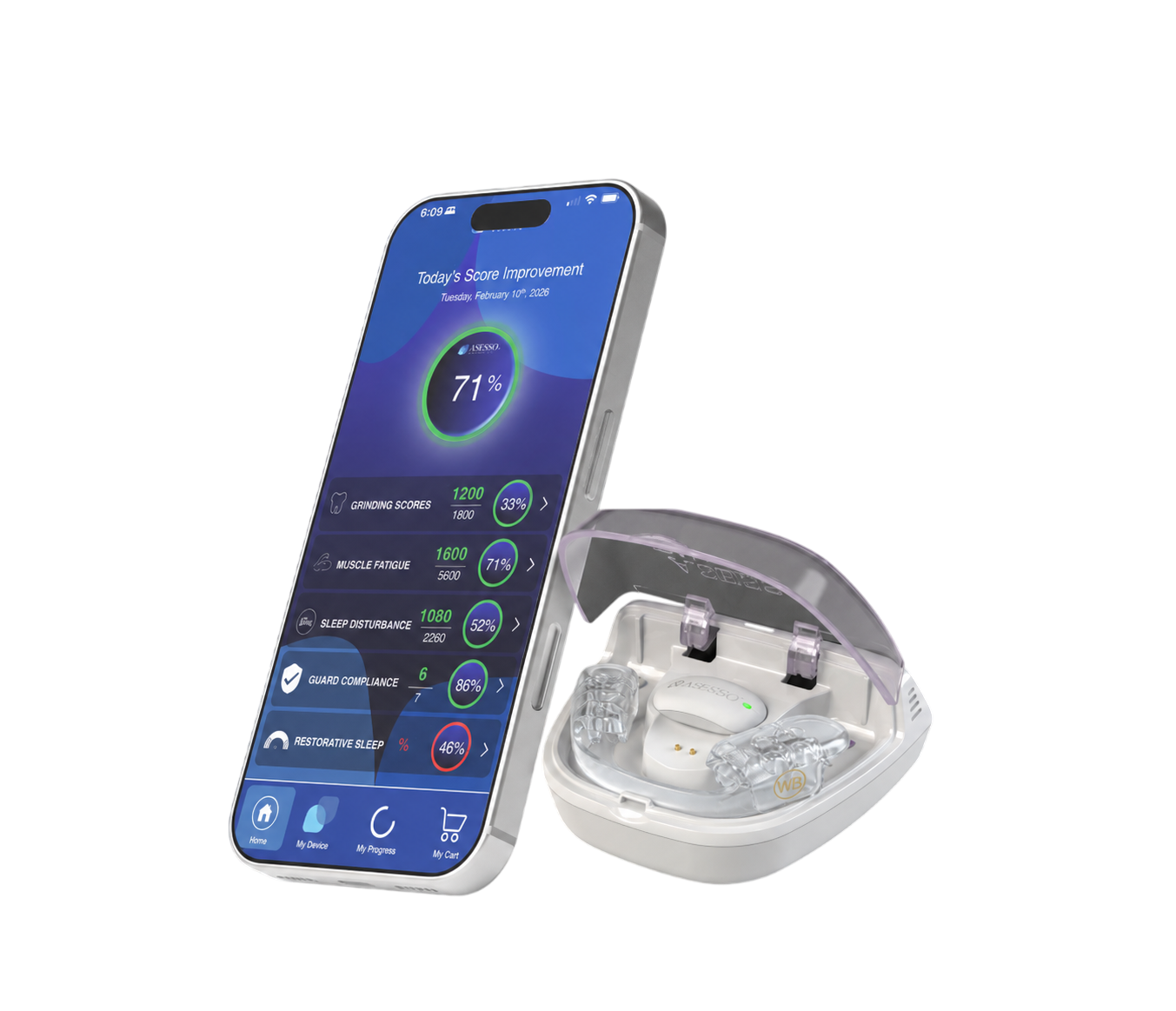
WAKEBRIGHT If nighttime grinding is contributing to your facial tension, the Wakebright Guard addresses that piece directly while your daytime awareness practices work on the rest.
This article is for informational purposes only and does not constitute medical advice. Consult a licensed dentist or healthcare provider for diagnosis and treatment recommendations specific to your situation.
References
- "The Efficacy of Manual Therapy Approaches on Pain, Maximum Mouth Opening and Disability in Temporomandibular Disorders: A Systematic Review of Randomised Controlled Trials." PMC, National Library of Medicine. https://www.ncbi.nlm.nih.gov/pmc/articles/PMC9967117/
- "Effect of Therapeutic Jaw Exercises in the Treatment of Masticatory Myofascial Pain: A Randomized Controlled Study." PubMed, National Library of Medicine. https://pubmed.ncbi.nlm.nih.gov/33290442/
- "Effects of Jaw-Opening Exercises with/without Pain for Temporomandibular Disorders: A Pilot Randomized Controlled Trial." International Journal of Environmental Research and Public Health, PMC. https://www.ncbi.nlm.nih.gov/pmc/articles/PMC9779752/
- "Effectiveness of an 8-week neck exercise training on pain, jaw function, and oral health-related quality of life in women with chronic temporomandibular disorders: a randomized controlled trial." PMC, National Library of Medicine. https://www.ncbi.nlm.nih.gov/pmc/articles/PMC11773986/
- "Facial Contouring Through Jaw Exercises: A Report of Two Cases Examining Efficacy and Consumer Expectations." PMC, National Library of Medicine. https://www.ncbi.nlm.nih.gov/pmc/articles/PMC11681191/