Effective At-Home Treatments for TMJ and Jaw Muscle Pain

Building Your At-Home TMJ Toolkit: A Practical Framework
Treating TMJ and jaw muscle pain at home requires no special equipment and no professional supervision. Everything you need is already in your house. What matters is the framework: manage acute symptoms first (ice, rest, pain relief) when a flare hits, then move into longer-term recovery (heat, muscle relaxation, posture), and finally lock in prevention (sleep-phase intervention, stress management). These stages are not a strict sequence where one must finish before the next begins. Many of them run in parallel. On a single day you might apply evening heat to loosen the muscles, practice calming breathwork, fix your sleep posture, and start wearing a jaw repositioning device overnight.
Whether at-home care succeeds comes down to whether it reaches the root cause. If your jaw pain traces back to an injury, recent surgery, or acute inflammation, then ice and rest for the first 48 hours followed by gentle heat and stretching will usually clear things up within days to weeks. If your pain is chronic and driven by bruxism and ongoing muscle stress, you need the whole toolkit: flare management when symptoms spike, daily self-care (heat, massage, posture), attention to stress and sleep, and above all else, a nightly reduction in the load your jaw muscles carry.
Wound healing offers the right analogy. After surgery or an injury, you rest the area and protect it from strain (acute management). In the days and weeks that follow, gentle movement and gradually increasing activity encourage healing (recovery). But if you then go straight back to the activity that caused the injury without changing anything, you get hurt again (prevention fails). At-home TMJ care follows the same logic: calm the acute symptoms, recover properly, and then deal with the behavior or condition that created the problem in the first place.
Ice and Heat Protocols: When, How Long, and How Often
Ice comes first when there is acute swelling and inflammation, meaning the first 24 to 48 hours after trauma or surgery. Cold narrows blood vessels, which limits swelling and numbs pain. To apply it, wrap ice in a thin towel (never place ice directly on skin, since bare contact causes ice burn) and hold it against the jaw and temple for 15 minutes. Take a 30-minute break, then repeat if needed, up to 3 or 4 sessions per day during the acute phase. The purpose is swelling control. Once the swelling starts to settle, typically after 48 hours, ice loses its value and heat becomes the better choice.
Heat loosens tight muscles and boosts blood flow, both of which support healing. Where ice belongs to the acute phase, heat belongs to chronic muscle tension and stiffness. Moist heat reaches deeper into tissue than dry heat, so a warm shower, a damp heating pad, or a heat gel pack all work well. Keep the temperature comfortably warm rather than hot. If you cannot hold it against your skin comfortably, it is too hot. Apply for 15 to 20 minutes, 2 to 3 times a day. An evening session before bed is especially valuable because it prepares the muscles for sleep and pairs beautifully with jaw repositioning overnight. A common and effective progression is ice for the first 48 hours, then a switch to heat. Some people alternate: 15 minutes of ice, 15 minutes of heat, then ice again.
A simple rule of thumb: visible or palpable swelling means ice first. Swelling gone but stiffness and muscle pain remaining means heat wins. If you are not sure whether swelling is present, gentle heat is the safer bet, since too much ice during recovery can slightly slow healing. The overall timeline runs like this: ice in the acute window (hours up to 2 days), then heat for lingering pain and stiffness (days to weeks). If pain and stiffness are still with you past 2 to 3 weeks, you have most likely crossed into chronic territory, and the priority shifts from calming inflammation to fixing the underlying drivers such as bruxism, stress, and posture.
Self-Massage and Trigger Point Techniques: Hands-On Muscle Relief
Self-massage goes straight at muscle tension, and the masseter and temporalis are both easy to reach and quick to respond. Begin with external massage: using three fingers (index, middle, and ring), make gentle to moderate circles over the side of your face where the jaw muscle sits. You will feel the bulk of the muscle under your fingertips. Work through the entire muscle methodically, giving each spot 30 to 60 seconds. Pressure should be firm enough that you feel the muscle responding, but it should never produce sharp pain. Do this 2 to 3 times daily, ideally right after heat, when the muscles are warm and most receptive.
Intraoral massage, done inside the mouth, reaches fibers that external work cannot touch. Wash your hands thoroughly first. Slide your index finger inside your cheek, into the space between your teeth and cheek, until you find the soft bulge of the masseter. Press in gentle circles for 30 to 60 seconds. This technique delivers remarkable results, but it demands care: stay gentle, stop if you feel sharp pain or tissue irritation, and never work hard enough to create tiny injuries. Many patients find a single intraoral session cuts their jaw pain by 30 to 50 percent, which is a dramatic effect. Pair it with external massage for full coverage of the tense muscles.
Trigger point release with a soft foam ball (smaller than a tennis ball) or a roller can add value, but treat it with caution. Press gently to moderately into the tense spot and hold for 30 to 60 seconds to coax the muscle into releasing. What you must avoid is aggressive deep pressure without proper training, which can cause inflammation or bruising. The guiding principle: pressure should feel like relief, not pain. If massage makes the pain worse or produces swelling, you are pressing too hard or working on acutely inflamed tissue. Gentle, consistent sessions beat forceful, occasional ones every time.
Jaw Exercises vs. Rest: When to Move and When to Stay Still
The usual advice says 'exercise heals.' For TMJ, that is true only in part. During acute inflammation, roughly the first 1 to 2 weeks, rest beats exercise. Muscles that are inflamed and painful should not be loaded, because stressing irritated tissue slows healing. So rest the jaw: choose soft foods, avoid opening wide, limit long stretches of talking, and skip chewing gum. None of this is permanent. It is protection for the acute phase only. Once the sharp pain and swelling ease, usually within days to a week or two, gentle movement starts to help.
Gentle stretching, as opposed to aggressive exercise, drives recovery forward. Passive stretching is the safest form: rest a clean finger on your lower front teeth and press downward lightly so the jaw opens a bit further. Hold for 30 seconds with zero pain. You want a mild stretching sensation, never discomfort. Do 3 repetitions, 2 to 3 times daily. That light, repeated pressure slowly restores your opening range. Basic jaw opening exercises, slowly opening and closing, become useful once pain has improved. Resistance work, meaning pushing against your own jaw, generally does not help. Gentle motion outperforms it.
The dividing line is simple: does an exercise feel relieving or painful? Relieving means it is aiding recovery and you should keep going. Painful means it is stressing inflamed tissue and you should back off. Plenty of patients push through pain, assuming 'no pain, no gain' applies here. It does not. Pain during an exercise is your tissue telling you it is not ready. Listen to your jaw. Gentle, pain-free movement is the target. As pain and inflammation fade over the weeks, ramp up gradually. A full return to forceful chewing, crunchy foods, and wide opening comes step by step as the inflammation clears and the muscles regain strength.
Over-the-Counter Pain Management: Appropriate Use and Considerations
Over-the-counter medication can support your at-home plan, but it should never stand in for fixing the root cause. Ibuprofen (Advil, Motrin) and naproxen (Aleve) are nonsteroidal anti-inflammatory drugs (NSAIDs) that lower both inflammation and pain. Dosing: ibuprofen at 200 to 400 mg every 6 to 8 hours, with a maximum of 1200 mg daily without a prescription; naproxen at 220 mg every 8 to 12 hours, with a maximum of 660 mg daily. For TMJ pain these tend to outperform acetaminophen (Tylenol), because inflammation is usually part of the picture. NSAIDs deliver the best results when started early, before pain gets severe, and taken on a consistent schedule rather than only when pain spikes.
Some cautions are essential. NSAIDs carry real risks, particularly with extended use. They can upset the stomach, raise cardiovascular risk, and in rare cases affect kidney function. Stick to the lowest dose that works, for the shortest time necessary, and take them with food to spare your stomach. Anyone with a history of ulcers, heart disease, or kidney problems should talk with a healthcare provider before using them. For most people facing acute TMJ pain, a short NSAID course lasting days to a couple of weeks is both safe and effective. If you find yourself needing NSAIDs beyond 3 weeks, see your provider, because that is a sign the underlying cause is going untreated.
Topical products such as creams and gels with menthol or capsaicin offer brief surface-level relief but barely reach the deep jaw muscles, so consider them a supplement at most. Also be careful not to stack multiple NSAID products by accident. Read labels closely, since many cold and flu remedies contain ibuprofen or naproxen and can push you into an unintentional overdose. The bottom line: NSAIDs are a tool for short-term pain and inflammation, useful for days to a couple of weeks. They are not a solution for chronic TMJ pain rooted in bruxism or muscle stress. That problem requires going after the cause.
Sleep Posture and Environment: Optimizing Recovery During Sleep
How you sleep has an outsized effect on how your jaw recovers. Sleeping face-down forces the jaw into twisted, loaded positions and should be off the table. Side sleeping generally works best, though the side you choose matters: favor the side without pain so you are not pressing on the sore TMJ all night. Sleeping on your back is acceptable, though slightly less ideal than side sleeping. Back sleeping can also encourage forward head posture and extra jaw muscle load, which makes pillow height critically important. Aim for a pillow that keeps your neck in neutral alignment: not so tall that your chin tucks, not so flat that your head tips backward.
Pillow choice deserves real attention. A pillow that sits too high forces your chin toward your chest, keeping the masseter and temporalis under tension all night long. A pillow that sits too low lets your head fall backward, straining the joint itself. The right pillow fills the gap between your neck and the mattress so that head, neck, and spine line up in a neutral position. Memory foam pillows that mold to the neck often support better than flat ones. Plenty of TMJ patients notice meaningful improvement from nothing more than fixing their sleep position and pillow height.
Your sleep environment counts as well. Keep the room cool, around 65 to 68 degrees Fahrenheit, since warmth raises both muscle tension and the risk of grinding. Make the room properly dark, with blackout curtains if necessary. Noise erodes sleep quality, so use white noise or earplugs if your surroundings are loud. As for duration, target 7 to 9 hours per night, because poor sleep slows muscle recovery and amplifies how strongly you feel pain. A sleep setup that supports deep, uninterrupted rest is foundational. And if you grind or clench at night, one more piece is critical: jaw repositioning during sleep with the Wakebright Grind Guard, which prevents the muscle tension and damage that would otherwise undo your recovery by morning.
Stress Management and Sleep Quality: Pillars of At-Home Recovery
Stress feeds directly into jaw tension and bruxism. When you are under pressure, your nervous system flips into 'fight or flight' mode and your jaw tightens as a protective reflex. Keep the stress constant and the muscles stay constantly tight. The nervous system data is striking: people under chronic stress carry measurably higher baseline jaw muscle tension than people who are not. Interrupting the cycle of stress, tension, bruxism, and pain is not optional for recovery. It is required.
The practical options are straightforward: deep breathing (inhale for a 4-count, exhale for a 6-count, 5 minutes daily), progressive muscle relaxation (tensing and releasing muscle groups one by one), meditation or mindfulness (10 to 30 minutes daily), or physical activity such as walking, yoga, or swimming. The aim in every case is moving your nervous system out of sympathetic (stress) dominance and into parasympathetic (relaxation) dominance. Even 10 minutes of daily practice produces measurable drops in jaw tension and pain. Many patients discover that stress management alone rivals pain medication for relief, with no side effects attached.
Sleep quality and recovery cannot be separated. In deep sleep, the parasympathetic system takes over, muscle tension falls naturally, and tissue repair speeds up. Poor sleep undermines every part of that. Worse, stress and bad sleep reinforce each other: stress ruins sleep, ruined sleep sharpens the stress response, and the muscles never get a break. Escaping that loop takes both stress management and sleep optimization together. Layer in jaw repositioning during sleep with the Wakebright Grind Guard to protect the muscles through the vulnerable overnight hours, and you have covered the foundational layers of recovery. From there, every other at-home tool works dramatically better, because the terrain underneath, stress and sleep, is finally in order.
The Wakebright Grind Guard Advantage: Foundational Nightly Intervention
Every tool covered so far, ice, heat, massage, exercises, pain relief, sleep optimization, and stress reduction, is valuable and genuinely supports recovery. But all of them operate on daytime. What about the 6 to 8 hours you spend asleep? If you grind or clench, enormous muscle stress piles up every single night. Your deliberate daytime self-care ends up fighting against fresh overnight damage. It is like pouring water into a bucket with a hole in the bottom. You make progress, yet the bucket never fills.
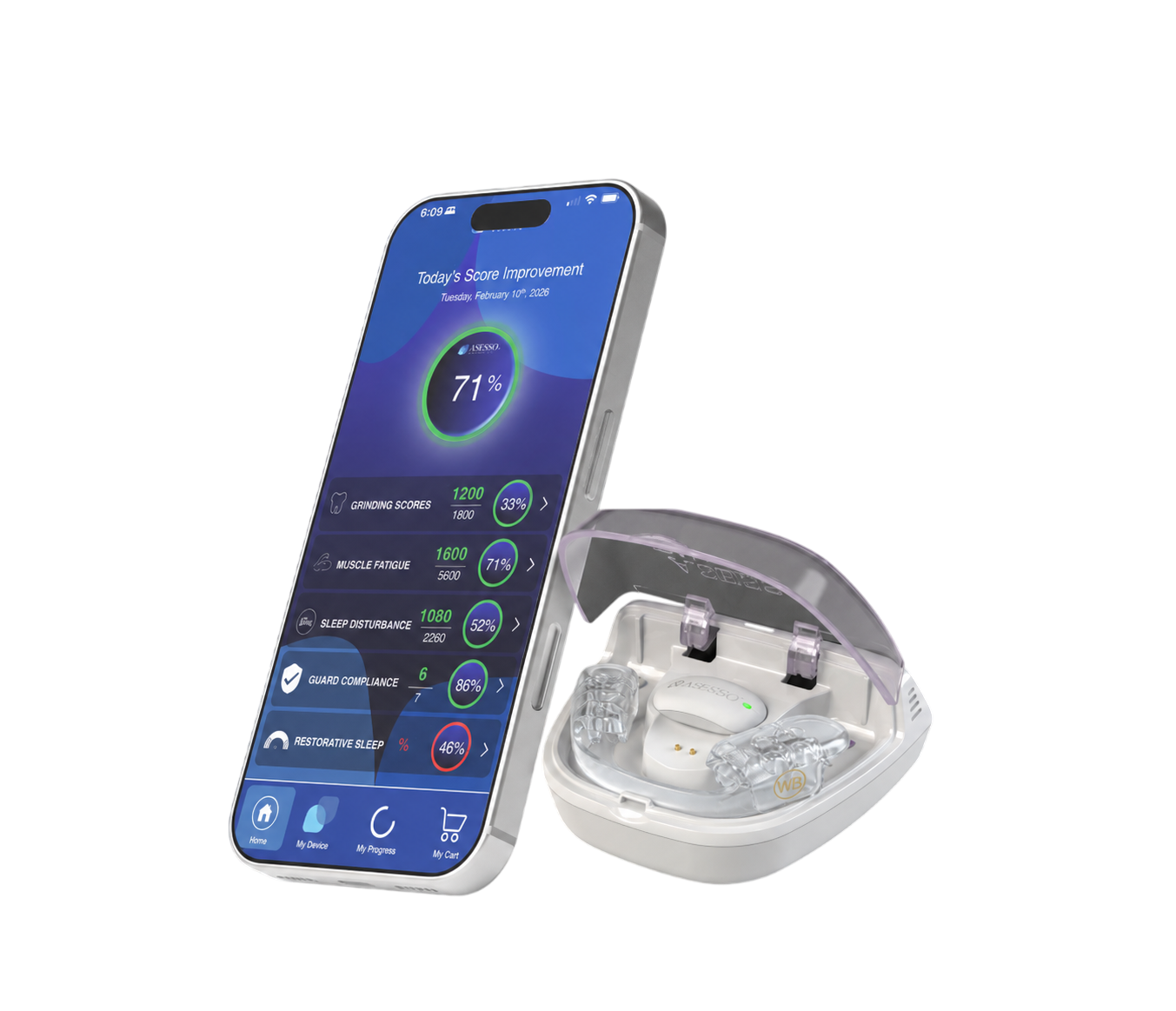
The Wakebright Grind Guard is the plug for that hole. By repositioning your jaw overnight to lower the muscle load, it stops the nightly buildup of stress before it starts. Instead of spending 6 to 8 hours in tension and microtrauma, your muscles rest supported in a relaxed position. That single change flips the role of everything else you do: your at-home treatments stop battling overnight damage and start compounding toward recovery. Daytime heat and massage now build on a rested, undamaged foundation. Sleep quality rises because the muscles actually recover while you sleep. Stress management lands harder because the muscles are no longer clocking night after night of strain.
Real-world experience across patients of at-home treatment users reveals the same pattern again and again: people who pair their daytime tools (heat, massage, stress management, a soft diet) with the Wakebright Grind Guard reach full, lasting recovery. People who lean on daytime tools alone improve for a while, then plateau or slide backward. The difference between the two groups plays out overnight, quite literally. The Grind Guard is not a replacement for solid daytime self-care. It is the missing foundation that lets all of that self-care do its job. And at a fraction of the cost of professional treatment, it delivers the nightly intervention that makes recovery stick.
What You Can Do Now
At-home treatment moves through acute management (ice, rest), then recovery (heat, stretching, massage), then prevention (fixing the root causes).
Use ice for acute swelling during the first 48 hours, and heat for chronic muscle tension, applied consistently and especially before bed.
Self-massage 2 to 3 times daily meaningfully lowers muscle tension. Combining external and intraoral techniques gives the most complete relief.
Jaw exercises should always be pain-free. Pushing hard during inflammation delays healing, so rest through the acute phase and add gentle movement as pain improves.
NSAIDs ease inflammation and pain, but they are short-term tools, not a fix for chronic TMJ pain driven by bruxism.
Sleep position, pillow height, and overall sleep quality all shape how well your jaw recovers, so make your sleep environment work for you.
Stress management and solid sleep form the foundation that determines how well every other at-home tool performs.
The Wakebright Grind Guard supplies the missing piece: nightly jaw repositioning that stops the 6 to 8 hours of overnight stress your daytime tools can never reach.
Frequently Asked Questions
Q: Should I use ice or heat for my jaw pain?
Start with ice during the first 24 to 48 hours to control acute swelling. After that, switch to heat for 15 to 20 minutes, 2 to 3 times daily, to release muscle tension. Alternating also works well for many people: 15 minutes of ice followed by 15 minutes of heat. An evening heat session before bed pairs especially well with nightly jaw repositioning.
Q: How often should I do self-massage for TMJ?
Aim for 2 to 3 sessions daily, spending 30 to 60 seconds on each muscle area (masseter and temporalis). External massage is safe and easy to do anywhere. Intraoral massage works even better but calls for clean hands and a gentle touch. Consistency beats intensity here: light daily massage outperforms hard, occasional sessions.
Q: Can I exercise my jaw during a TMJ flare?
Rest during the acute phase, roughly the first 1 to 2 weeks, then start moving once the pain eases. Gentle, pain-free stretching rather than aggressive exercise is what drives recovery. If an exercise hurts, it is stressing inflamed tissue, so stop and give it more rest. Pain-free movement is the standard to follow.
Q: How much ibuprofen should I take for jaw pain?
Take 200 to 400 mg every 6 to 8 hours, with a daily maximum of 1200 mg, and always with food to protect your stomach. NSAIDs work best when you start them early, before pain climbs. If you still need them after 3 weeks, see your provider, because chronic pain means the root cause needs attention.
Q: What's the best sleep position for TMJ?
Side sleeping generally wins, and face-down sleeping should be avoided entirely. Back sleeping can work if your pillow height is right: your neck should rest in a neutral position, neither propped so high that your chin tucks nor so low that your head tips backward.
Q: Does stress really make jaw pain worse?
Yes, and by a lot. Stress drives both muscle tension and bruxism. Techniques such as breathing exercises, meditation, and physical activity directly lower jaw pain. Paired with good sleep, stress reduction often matches medication for effectiveness.
Q: Why doesn't home treatment fully resolve my jaw pain?
Home care handles daytime symptoms but usually misses the stress that accumulates overnight. Jaw repositioning during sleep with the Wakebright Grind Guard covers the 6 to 8 hours when most muscle damage happens. Put nightly intervention together with daytime home treatment and full recovery becomes achievable.
WAKEBRIGHT | Your at-home toolkit of heat, massage, stress management, and proper sleep absolutely works. But if you grind your teeth at night or wake up with jaw pain, you lose ground every single night. The Wakebright Grind Guard delivers the nightly intervention that ties all your daytime efforts together. The answer is not doing more at home; it is stopping the overnight damage so your home treatment can finally work as intended. Add jaw repositioning during sleep and experience at-home recovery that actually sticks. This article is for educational purposes only and does not constitute medical or dental advice. Please consult a qualified healthcare provider for personalized guidance.