Can You Train Yourself to Stop Clenching During the Day? (Awake Bruxism Guide)

If someone asked you right now whether your teeth are touching, you might be surprised by the answer. Daytime clenching technically called awake bruxism is remarkably common and often goes completely unnoticed by the person doing it. The genuinely good news is that unlike sleep bruxism, which happens below conscious control, awake bruxism is a behavior you're actually present for. That means it's one of the few forms of bruxism you can realistically train yourself out of and there's a real, if still developing, evidence base behind how.
How Common Is This, and Why Does It Happen?
Awake bruxism is reported by roughly one in four people in the general population, according to a 2025 systematic review on its management. Unlike sleep bruxism, which is understood as a sleep-related movement disorder largely outside conscious control, awake bruxism is more closely tied to emotional states and behavioral patterns stress, anxiety, and intense concentration are the most consistently identified triggers. Research has found what's described as a dose-response relationship between psychological distress and waking-state oral behaviors like clenching: the more distress, the more clenching.
That link to concentration in particular explains a pattern a lot of people recognize once it's pointed out teeth pressed together while driving, typing, reading something stressful, or focusing hard on a task. It's rarely a conscious decision; it's closer to a habit that's slipped below your radar of awareness.
The Actual Evidence for Behavioral Training
Here's the honest state of the research: a 2025 systematic review looking specifically at awake bruxism management found that biofeedback, guided music listening, habit reversal training, reminder prompts, and counseling with self-management all showed generally positive effects. The important caveat is that the review also noted the overall quality of evidence is still low studies are small, and there's no official clinical guideline yet for managing awake bruxism specifically. So the honest framing is: behavioral training is genuinely promising and worth trying, not a proven cure with large-scale clinical trials behind it.
That's still a meaningfully different picture than sleep bruxism, where behavior alone can't stop something happening below consciousness. Awake bruxism, almost by definition, is a habit you have some access to while it's happening which is exactly what these techniques are built around.
Technique 1: Habit Reversal Training
This is one of the more studied behavioral approaches, borrowed from techniques originally developed for habits like nail-biting and skin-picking. The core idea is straightforward: increase your awareness of the habit until you can catch it as it starts, then substitute a specific, incompatible action.
In practice, this looks like:
- Awareness training: Spend a few days simply noticing when your jaw is clenched, without trying to change anything yet. This builds the baseline awareness the rest of the technique depends on.
- Identify your triggers: Notice what tends to precede clenching for you specifically a stressful email, driving in traffic, a certain posture, deep focus on a task.
- Build a competing response: The moment you notice clenching (or a known trigger), deliberately do something your jaw physically can't do while clenched let your jaw drop slightly, tongue resting gently on the roof of your mouth, teeth apart, lips lightly together. Some people find "lips together, teeth apart" a useful mental cue to repeat.
The habit doesn't break in a day. The mechanism is repetition every time you catch and interrupt it, you're weakening the automatic pattern a little.
Technique 2: External Reminder Cues
Since awake bruxism largely operates below conscious awareness, one of the most practical fixes is simply forcing more moments of awareness into your day.
- Setting a recurring phone or watch alarm every 30-60 minutes is a common starting point as a simple prompt to check: "Are my teeth touching right now?"
- Use visual triggers you already look at often: a small sticky note on your monitor, a dot on your steering wheel, a lock-screen reminder, anything that catches your eye repeatedly during the parts of your day where clenching is most likely.
- Pair the check with your existing habits: every time you check your phone, every red light while driving, every time you switch tasks at work.
This isn't a sophisticated technique, and that's the point it works because it's low-effort enough to actually stick with.
Technique 3: Biofeedback
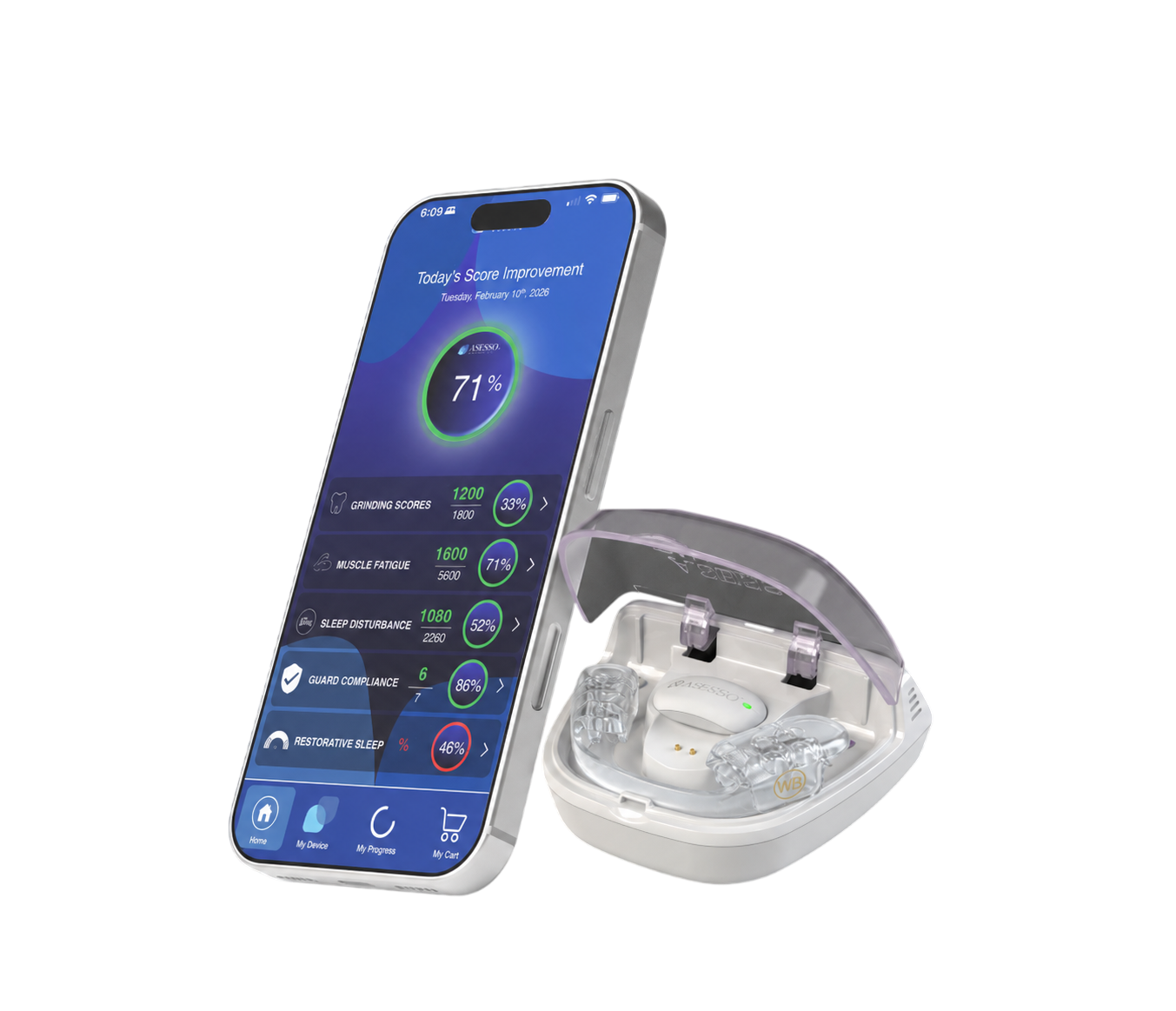
Biofeedback takes the same core idea interrupt the habit with awareness and automates the noticing part using a device. Small wearable sensors (some worn on the jaw, others integrated into oral appliances) detect muscle activity in real time and deliver a cue usually a vibration or sound the moment clenching starts, prompting you to consciously release.
Clinical studies using EMG (electromyography) biofeedback for daytime clenching have found reductions in muscle activity during training periods, and some research has suggested the effect can carry over into reduced nighttime muscle activity as well, though that connection needs more research to be considered established. This is a more structured, technology-assisted version of the same principle as the reminder-cue approach above some people find the automated, real-time feedback easier to stick with than a generic timer.
Technique 4: Stress and Trigger Management
Since psychological distress is one of the most consistently identified drivers of awake bruxism, addressing the underlying stress, not just the physical habit, is a legitimate part of the approach, not a separate topic.
- Identify your specific high-clenching contexts. For a lot of people this is concentrated work, commuting, or specific stressful situations rather than being constant throughout the day. Knowing your pattern makes the reminder-cue and habit-reversal techniques far more targeted.
- Build in brief stress-relief moments during known trigger periods. A few slow breaths before a stressful meeting, a short break during intense focus work, or simply pausing to do a jaw check at a predictable stress point in your day.
- Guided music or audio has shown up as a legitimate technique in the research on awake bruxism management, plausibly by giving the nervous system a lower-arousal state to settle into during the parts of the day when clenching is most likely.
Comparing the Techniques
| Technique | What It Requires | Best For |
|---|---|---|
| Habit reversal training | A few minutes of awareness-building, then ongoing self-monitoring | People who can identify a specific, recognizable pattern |
| External reminder cues | Setting alarms or visual prompts | People who want a low-effort, no-cost starting point |
| Biofeedback (wearable device) | A sensor device, real-time cueing | People who've tried manual awareness and want automated support |
| Stress/trigger management | Identifying personal stress patterns, brief relaxation practices | People whose clenching is clearly tied to specific stressful contexts |
What This Won't Fix
Behavioral training targets the conscious, waking part of bruxism it does essentially nothing for sleep bruxism, which happens outside your awareness entirely. If you have both awake and sleep bruxism (not uncommon), expect these techniques to help with the daytime piece while a night guard continues to be the standard protective measure for what happens while you sleep.
It's also worth being realistic about timeline and effort: this is retraining an unconscious habit, and habit reversal for anything typically takes weeks of consistent practice, not days. Expecting immediate elimination of the habit is likely to set you up for discouragement rather than progress.
When to See a Dentist Alongside Self-Training
Behavioral techniques are a reasonable first step, but they're not a substitute for dental evaluation if you notice:
- Tooth wear, sensitivity, or damage that suggests significant clenching force
- Jaw pain or soreness that persists despite reduced daytime clenching
- Headaches that seem connected to jaw tension
- Clenching severe enough that it's affecting your ability to concentrate or work
A dentist can assess for physical damage, rule out or identify a TMD component, and if daytime clenching is severe discuss whether a daytime appliance makes sense alongside behavioral training, rather than instead of it.
Frequently Asked Questions
Can you really train yourself out of daytime teeth clenching?
There's genuine, if still developing, evidence that behavioral techniques, habit reversal, reminder cues, biofeedback reduce awake bruxism. It requires consistent practice over weeks, not an overnight fix, and evidence quality is still considered low by researchers, though the direction of effect is generally positive.
What's the difference between awake bruxism and sleep bruxism?
Awake bruxism happens while you're conscious and is more closely tied to stress, anxiety, and concentration, while sleep bruxism is a sleep-related movement disorder that happens below conscious awareness. Behavioral training works for awake bruxism specifically; it doesn't address sleep bruxism.
How do I even know if I clench my jaw during the day?
Since it's often unconscious, the easiest way to find out is to start checking deliberately set a few random reminders throughout a normal day and simply notice whether your teeth are touching each time.
What is "lips together, teeth apart" and does it actually help?
It's a simple cue some clinicians use to describe the jaw's natural resting position teeth apart, tongue lightly resting on the roof of the mouth. Practicing a return to this position when you notice clenching is a basic form of the competing-response technique used in habit reversal training.
Do biofeedback devices for jaw clenching actually work?
Clinical studies using EMG biofeedback have shown reductions in daytime muscle activity during training, which is a genuinely useful data point, though larger, higher-quality trials are still needed before it can be called a proven standard treatment.
How long does it take to break a daytime clenching habit?
There's no fixed timeline in the research, but habit reversal techniques generally require weeks of consistent practice rather than days. Gradual reduction, not instant elimination, is the realistic expectation.
Is stress really the main cause of daytime clenching?
It's one of the most consistently identified drivers, along with intense concentration, and research has found a dose-response relationship between psychological distress and awake bruxism behaviors more distress tends to correlate with more clenching.
Will fixing my daytime clenching also stop my nighttime grinding?
Not necessarily the two are thought to have different underlying mechanisms. Some research suggests daytime muscle-activity training may have some carryover effect on nighttime activity, but that connection isn't well established, and a night guard remains the standard protection for sleep bruxism regardless.
Should I see a dentist before trying these techniques on my own?
It's reasonable to start with basic awareness and reminder techniques on your own, but if you already have tooth wear, jaw pain, or headaches, it's worth a dental evaluation alongside self-training rather than waiting to see if behavioral changes alone resolve existing damage.
Are there apps or devices specifically designed to help with jaw clenching?
Wearable biofeedback devices designed for jaw muscle activity exist and have some clinical research behind them, though this is a developing area ask your dentist if they have a recommendation suited to your specific situation.
What You Can Do Now
- Awake bruxism is one of the more trainable forms of bruxism, since it happens while you're conscious
- Habit reversal training, reminder cues, biofeedback, and stress management all have real, evolving evidence behind them
- Give these techniques real time weeks, not days before judging whether they're working
- Pair self-training with a dental evaluation if tooth wear, jaw pain, or headaches are already present
WAKEBRIGHT While you work on breaking the daytime clenching habit, the Wakebright Guard can protect your teeth from any grinding that continues at night.
This article is for informational purposes only and does not constitute medical advice. Consult a licensed dentist or healthcare provider for diagnosis and treatment recommendations specific to your situation.
References
- Management of awake bruxism: a systematic review. BMC Oral Health (2025). https://pmc.ncbi.nlm.nih.gov/articles/PMC13037066/
- Effectiveness of Biofeedback in Individuals with Awake Bruxism Compared to Other Types of Treatment: A Systematic Review. International Journal of Environmental Research and Public Health (MDPI). https://www.mdpi.com/1660-4601/20/2/1558
- Electromyogram biofeedback training for daytime clenching and its effect on sleep bruxism. Journal of Oral Rehabilitation (PubMed). https://pubmed.ncbi.nlm.nih.gov/25256380/