Can Dental Issues Cause Migraines? The Jaw-Migraine Connection

The Jaw-Head Connection: An Often-Overlooked Link
Many migraine sufferers never realize that their jaw could be a significant contributor to their headaches. The temporomandibular joint (TMJ) and its surrounding muscles are connected, both neurologically and physically, to the structures and nerves that generate migraines. When jaw function is compromised or the jaw muscles are stressed, that affects pain signaling throughout the head and neck, sometimes triggering migraines or dramatically worsening existing ones.
The link between dental and jaw issues and migraines is well established in the clinical literature, yet it is often overlooked in migraine management. Many people cycle through migraine medications, lifestyle changes, and dietary tweaks while their jaw tension goes completely unaddressed. Treating the jaw component often produces relief that other interventions cannot achieve on their own.
The mechanism is neither mysterious nor speculative. The trigeminal nerve, the primary pain-signaling nerve for the face and jaw, connects extensively with the migraine-generating pathways in the brain. When jaw muscles are tense, when teeth are ground at night, or when the bite is misaligned, sensory input from the jaw intensifies, activating and amplifying migraine circuits. Reducing jaw muscle load and stress lowers this migraine-triggering input.
If you experience both jaw discomfort and migraines, examining the connection could unlock relief. Even if your migraine history predates any obvious jaw problems, addressing jaw muscle tension might significantly improve your headache patterns. The jaw component is treatable without invasive procedures, which makes it a practical intervention worth exploring.
Bruxism: Teeth Grinding as a Migraine Trigger
Bruxism, meaning involuntary teeth grinding or jaw clenching, is one of the strongest dental connections to migraines. During sleep, many people grind their teeth forcefully, subjecting the jaw muscles and joints to repeated, high-impact stress. Others clench during the day, especially during stress, concentration, or sleep transitions. Both habits fatigue the jaw muscles and heighten the nervous system's state of arousal.
Nighttime grinding is especially problematic because you cannot consciously prevent it. Your brain initiates grinding episodes during lighter sleep or arousal responses, and you grind unconsciously through the entire episode. Over a single night, hundreds of grinding episodes create cumulative muscle fatigue. Over weeks and months, that builds into chronic jaw muscle tension that lingers even while you are awake.
Teeth grinding triggers migraines through several mechanisms. First, the repetitive impact and muscle contraction directly stress the trigeminal nerve and the surrounding tissues. Second, the muscle fatigue itself amplifies pain sensitivity across the craniofacial region, meaning the face, head, and jaw. Third, grinding-induced tension activates stress responses that lower the migraine threshold, making migraines more likely to fire from other triggers.
People with bruxism often report that their migraines rise and fall with grinding intensity. On nights when grinding is severe, migraines are more likely the next day. On nights when grinding is minimal, migraine frequency drops. That correlation suggests that reducing grinding-induced muscle load directly reduces migraine risk. This is exactly why nighttime jaw support, which prevents or minimizes grinding stress, can significantly help migraine sufferers.
TMD and the Migraine Connection
Temporomandibular disorder (TMD) and migraines are neurologically linked. Research shows that migraine sufferers have significantly higher rates of TMD, and the reverse holds too: people with TMD have higher migraine prevalence. This is not coincidence. Both conditions activate overlapping pain pathways, and jaw muscle tension directly amplifies the migraine-generating circuits.
TMD pain itself can trigger migraines. A person might feel jaw discomfort from TMD, and within hours a full migraine develops. The jaw pain is not the migraine; it is a triggering event in someone with migraine susceptibility. The jaw muscle tension, joint stress, and elevated pain signaling from TMD push the nervous system toward the migraine threshold.
The shared neurological pathways explain the connection. Both the jaw (through the trigeminal nerve) and the migraine-generating structures (deep in the brainstem) communicate through the same neural networks. When jaw input is heightened, whether from TMD pain, muscle tension, or grinding, it amplifies the migraine circuits. Reducing jaw input calms these shared pathways, lowering migraine frequency and severity.
Many migraine sufferers with TMD find that treating their jaw problems substantially improves their headaches. Not every migraine disappears, since migraine is multifactorial, but the jaw contribution often represents a significant and addressable component. Addressing TMD is not a cure-all, yet for many people it is the missing piece that transforms their migraine management.
Bite Misalignment and Headache Cascades
Malocclusion, meaning misalignment of the upper and lower teeth, forces the jaw muscles to work asymmetrically to chew efficiently. One side may carry more load, the muscles must compensate, and tension develops unevenly. Over time, chronic asymmetrical muscle tension contributes to headaches. Some people with significant bite misalignment report dramatic migraine reduction after orthodontic correction, which demonstrates the direct impact of dental alignment on migraine pathways.
Bite problems create a mechanical disadvantage. Picture pushing a door with misaligned hinges: the effort required climbs. Chewing with misaligned teeth works the same way, demanding greater muscle effort. That sustained effort fatigues the jaw muscles through the day. Fatigued, tense muscles feed more pain input into the trigeminal nerve. That elevated baseline input lowers the migraine threshold, making migraines more likely.
Some people develop compensatory postural patterns to work around bite problems. They shift their head or neck position to chew more comfortably, changing how the neck and shoulder muscles engage. That postural compensation cascades upward, affecting upper cervical spine alignment and increasing muscle tension throughout the head and neck. The resulting widespread tension often shows up as chronic headaches or frequent migraines.
Correcting significant bite problems sometimes requires orthodontic intervention, which sits beyond at-home management. However, reducing bite-related muscle tension through nighttime jaw support and daytime stress reduction helps bridge the gap. Even people already in orthodontic treatment benefit from addressing the muscle tension component, because treatment works better when the muscles are not fighting the realignment process.
The Stress-Clenching-Migraine Cycle
Stress directly triggers jaw clenching and teeth grinding through the sympathetic nervous system. When stressed or anxious, most people unconsciously tighten the jaw muscles, sometimes severely. This happens both during waking hours (daytime clenching) and during sleep (nocturnal grinding). The clenching itself is a stress response, and the resulting muscle fatigue and tension keep the stress state going.
This creates a vicious cycle: stress causes clenching, clenching fatigues muscles and amplifies pain signaling, amplified pain input triggers migraines, migraines raise stress about future headaches, and that stress drives still more clenching. Without breaking this cycle, people get locked into a pattern of worsening headaches. The cycle feeds on itself, and migraine frequency escalates.
The jaw offers a practical intervention point for this cycle. By reducing jaw muscle clenching, particularly during sleep when you cannot consciously prevent it, you interrupt the cycle directly. Less clenching means less muscle fatigue, less amplified pain signaling, and lower migraine activation. Breaking the jaw component often lets other stress management efforts work more effectively.
People practicing stress reduction techniques such as meditation, deep breathing, or yoga often find they are more effective when combined with nighttime jaw support. It is as if the stress management sets a ceiling on overall tension, and jaw support removes the baseline jaw muscle tension that was pushing people past that ceiling toward the migraine threshold.
Managing the Dental-Migraine Connection
If you experience both jaw issues and migraines, addressing the jaw component is a logical, evidence-based strategy. Start with professional assessment: see a dentist or TMJ specialist who can evaluate your bite, check for evidence of bruxism (tooth wear, muscle tenderness), and assess your jaw function. Understanding your specific jaw contribution guides targeted intervention.
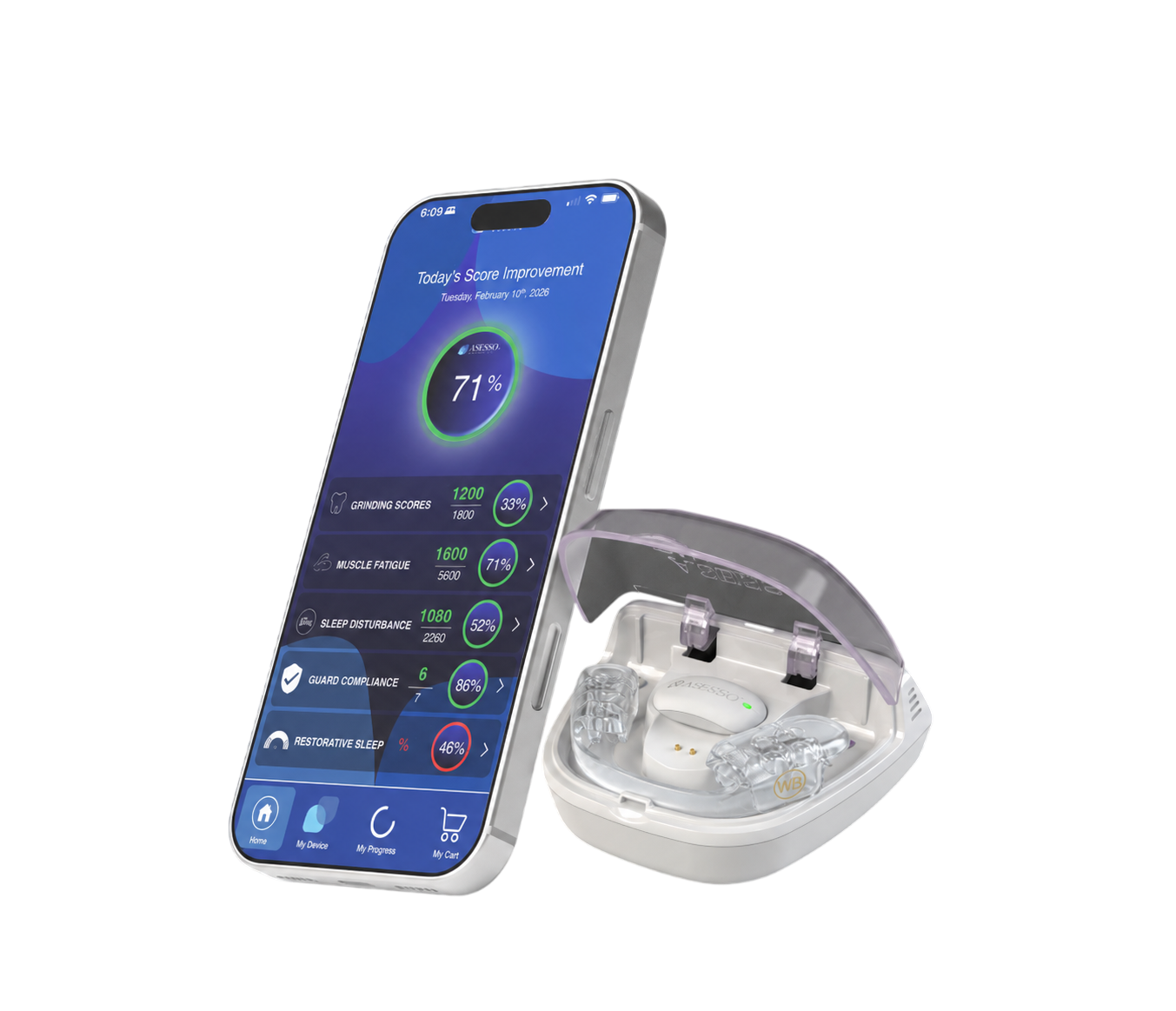
Nighttime protection is crucial when bruxism is present. A night guard, also called an occlusal splint, protects the teeth from grinding damage and can reduce grinding intensity by changing jaw position. Standard night guards, however, focus on tooth protection rather than jaw muscle load management. The Wakebright Grind Guard, designed specifically to reduce jaw muscle load during sleep, takes a different approach: by supporting the jaw in a more relaxed position, it addresses the muscle fatigue component directly.
Daytime habits matter enormously. Awareness of daytime clenching, checking yourself periodically through the day, helps. When you notice clenching, consciously relax your jaw and drop your tongue. Stress management practices such as deep breathing, meditation, or progressive muscle relaxation lower overall tension. Physical therapy or jaw exercises prescribed by a specialist can improve muscle balance and reduce tension.
Bite correction may be necessary if malocclusion is a significant contributor. That could involve orthodontics, restorative dental work, or other interventions. These are long-term projects that benefit from concurrent jaw muscle management, the shorter-term solutions that reduce muscle tension while the dental correction is underway. Combining approaches works better than addressing the bite alone.
What You Can Do Now
The jaw and migraines are neurologically connected through the trigeminal nerve, which processes both jaw sensation and migraine pain.
Teeth grinding (bruxism) is a strong migraine trigger, since nightly grinding fatigues muscles and amplifies pain signaling to the brain.
TMD and migraines often coexist, because jaw disorder pain and muscle tension directly activate the migraine-generating pathways.
Stress-induced clenching creates a cycle: stress leads to clenching, which leads to muscle fatigue, then amplified pain, then migraines, then more stress.
Reducing jaw muscle load during sleep directly interrupts the jaw-migraine cycle and often produces substantial headache improvement.
Frequently Asked Questions
Q: Can dental problems actually cause migraines?
Yes. Bruxism (teeth grinding), TMD (jaw disorder), bite misalignment, and jaw muscle tension all directly activate the trigeminal pathways that generate migraines. For many people, addressing these dental and jaw factors significantly improves their migraine patterns.
Q: What's the connection between teeth grinding and migraines?
Teeth grinding fatigues the jaw muscles, heightens trigeminal nerve activation, and intensifies pain signaling to the brain. That amplified input directly triggers migraines in susceptible people, especially after nights of heavy grinding.
Q: Do all migraine sufferers have TMD?
No, but migraine sufferers have significantly higher TMD rates than the general population, and the reverse holds too. The connection is strong but not universal. Many people have migraines from other causes, while some carry a meaningful jaw component worth addressing.
Q: How does jaw muscle tension trigger migraines?
The jaw muscles are innervated by the trigeminal nerve, which is central to migraine generation. Tense, fatigued muscles send amplified pain signals through this nerve. In people with migraine susceptibility, that amplified input can set off full migraine episodes.
Q: Can correcting my bite help my migraines?
For some people, yes. If bite misalignment is significant and forcing compensatory muscle tension, orthodontic correction can reduce headaches. Bite correction is a long-term process, though, so reducing muscle tension at the same time helps faster by addressing the tension component directly.
Q: What can I do immediately to reduce jaw-related migraines?
Start with awareness of daytime clenching and consciously relax your jaw whenever you notice it. Manage stress through breathing exercises or meditation. If you grind at night, use a night guard or jaw support. And see a dentist or TMJ specialist for assessment.
Q: Does reducing jaw muscle load actually help migraines?
Yes. Extensive real-world experience and research confirm that reducing jaw muscle load, especially during sleep, significantly reduces migraine frequency in people whose migraines have a jaw component. Many people report dramatic improvement.
WAKEBRIGHT | If your migraines have a jaw component, especially if you grind your teeth at night, addressing jaw muscle load during sleep can transform your migraine pattern. The Wakebright Grind Guard is designed precisely for this: reducing jaw muscle fatigue during the hours when clenching and grinding cause the most damage. This article is for educational purposes only and does not constitute medical or dental advice. Please consult a qualified healthcare provider for personalized guidance.