Bruxism (Teeth Grinding & Jaw Clenching): What Your Jaw Is Trying to Tell You

You wake with a dull ache behind your eyes. Your jaw feels tight before your morning coffee is even poured. Your partner mentions, once again, that you were grinding your teeth in the night. Sound familiar?
Bruxism, the clinical term for teeth grinding and jaw clenching, affects an estimated 75% percent of adults during sleep. The reported numbers tend to be lesser because it is one of the most underdiagnosed conditions that most people face. But here is what most people never hear: the real problem is not only what happens to your teeth. It is what happens inside your jaw muscles, and the ripple effects that sustained muscle tension sends through your head, your neck, and your sleep cycle.
At Wakebright Guards, we approach bruxism differently. Not as a dental problem, but as a muscular behavior. That reframe changes everything about how you can find lasting relief.
What Is Bruxism?
Bruxism is the habitual, often unconscious grinding, gnashing, or clenching of the teeth. It can happen during the day (awake bruxism) or overnight (sleep bruxism), and many people have no idea they are doing it until symptoms, or a concerned partner, bring it to their attention.
Two Types of Bruxism
Sleep bruxism takes place during sleep and is classified as a sleep-related movement disorder. Because you are unconscious, the clenching forces can far exceed anything you would produce while awake, sometimes surpassing 250 pounds per square inch.
Awake bruxism leans toward clenching rather than grinding and is commonly triggered by stress, concentration, or emotional tension. You might catch your teeth pressed firmly together while working, driving, or feeling anxious. Both types trace back to the same root issue: prolonged, excessive activation of the muscles of mastication, the jaw muscles responsible for chewing.
The Real Problem: It's a Muscle Story, Not Just a Tooth Story
Traditional conversations about bruxism revolve around tooth damage: worn enamel, cracked teeth, fractured restorations. Protecting your teeth matters, but treating only the dental side leaves the root cause running untouched.
Your jaw muscles, particularly the masseter and temporalis, rank among the most powerful muscles in your body relative to their size. When they fire repeatedly and forcefully across hours of sleep, the cumulative muscular load becomes enormous.
That sustained engagement drives jaw soreness and facial tension, because these muscles fatigue like any overworked tissue. It generates headaches and pressure as tension radiates upward from the jaw into the temples, the forehead, and the space behind the eyes. It tightens the neck and shoulders, since muscular tension never stays politely in one place. It disrupts sleep, because even when you never consciously wake, elevated muscle activity interferes with the restorative sleep stages. And it can produce ear pressure and tinnitus-like sensations, given how close the jaw muscles sit to the structures of the ear.
Protecting teeth without addressing the muscle load is like putting in earplugs during a storm and hoping the damage stops there.
What Causes Bruxism?
Bruxism is multifactorial, meaning several factors usually converge to trigger it or make it worse.
Damage to the Articular Disc
The primary cause is the damage to the articular disc near the mandible. Unfortunately, it is easier than we think, to displace or damage this disc, which can happen due to a fall in the playground or a blow to the face. When this disc is displaced, it causes the 4 muscles of mastication (masseter, temporalism and the 2 pterygoid muscles) to act and try to restore the disc in its original position. Unfortunately, once displaced, it cannot be permanently re-positioned. The resulting action is a grinding action that is caused by the muscles to reposition the articular disc.
Stress and Anxiety
Emotional stress is one of the most frequently cited contributors to both sleep and awake bruxism. When the body sits in a heightened state of arousal, whether physical or psychological, the jaw muscles often become the outlet where that tension lands.
Sleep Architecture Disruption
Overnight bruxism episodes tend to cluster around transitions between sleep stages, especially in the lighter phases. Poor sleep quality, fragmented sleep, and sleep disorders such as sleep apnea have all been tied to increased bruxism activity.
Caffeine, Medications, and Substances
Heavy caffeine intake, especially later in the day, is associated with more bruxism episodes during sleep. Certain medications, particularly SSRIs, antipsychotics, and stimulant-based drugs, have been linked to bruxism as a side effect. Alcohol, despite its sedative reputation, can increase nighttime grinding by disrupting sleep architecture.
Neuromuscular Patterns
Bruxism carries a neuromuscular component: a learned, patterned activation of the jaw muscles that can turn habitual over time. This explains why people who have bruxed for years often keep going even after the obvious stressors disappear. The pattern has been etched into the nervous system's muscle activation sequences.
Recognizing the Signs of Bruxism
Because sleep bruxism happens while you are unconscious, awareness depends largely on symptoms and outside observation. Common signs include morning jaw soreness or stiffness, frequent headaches especially on waking, facial muscle fatigue or pain, worn or flattened tooth surfaces flagged by your dentist, heightened tooth sensitivity, and indentations along the sides of the tongue from pressing against the teeth during clenching. The most visual indication is when you front teeth (incisors) are flat at the top.
Disrupted, unrefreshing sleep is another significant indicator. If several of these ring true for you, bruxism deserves your serious attention, not only for your teeth but for how it shapes your daily comfort and overall wellbeing.
The Muscle-Load Reduction Approach
The Wakebright perspective rests on one core insight: reducing sustained jaw muscle load is the most direct way to break the cycle of tension, discomfort, and sleep disruption that bruxism creates.
A grind guard system built with this in mind works by mechanically limiting how fully the muscles of mastication can clench. Worn correctly, the jaw guard positions the jaw so that the masseter and temporalis cannot complete a full, forceful contraction. The muscles still fire, but the full clenching motion never lands.
Why does that matter? Lower peak muscle force means less cumulative fatigue and tension building up. Interrupted clenching patterns can, over time, help retrain the jaw away from habitual over-engagement. And quieter nighttime muscle activity creates conditions where genuine, restorative rest becomes possible.
This is fundamentally different from a tooth guard that simply cushions enamel against enamel. Tooth protection becomes a by-product. Muscle-load reduction is the mechanism.
What You Can Do Now
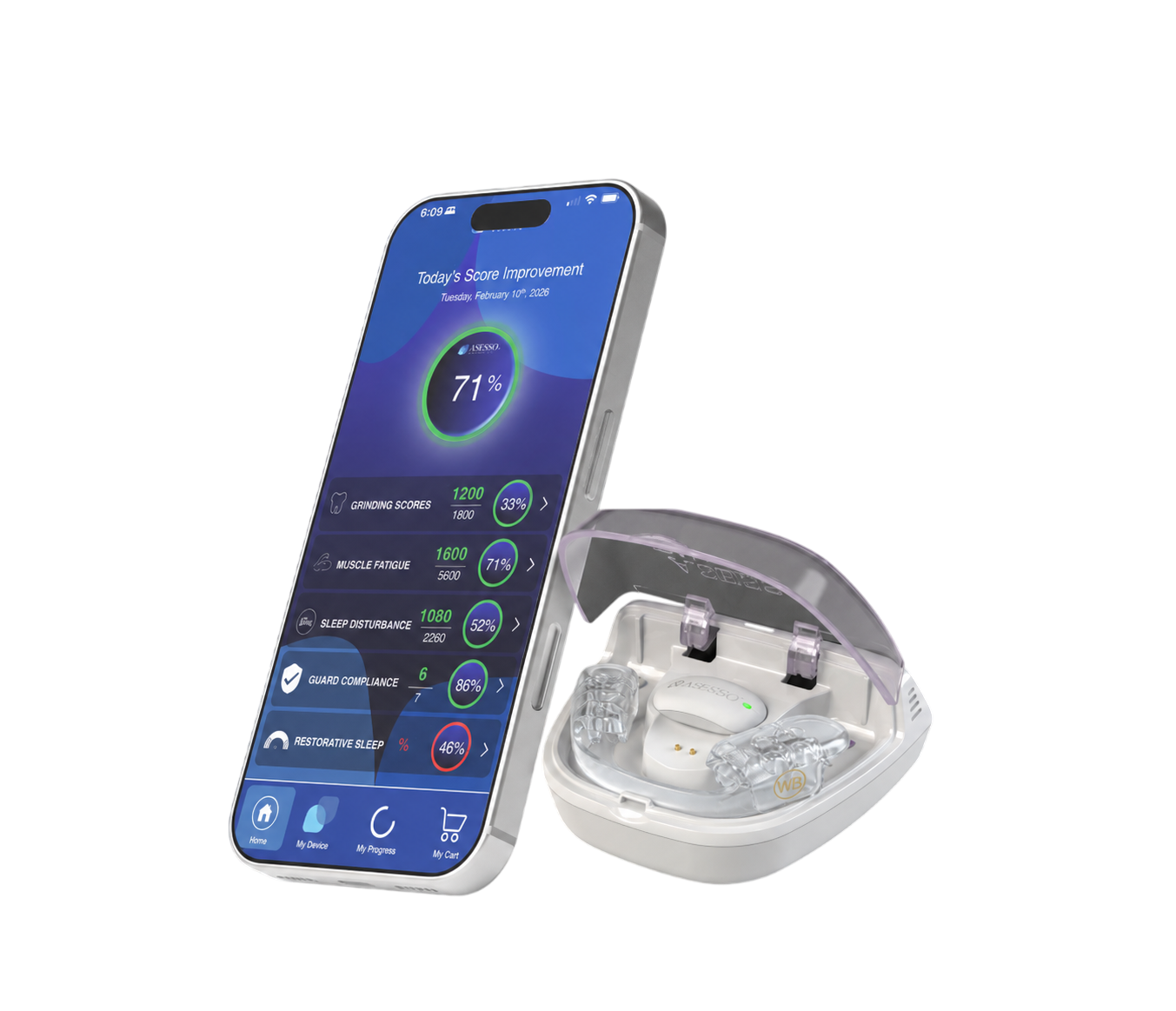
Track your symptoms daily. Log jaw soreness (0 to 10), whether a morning headache appeared, and your sleep quality. Pattern recognition is the fastest route to identifying bruxism. You can also use the Asesso Health App to track you symptoms and align that with your sleep.
Audit your caffeine timing. Try cutting off caffeine after 1 to 2 PM and watch whether your sleep-related jaw symptoms improve over two to three weeks.
Build a pre-sleep jaw relaxation ritual. Gentle jaw massage, a warm compress on the masseter and temples, and conscious jaw positioning (teeth apart) before bed can all lower overnight tension.
Check your jaw position during the day. Your teeth should touch only when you are actively chewing or swallowing. Each time you notice contact, consciously let the jaw relax.
Consider a mechanism-led grind guard. Not every night guard addresses muscle load. A system built around reducing jaw muscle engagement treats the source of your symptoms rather than the surface.
Use wearable sleep data as feedback. Compare your sleep efficiency before and after introducing a grind guard to watch for directional improvement in rest quality.
Frequently Asked Questions
Q: Is bruxism dangerous if left untreated?
Yes. Over time, untreated bruxism can lead to irreversible enamel loss, cracked teeth, failed dental restorations, temporomandibular joint damage, chronic headaches, and seriously disrupted sleep. The earlier it is addressed; the less cumulative damage builds up. Enamel, once lost, never regenerates.
Q: Can stress alone cause bruxism?
Stress is among the strongest contributors, but it is rarely the whole story. Bruxism usually develops when several factors converge: articular disc displacement, stress, sleep disruption, caffeine, certain medications, and neuromuscular patterns that have hardened into habit. Managing stress helps, yet a comprehensive approach that addresses the muscular mechanism generally delivers more complete relief.
Q: Does a standard night guard fix bruxism?
A standard night guard shields the teeth from direct contact but does nothing to lower the force the jaw muscles generate. That is why so many people still wake with headaches and jaw soreness while wearing one. A grind guard system built specifically to reduce jaw muscle load targets the muscular source of the symptoms rather than just the dental surface effects.
Q: Can bruxism affect sleep quality?
Absolutely. Sleep bruxism episodes come paired with microarousals, brief dips out of deeper sleep that keep the brain from completing its restorative cycles. Many heavy bruxers wake up tired despite plenty of time in bed. Quieting jaw muscle activity during sleep can directly lift sleep efficiency and morning energy.
Q: How do I know if jaw muscle stress is the source of my morning headaches?
A headache that is already there the moment you wake, before anything has happened to trigger it, points strongly toward overnight jaw muscle activity. When those headaches arrive alongside jaw soreness, facial tension, or tight temples, the jaw muscles are very likely the source. Tracking these patterns for two weeks and sharing them with a healthcare provider can help confirm the connection.
WAKEBRIGHT | The Wakebright grind guard system is built around reducing the sustained jaw muscle load that drives bruxism symptoms. Across more than 20 years of real-world use, users have reported fewer headaches, better jaw comfort, and more restorative sleep. If you have been living with the morning soreness and fatigue that bruxism brings, and a standard night guard has never delivered lasting relief, it may be time to think about the muscle, not just the teeth. Visit wakebrightguards.com to learn more and begin your jaw health journey today. This article is for educational purposes only and does not constitute medical or dental advice. Please consult a qualified healthcare provider for personalized guidance.