Broken Fillings and Cracked Crowns: The Grinding Problem Behind "Bad Luck"

If you've cracked a crown, chipped a filling, or had a repair fail sooner than expected more than once it can start to feel like you just have unlucky teeth. The research tells a more specific story, and it's one worth knowing: bruxism has long been recognized as a major driver of restoration failure, though newer research is also revealing some genuinely interesting nuance about which restorations actually hold up.
The Case Against "Bad Luck"
Fixed dental restorations crowns, bridges, and similar work have well-documented survival rates in the general population: a critical review of the topic cites systematic review data showing roughly 94% survival at 5 years and 89% at 10 years for conventional fixed restorations. The most common technical failures behind that attrition are loss of retention (the restoration coming loose) and fracture of the material itself and the same review notes these failures occur disproportionately in patients with bruxing habits.
The force involved explains why. Grinding and clenching can generate significantly more force on your teeth than normal chewing commonly cited estimates put bruxism-related forces at several times greater than typical chewing loads. Case examples documented in prosthodontic literature illustrate just how dramatic the effect can be: one report described a patient with a long history of fractured restorations across multiple materials metal-ceramic and gold-acrylic constructions — including a newly cemented crown that suffered porcelain fractures within a single year, attributed to excessive loading from bruxism.
What Actually Fails, and How
Restorations fail in a few characteristic ways under bruxism-related stress:
Loss of retention. The cement bond holding a crown or bridge to your tooth can gradually weaken under repeated, excessive force, eventually allowing the restoration to loosen or come off entirely.
Material fracture. Porcelain, composite, and even metal components can crack or chip under sustained heavy loading, particularly at thin edges or where different materials meet within the same restoration.
Accelerated wear. Beyond outright failure, bruxism can simply wear down restorative materials faster than they'd wear under normal use, shortening their effective lifespan even without a dramatic breakage event.
A broader review of factors affecting single-unit crown longevity specifically lists bruxism alongside other biomechanical and occlusal factors improper occlusal adjustment, poor margin design, loss of tooth vitality as a recognized contributor to premature restoration failure.
A Recent Wrinkle: Modern Materials May Be More Bruxism-Resistant Than Once Assumed
Here's where the story gets genuinely more interesting than a simple "grinding breaks everything" narrative. Sleep bruxism has traditionally been treated as a strong contraindication for all-ceramic crowns, with many clinicians avoiding materials like zirconia or lithium disilicate in bruxing patients specifically because of the failure risk. A randomized controlled trial published in 2026 directly tested this long-standing assumption comparing monolithic lithium disilicate and zirconia molar crowns in patients with and without sleep bruxism (confirmed with electromyographic monitoring, a relatively rigorous assessment method) over a 3-year period.
The result: comparable survival and complication rates between the bruxism and non-bruxism groups. The study's authors concluded that sleep bruxism alone may not increase complication or failure rates for these modern ceramic materials over the timeframe studied a genuine challenge to the standard clinical assumption, even though the review of this study also noted real limitations, including a relatively short 3-year follow-up period for evaluating long-term ceramic performance.
This tracks with other research on modern zirconia restorations specifically: one retrospective study following patients with extensive tooth wear (including self-reported bruxism) over up to six years found a 99.7% overall success rate, and another study of both bruxers and non-bruxers found comparable 99.6% survival and success rates regardless of bruxism status.
The Research Is Genuinely Contradictory
To be fully honest about this: not all the evidence points the same direction. One study specifically examining zirconia restoration complications found that 80% of catastrophic failures and roughly 77% of all complications occurred specifically in patients with clinical signs of bruxism a striking concentration even though, in that same study, the overall difference in survival rate between bruxers and non-bruxers didn't reach statistical significance. Older materials and older prosthetic designs, meanwhile, have more consistently shown worse outcomes in bruxing patients across the literature.
The reasonable takeaway: bruxism remains a real, recognized risk factor for restoration failure, particularly for older materials, certain restoration types, and cases of severe, unmanaged grinding — but modern high-strength ceramic materials appear considerably more resilient to bruxism-related forces than clinicians once assumed, and "your restoration failed because you grind your teeth" is a less absolute explanation than it used to be.
Failure Patterns at a Glance
| Factor | What Research Shows |
|---|---|
| General fixed restoration survival | ~94% at 5 years, ~89% at 10 years (broader population) |
| Common bruxism-related failure modes | Loss of retention, material fracture, accelerated wear |
| Older materials/case reports | Dramatic failures documented in heavy bruxers, sometimes within a year |
| Modern monolithic ceramics (RCT, 2026) | Comparable survival between bruxism and non-bruxism groups over 3 years |
| Zirconia restoration studies | Mixed some show bruxism concentrated among catastrophic failures; others show no significant survival difference |
What This Means If You've Had Repeat Restoration Failures
If you've gone through multiple failed fillings or crowns, a few things are worth considering rather than chalking it up purely to chance:
Get evaluated for bruxism specifically, if you haven't been already, since it remains a recognized risk factor worth identifying and managing regardless of which specific research findings apply to your case.
Ask about material choice. Given the newer research on modern ceramics, it's worth discussing with your dentist whether a different restoration material might hold up better for your specific situation, rather than assuming all materials fail equally under bruxism.
Protect existing and future restorations with a night guard, since reducing the force reaching your restorations is a reasonable step regardless of exactly how much any individual failure was attributable to grinding versus other factors.
Consider occlusal design, since the broader restoration-longevity research also points to factors like proper occlusal adjustment and margin design as contributors to restoration success meaning how a restoration is placed and adjusted matters alongside the material itself.
Frequently Asked Questions
Does bruxism really cause crowns and fillings to fail more often?
It's a recognized risk factor a critical review of prosthetic treatment and bruxism found technical failures like loss of retention and material fracture occur disproportionately in bruxing patients. However, newer research on modern ceramic materials has found comparable survival rates between bruxism and non-bruxism patients, suggesting the connection is more nuanced than previously assumed.
Are some crown materials more resistant to bruxism than others?
Emerging research suggests modern monolithic ceramics like zirconia and lithium disilicate may hold up better under bruxism-related forces than once assumed, with some studies showing success rates above 99% regardless of bruxism status. Older materials and certain restoration designs have more consistently shown worse outcomes in bruxing patients.
If my crown broke, does that mean my bruxism is severe?
Not necessarily restoration failure can result from multiple factors, including material choice, occlusal design, and placement technique, not just grinding intensity. It's worth a broader evaluation rather than assuming grinding severity alone explains a single failure.
How much more force does grinding put on teeth compared to normal chewing?
Bruxism-related forces are commonly described as several times greater than typical chewing loads, which is part of why the cumulative effect on restorations, especially over years of unmanaged grinding, can be substantial.
Will a night guard actually protect my crowns and fillings?
Yes a properly fitted night guard reduces the direct force reaching your restorations during grinding episodes, which is a reasonable and evidence-supported way to protect existing dental work regardless of which specific materials you have.
Should I avoid ceramic crowns entirely if I have bruxism?
Not necessarily, based on newer research a 2026 randomized controlled trial found comparable survival rates for modern ceramic crowns between bruxism and non-bruxism patients over three years, challenging the older assumption that ceramics should generally be avoided in bruxing patients. This is still a conversation to have with your dentist based on your specific case.
Why did my dentist warn me that ceramic crowns might not hold up with my grinding?
This reflects a long-standing, traditionally cautious clinical stance based on older research and case reports showing dramatic ceramic failures in bruxing patients. Some newer research is challenging this assumption for modern materials specifically, so it's a reasonable topic to revisit with your dentist.
How long should a crown last if I have bruxism and wear a night guard consistently?
There's no universal figure, since it depends on material, occlusal design, and how consistently the night guard is worn, but protecting a restoration from direct grinding forces is generally expected to meaningfully extend its functional lifespan compared to no protection at all.
Can implants fail due to bruxism the same way crowns and fillings do?
Research on this specifically has produced mixed results some studies have found higher complication rates in bruxers with dental implants, while others have found high success rates regardless of bruxism status, similar to the mixed picture seen with crown research.
Is it worth getting a night guard even if my restorations are made of a "bruxism-resistant" modern material?
Yes even materials that perform comparably well in bruxism research still benefit from reduced force exposure, and a night guard also protects your natural teeth from wear, which matters independent of your restoration material.
What should I ask my dentist if I've had repeated restoration failures?
Ask specifically whether bruxism has been evaluated as a contributing factor, whether a different restoration material might be more appropriate for your situation, and whether your bite and occlusion have been assessed as part of understanding why previous restorations failed.
Does this research mean bruxism isn't actually a big deal for dental work?
No it remains a recognized risk factor worth managing, particularly for severe or unmanaged grinding, and protecting restorations with a night guard remains a reasonable standard recommendation. The nuance is that modern materials may be more resilient than assumed, not that bruxism doesn't matter at all.
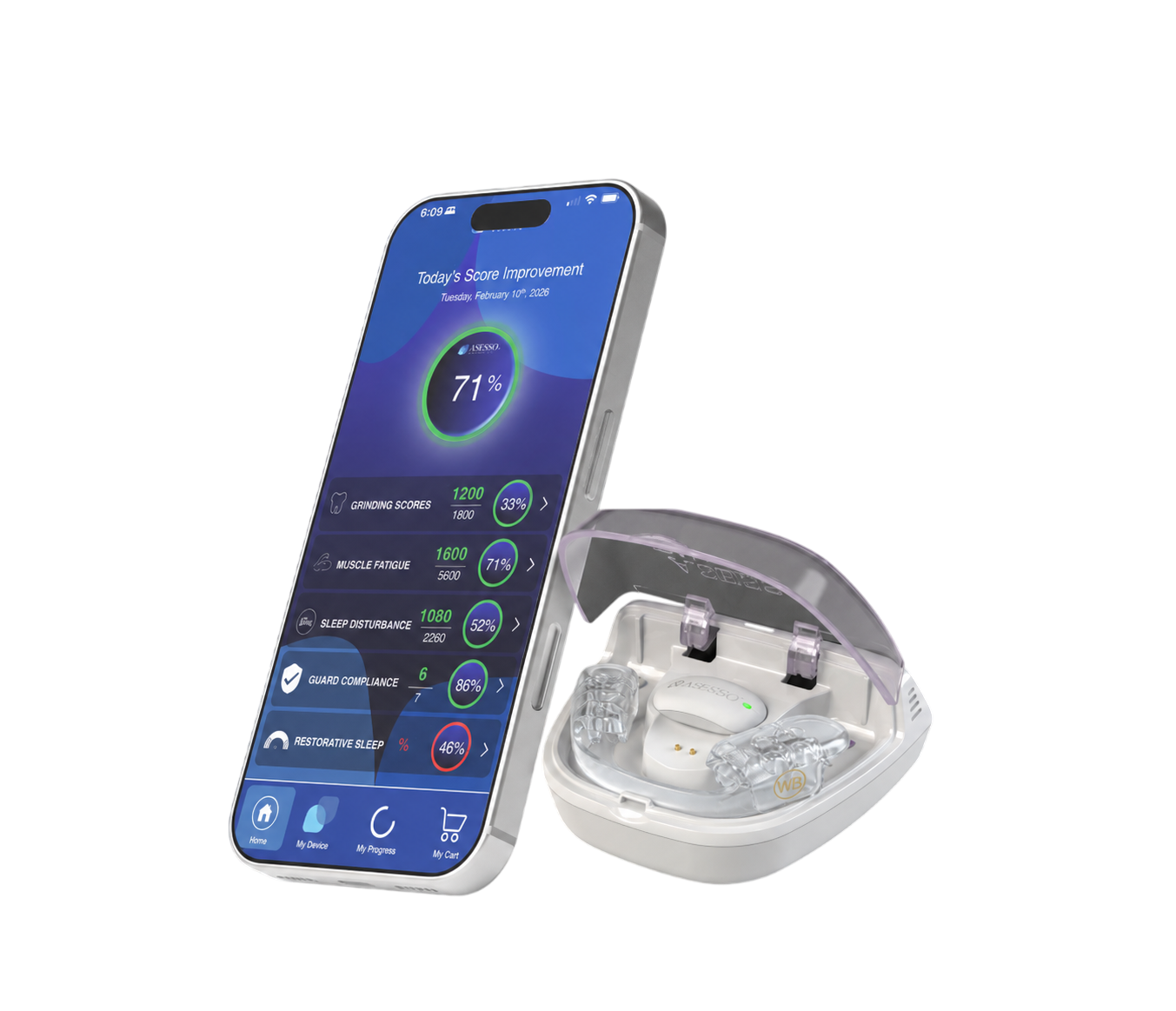
WAKEBRIGHT | If grinding is behind your repeated restoration failures, the Wakebright Guard protects both your natural teeth and your existing dental work from the same underlying force.
This article is for informational purposes only and does not constitute medical advice. Consult a licensed dentist or healthcare provider for diagnosis and treatment recommendations specific to your situation.
References
- "Bruxism and prosthetic treatment: A critical review." Journal of Prosthodontic Research, ScienceDirect. https://www.sciencedirect.com/science/article/pii/S1883195811000387
- "Do sleep bruxism patients experience higher complication or failure rates with monolithic lithium disilicate or zirconia molar crowns?" Evidence-Based Dentistry, Nature. https://www.nature.com/articles/s41432-026-01230-2
- "Survival and Success Rates of Monolithic Zirconia Restorations Supported by Teeth and Implants in Bruxer versus Non-Bruxer Patients: A Retrospective Study." PMC, National Library of Medicine. https://www.ncbi.nlm.nih.gov/pmc/articles/PMC8836879/
- "Biomechanical and Occlusal Factors Influencing the Longevity of Single-Unit Restorations: A Comprehensive Review." PMC, National Library of Medicine. https://www.ncbi.nlm.nih.gov/pmc/articles/PMC12258076/