Better Sleep Starts in Your Jaw: Practical Tips for More Restorative Rest

Most sleep advice sounds the same: avoid screens before bed, keep your room cool, go to sleep at the same time every night. These recommendations are not wrong; they are all evidence-based. But for a significant portion of people who still wake up exhausted despite doing everything "right," the missing piece has nothing to do with screen time or room temperature.
It has to do with the jaw.
Jaw muscle tension, whether from habitual daytime clenching, nighttime bruxism (teeth grinding), or chronic stress held in the face, is one of the most overlooked disruptors of sleep quality. Understanding this connection opens up a set of sleep improvement strategies that go beyond standard advice and address a root cause that millions of people carry to bed with them every night.
Why Sleep Quality Matters More Than Duration
Sleep is not passive downtime. It is an active, structured biological process during which the body does some of its most critical work: consolidating memories, regulating hormones, repairing tissue, and clearing metabolic waste products from the brain through the glymphatic system. The quality of this process depends on cycling through different sleep stages, including deep slow-wave sleep and REM sleep, without significant interruption.
When sleep is fragmented, even if total duration appears adequate, the brain and body do not complete these restorative cycles efficiently. The result is waking up tired, mentally foggy, physically tense, and more reactive to stress, all of which make the following night's sleep worse. It is a compounding cycle that can feel impossible to escape without identifying its drivers.
How Jaw Muscle Stress Disrupts Sleep
The jaw muscles are uniquely positioned to interfere with sleep quality through several overlapping mechanisms.
Nighttime bruxism and microarousals: sleep bruxism involves sustained, involuntary activation of the jaw muscles. Episodes tend to cluster around transitions between sleep stages, and each episode can trigger a brief arousal from deeper sleep, short enough to go unremembered but disruptive enough to prevent cycling into restorative stages.
Muscular tension and arousal physiology: when the nervous system remains in a state of arousal due to stress, caffeine, or screen exposure, the jaw muscles are often the first to reflect it. Falling asleep with jaw tension primes the nervous system for a night of increased muscular activity.
Pain signaling: sustained jaw muscle contraction produces gradual discomfort that, while not always severe enough to fully wake someone, can prevent the deep restorative sleep stages from being completed. Many people who wake feeling unrefreshed are experiencing the cumulative effect of overnight muscular tension.
6 Evidence-Based Strategies for Better Sleep
1. Establish a Consistent Sleep and Wake Schedule
The body's circadian rhythm functions best with consistency. Going to bed and waking at the same time every day, including weekends, reinforces this rhythm and makes falling asleep and waking naturally much easier. Irregularity in sleep timing is associated with increased sleep fragmentation, which is precisely the disruption that nighttime jaw clenching exacerbates.
2. Create a Wind-Down Ritual That Includes Jaw Relaxation
A deliberate pre-sleep routine signals the nervous system to shift from daytime demands to rest. Standard recommendations include dimming lights, avoiding screens, and engaging in calming activities. The Wakebright addition: include explicit jaw relaxation. Gentle jaw massage (circular motions on the masseter and temporalis), a warm damp cloth applied to the jaw and temples for 10 to 15 minutes, and conscious jaw positioning (teeth apart, tongue lightly on the palate) before bed can meaningfully reduce the muscle tension your jaw carries into sleep.
3. Optimize Your Sleep Environment and Position
Cool room temperatures (60 to 68 degrees Fahrenheit), darkness, and minimized noise support the physiological drop in core body temperature that facilitates sleep onset. From a jaw perspective, also consider sleep position. Sleeping on your stomach or with your face pressed into a pillow can compress the jaw and increase nighttime clenching activity. Side or back sleeping positions allow the jaw to rest in a more neutral, relaxed alignment.
4. Manage Caffeine Intake Strategically
Caffeine has a half-life of approximately 5 to 6 hours. A coffee consumed at 3 PM still has half its stimulant effect present at 8 PM. Caffeine is associated with increased bruxism episodes during sleep through its stimulating effects on the central and peripheral nervous systems. Moving your caffeine cutoff to early afternoon, around 1 or 2 PM, is a practical change with meaningful potential impact on nighttime jaw muscle activity.
5. Address Daytime Stress and Jaw Clenching
Sleep quality is significantly shaped by the physiological state you are in before you get into bed. A day of high stress, sustained clenching, and muscle tension does not simply dissolve the moment you pull back the covers. During the day, practice jaw awareness: check whether your teeth are touching and consciously separate them. The jaw's natural resting position has the teeth slightly apart, not in contact. Brief, regular check-ins interrupt the clenching habit that compounds overnight.
6. Reduce Muscular Load During Sleep with a Purpose-Built System
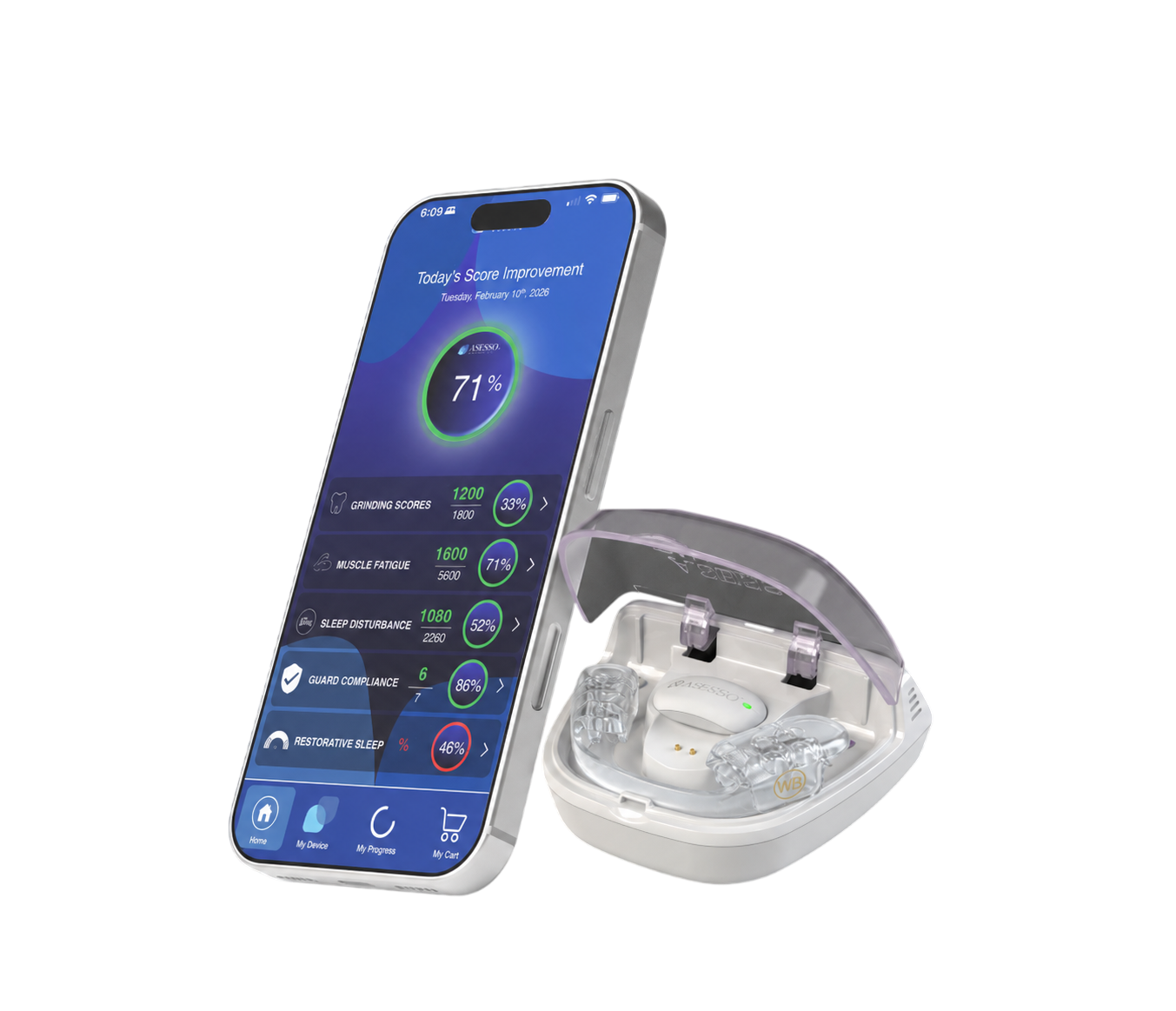
If nighttime bruxism is contributing to your sleep disruption, addressing it with a tool designed specifically to reduce jaw muscle load rather than just protect teeth is one of the most direct interventions available. A grind guard system that mechanically limits how fully the jaw muscles can clench reduces the sustained muscular activity that produces both direct discomfort and sleep fragmentation. Users who track sleep with wearable devices have observed directional improvements in sleep efficiency and reductions in disturbance events over time.
Tracking Your Sleep Progress
When implementing sleep changes, measuring progress objectively is valuable. Consumer wearables such as smartwatches and fitness trackers offer meaningful data on sleep duration, efficiency, and disturbance frequency. When evaluating jaw-related interventions like a grind guard, tracking your sleep metrics before and after provides directional insight into whether the muscular changes are translating into measurable improvements in rest quality. Look for trends over weeks rather than night-to-night variation, which is naturally high.
What You Can Do Now
Set a fixed wake time and hold to it for two weeks, including weekends. This single change carries the highest leverage of any sleep timing modification.
Track your jaw during the day. Your teeth should not be touching unless you are chewing or swallowing. Every time you find them in contact, consciously relax the jaw.
Apply heat to the jaw before bed every night for two weeks. A warm compress for 10 to 15 minutes is one of the simplest and most effective jaw tension resets available.
Cut caffeine before 2 PM for two weeks and monitor how your sleep quality and morning jaw symptoms respond.
Note whether your mornings improve after good sleep nights. If jaw soreness and headaches correlate with sleep quality, the jaw is almost certainly part of the picture.
Use wearable sleep data as a feedback loop. Establish a baseline before any intervention and track change over two-week periods to evaluate effectiveness objectively.
Frequently Asked Questions
Q: How do I know if jaw clenching is disrupting my sleep?
The clearest indicators are morning jaw soreness or stiffness (present before eating or talking), morning headaches concentrated in the temples, waking during the night without knowing why, and tracking data from a wearable showing frequent disturbances or poor sleep efficiency. If a bed partner has mentioned grinding sounds, that is a direct confirmation of sleep bruxism.
Q: Can fixing my jaw posture during the day actually improve my sleep?
Yes, meaningfully so. Daytime clenching habits build up muscular tension that carries into sleep. Developing the habit of keeping teeth slightly apart during waking hours reduces the baseline tension level the jaw muscles start the night with, which can lower the intensity of nocturnal clenching and improve sleep quality. This is a high-leverage, low-cost intervention that compounds over time.
Q: What is the ideal sleeping position for jaw health?
Back sleeping is generally optimal for jaw health, as it allows the jaw to rest in a neutral position without any compression. Side sleeping is acceptable if the pillow provides sufficient support without pushing the jaw forward or sideways. Sleeping on your stomach or with your face pressed into a pillow compresses the jaw and is associated with increased clenching activity, so it should be avoided when jaw symptoms are present.
Q: How long does it take to see improvement in sleep with a grind guard?
Most people begin noticing reduced morning jaw soreness within one to two weeks of consistent nightly use. Sleep quality improvements, as tracked by wearables, typically emerge over two to four weeks as the jaw muscles gradually adapt and lower their nocturnal activity level. Consistency matters: a guard worn three nights per week delivers only a fraction of the benefit of nightly use.
Q: Are sleep medications helpful for bruxism-related sleep disruption?
Sleep medications can improve sleep onset and sometimes duration, but they do not address the jaw muscle activity that fragments sleep. Some sedatives may actually reduce the microarousal response to bruxism episodes without reducing the episodes themselves, meaning the teeth continue to grind even if the person sleeps through it. Addressing the mechanical source of the disruption, the jaw muscle load, is a more targeted and sustainable approach.
WAKEBRIGHT | Better sleep is not only a matter of when you go to bed or whether your room is dark enough. For many people, the missing piece is what their jaw is doing for the eight hours they are supposed to be resting. Wakebright's grind guard system addresses sleep disruption from the angle that standard sleep hygiene advice ignores: reducing the sustained jaw muscle load that fragments sleep, produces morning discomfort, and leaves you tired despite adequate time in bed. Users tracking sleep with wearables have observed directional improvements in sleep efficiency and reduced disturbance counts. Visit wakebrightguards.com to learn more about the jaw-sleep connection. This article is for educational purposes only and does not constitute medical or dental advice. Please consult a qualified healthcare provider for personalized guidance.