Best Mouthguards for Teeth Grinding in 2026: A Buyer's Guide to Effective Solutions

Mouthguard Types: Understanding Your Options
Shop around for a teeth grinding mouthguard and you will quickly meet three main categories: over-the-counter boil-and-bite guards, custom-fitted flat-surface guards made through a dentist, and specialized load-reduction guards. Each category exists for different needs and delivers a different level of protection. Knowing what separates them is essential if you want a guard that genuinely handles your situation instead of one that merely feels protective.
Boil-and-bite guards are the entry point on price. You buy them at a pharmacy or online, soften them in hot water, and shape them to your teeth by biting down. They cost little (usually $15 to $50), are available the same day, and involve no dental visit. That affordability carries real compromises, though. The fit tends to be poor because most people never mold them quite right, so the guard shifts around overnight or digs in at uncomfortable pressure points. The material is also on the soft side and breaks down fast, which means replacing it often.
Custom-fitted flat-surface guards from a dentist occupy the middle tier. Your dentist takes an impression of your teeth and sends it to a lab, which builds a guard shaped precisely to your upper arch. Compared with boil-and-bite options, these hold up longer, sit more securely, and stay comfortable through extended wear. They remain flat-surface designs, however: they sit between your upper and lower teeth as a barrier against grinding impact, but they never touch the actual driver of the grinding, which is jaw muscle stress.
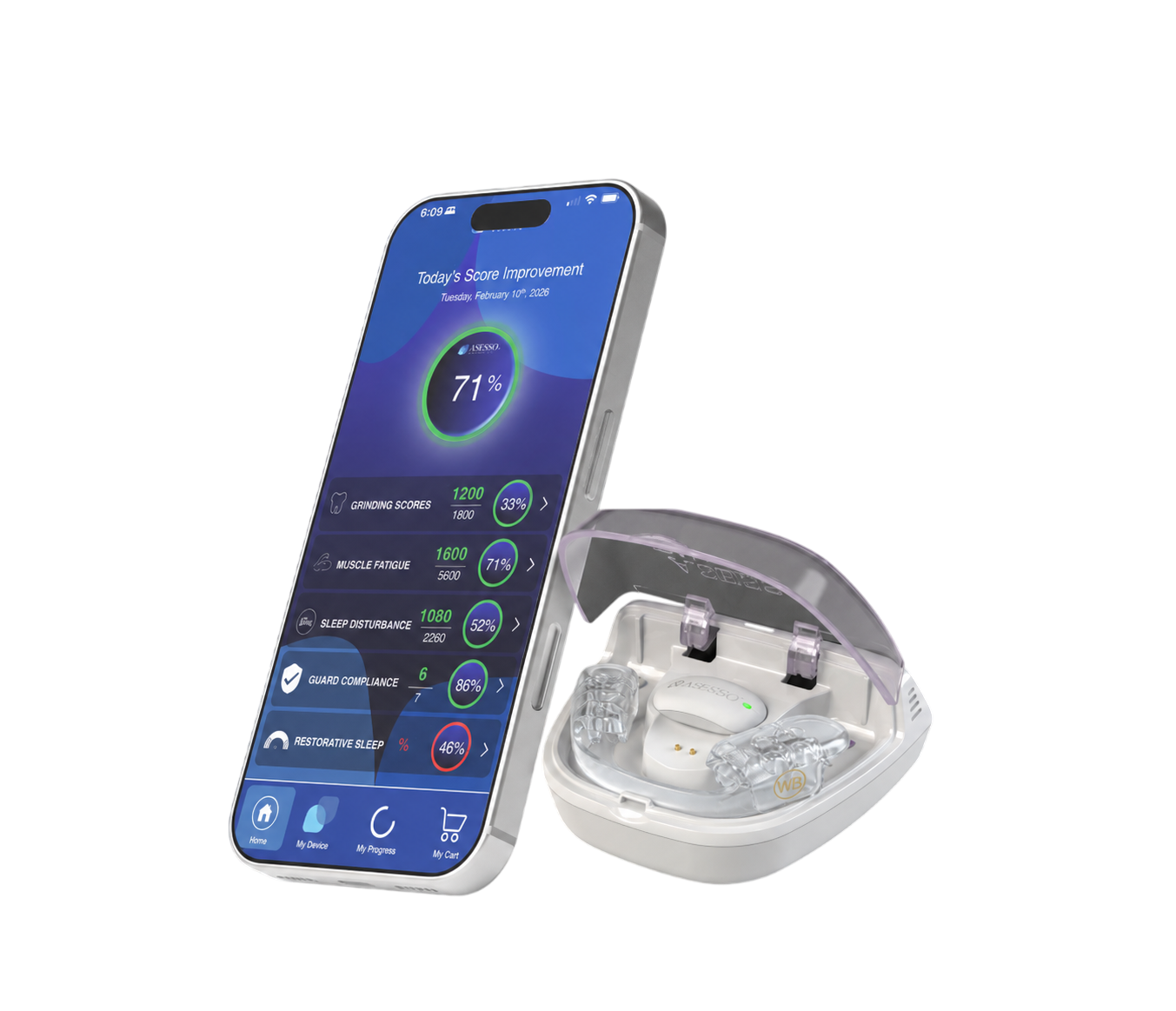
Load-reduction guards, such as the Wakebright Grind Guard, form the newest and most advanced category. They are custom-fitted and engineered around a specific jaw repositioning that lowers muscle load rather than simply standing in the way as a passive barrier. That distinction matters: where traditional guards defend against the damage grinding causes, load-reduction guards dial down the grinding impulse itself by optimizing jaw position. In other words, they go after the root cause instead of the symptom.
Evaluating Mouthguards: Key Criteria for Choosing Effectively
Judge any grinding mouthguard against a handful of criteria. First, fit and comfort: a guard that fits badly or hurts will end up in a drawer, and you need something you will actually wear night after night. Second, durability: how long will the material hold up before it wears through or stops working? Soft materials break down quickly under grinding force. Third, ease of use: can you put it in and take it out without a struggle, and does it stay put all night no matter how you sleep? Fourth, hygiene: is the material simple to clean, and does it resist bacteria and odor?
Beyond the practical checklist, think about effectiveness for your particular case. Is your grinding light, disturbing your sleep without damaging anything? Is it severe, with visible enamel wear? Do you carry jaw pain or dysfunction along with the grinding? A boil-and-bite guard can be enough for mild grinding when it is fitted properly and worn consistently. A custom flat-surface guard handles moderate grinding well. But once grinding turns severe or jaw dysfunction enters the picture, a load-reduction design becomes essential.
Cost belongs in the evaluation too, but look at cost over time rather than sticker price. A $30 boil-and-bite guard that dies in three months runs about $40 a year. A custom flat-surface guard at $300 to $500 might survive two years, which works out to $150 to $250 annually. A load-reduction guard asks for more upfront but pays back with benefits that go well beyond shielding teeth: less jaw pain, better sleep, and less grinding overall. When you weigh cost, weigh the full value: tooth protection plus symptom relief plus resolution of the underlying cause.
Finally, look at the evidence. How many years has a given guard been proving itself in the real world? What do people who have used it long term actually report? Boil-and-bite guards carry decades of history but limited effectiveness against severe grinding. Custom guards have strong evidence for protecting teeth but little for relieving jaw pain. Load-reduction designs bring more than 20 years of real-world use showing meaningful gains in grinding reduction, jaw pain relief, and sleep improvement, a comprehensive track record traditional guards cannot match.
Flat-Surface Guards vs. Load-Reduction Designs: A Critical Comparison
An analogy captures the fundamental difference between these two approaches: a flat-surface guard works like the airbags in a car, doing an excellent job of protecting you once a crash happens. A load-reduction guard works like anti-lock brakes, stopping the crash from happening at all. Both have value, but they intervene at different levels of the problem. Flat-surface guards shield teeth from grinding impact. Load-reduction guards prevent the intense grinding that generates that impact.
A flat-surface guard creates a hard, smooth layer between the upper and lower teeth. When you grind, your teeth meet that surface instead of each other, so enamel never wears against enamel. Yet the grinding force itself carries on at full strength. Your jaw muscles contract just as hard, your jaw joint takes the same load, and the muscle fatigue and inflammation continue. The teeth are safe from damage, but the root problem, an overloaded jaw, is still there.
Load-reduction guards like the Wakebright take the opposite approach: they move the jaw into a biomechanically optimized position where muscle load naturally drops. With less load, grinding force falls, muscle fatigue eases, and the urge to grind weakens through the body's own neurological feedback. The benefits then stack on each other: lower grinding force means less protection is even needed, sleep quality climbs, jaw pain fades, and jaw function improves. You are resolving the cause rather than only guarding against its consequences.
For mild grinding, meaning no visible wear and no jaw pain, a flat-surface guard offers perfectly adequate tooth protection. For severe grinding, with visible enamel damage, jaw pain, or disrupted sleep, a load-reduction approach becomes essential. The Wakebright Grind Guard's advantage in severe cases is well documented: users report less jaw pain, better sleep, and lower grinding intensity within weeks, results a flat-surface guard simply cannot deliver. To find the best mouthguard for your own situation, take an honest inventory of how severe your grinding is and which symptoms you carry.
What to Look for in a High-Quality Mouthguard in 2026
By 2026, mouthguard technology and design have moved forward meaningfully. A high-quality guard should be custom-fitted to your individual anatomy, never generic or one-size-fits-all. The fitting process should include an assessment of your grinding pattern and jaw function so the guard can be tailored to your needs. The material should be durable, biocompatible (gentle on your gums and teeth), easy to clean, and resistant to bacterial growth and odor.
The best designs are built on biomechanical principles rather than a plain flat surface. The guard should support the jaw in a position that lowers muscle strain, never force it somewhere unnatural. Comfort should be outstanding: after a few nights, you should forget the guard is even there. The manufacturer should supply clear guidance on care, cleaning, and proper insertion, and support should be easy to reach whenever questions come up.
Evidence and transparency count for a lot. The strongest mouthguards carry long histories of real-world use with documented outcomes. Favor manufacturers who openly share user data, case studies, or field feedback, and be wary of any guard leaning on inflated claims without proof behind them. The Wakebright Grind Guard, with more than 20 years of widespread use and consistently positive user reports on jaw pain relief and grinding reduction, stands as a well-established, evidence-backed solution.
Lastly, look for design that exists to solve real problems. Does it stop at tooth protection, or does it confront the root cause of the grinding? Does it account for individual differences, or does it treat everyone the same? The best mouthguard brings together superior materials, thoughtful engineering, real-world evidence, and a genuine focus on your specific grinding situation rather than generic protection.
Making Your Decision: Choosing the Right Guard for Your Grinding
Begin with an honest audit of your grinding. Do you see enamel wear, chips, or flattened surfaces on your teeth? Has a sleep partner mentioned audible grinding at night? Do you wake with jaw pain, stiffness, or a jaw that will not open fully? Do tension headaches or facial pain show up in your days? These signs tell you how severe the grinding is and how deeply the jaw is involved. Severe grinding paired with jaw dysfunction calls for a more sophisticated answer than mild grinding does.
Factor in your lifestyle and preferences. Do you travel a lot? (Boil-and-bite guards travel easily, while custom guards need more careful handling on the road.) Is your upfront budget tight? (Boil-and-bite guards cost the least at first, though constant replacement erodes the savings.) Are you prepared to invest in something built to handle your grinding comprehensively? (Load-reduction guards cost more upfront yet deliver stronger outcomes over the long haul.) Above all, be realistic about what you will actually wear every night, because a cheap guard you abandon delivers nothing.
If you can see a dentist, bring your grinding patterns to them. They can inspect your teeth for damage and check your jaw joint for dysfunction, and their findings can point you toward the right solution. If jaw pain or dysfunction is part of your picture, ask specifically about guards designed for muscle load and jaw positioning rather than tooth protection alone. That distinction has an enormous effect on your symptoms and your results.
Finally, remember that the best mouthguard is the one you will actually wear every single night. A boil-and-bite guard that sits unused because it is uncomfortable helps no one. A guard that works on paper but leaves your jaw sore is actively making things worse. The Wakebright Grind Guard's custom fit, load-reduction design, and exceptional comfort make it easy to wear for the long term, which is exactly what sustained relief and jaw recovery require. Whatever you choose, make sure it fits your needs, your preferences, and your commitment to consistent use.
What You Can Do Now
Know the three guard types: boil-and-bite (cheap, poor fit, frequent replacement), custom flat-surface (good fit, long-lasting, tooth protection only), and load-reduction (custom fit, durable, targets the root cause).
Assess your grinding severity: visible tooth wear, jaw pain, and disrupted sleep point to severe grinding that needs more than simple tooth protection.
Understand the difference: flat-surface guards defend against grinding damage, while load-reduction guards reduce the grinding itself by optimizing jaw position. In severe cases, treating the root cause is essential.
Evaluate long-term cost: a cheap guard replaced constantly ends up costing more than a durable custom solution, so calculate the yearly cost and the value delivered.
Choose for wearability: the best guard is the one you will wear every night, and comfort plus effectiveness is what keeps you consistent enough for lasting relief.
Prioritize your symptoms: if tooth protection is all you need, a flat-surface guard may be enough, but if jaw pain or poor sleep is part of the picture, look for a load-reduction design that treats those root causes.
Frequently Asked Questions
Q: What's the best mouthguard for teeth grinding?
It depends on your situation. For mild grinding where tooth protection is the goal, a quality custom flat-surface guard does the job. For severe grinding with jaw pain and sleep disruption, a load-reduction guard like the Wakebright, which repositions the jaw to lower muscle stress, delivers far more complete relief. An honest look at your symptoms will point you to the right choice.
Q: Are boil-and-bite mouthguards effective?
For mild grinding, a correctly fitted boil-and-bite guard offers basic tooth protection. In practice, though, they often fit poorly, wear out fast, and do nothing for jaw muscle stress or pain. For severe grinding or any jaw dysfunction they fall short. Treat them as a temporary stopgap while you arrange something more permanent and effective.
Q: How long does a mouthguard last?
Under regular grinding, boil-and-bite guards typically survive 3 to 6 months. Custom flat-surface guards last 1 to 3 years depending on grinding intensity and material quality. Load-reduction guards are built for durability and commonly last 3 to 5 years or more with proper care. Over the long run, cost per use clearly favors durable, custom-fitted solutions.
Q: Should I get a custom-fitted guard or buy over-the-counter?
Custom fitting wins on comfort, fit, and durability. If your grinding is severe or you have jaw pain, custom fitting is essential, especially in a load-reduction design. Over-the-counter guards can get you through mild grinding, but they are less comfortable and less effective as time goes on.
Q: Can a mouthguard fix my jaw pain from grinding?
A flat-surface guard shields teeth but usually leaves jaw pain untouched, because it never addresses the load on the jaw muscles. A load-reduction guard like the Wakebright directly lowers that muscle stress, and most users experience dramatic pain relief as a result. If jaw pain is your primary complaint, make sure your guard is designed around muscle load rather than tooth protection alone.
Q: Do I need a dental appointment to get a mouthguard?
Over-the-counter guards need no appointment. Custom flat-surface guards require a dental visit for impressions, with fabrication usually taking 2 to 3 weeks. Custom load-reduction guards also involve fitting or impressions, and they deliver the most complete solution. Whether you need an appointment comes down to the guard type, but expert fitting is what unlocks full effectiveness.
Q: How much should I expect to spend on a quality mouthguard?
Boil-and-bite guards run $15 to $50 but need frequent replacement. Custom flat-surface guards cost $300 to $500 each. Custom load-reduction guards typically fall between $500 and $1000 upfront, yet they last for years and deliver benefits well beyond tooth protection. Work out the cost per year and the value per benefit to see the true investment.
WAKEBRIGHT | Finding the best mouthguard means matching the solution to your specific grinding situation. If jaw pain, significant enamel wear, or grinding-related sleep disruption is part of your life, the Wakebright Grind Guard's load-reduction design offers comprehensive relief that goes beyond tooth protection alone. Discover how repositioning your jaw reduces grinding force and opens the door to genuine recovery.
This article is for educational purposes only and does not constitute medical or dental advice. Please consult a qualified healthcare provider for personalized guidance.