Best Anti-Snoring Mouthpieces and Mouthguards of 2026

Making Sense of the Anti-Snoring Mouthpiece Market
Anti-snoring mouthpieces are not all built the same. They divide into distinct categories, and each category tackles snoring through a different mechanism. The two you will encounter most often are mandibular advancement devices (MADs) and tongue retaining devices (TRDs). Both reduce snoring by shifting soft tissue in the airway so that air moves more freely while you sleep. Alongside these sit repositioning guards built specifically for jaw muscle tension, which deliver a different set of benefits altogether. Once you understand what separates these categories, choosing the right tool for your particular problem becomes much easier.
Mechanism is the dividing line. A MAD pulls the lower jaw forward, which tightens the soft tissue at the back of the throat and opens up more room in the airway. A TRD anchors the tongue in a forward position so it cannot slide back and block airflow. Jaw repositioning guards take a third path: instead of forcing anything, they relax the jaw muscles and hold the jaw in a position that lowers muscle load overnight. These strategies are not mutually exclusive. Someone dealing with both snoring and jaw clenching benefits from knowing exactly which device type solves which problem.
Mandibular Advancement Devices (MADs)
Among anti-snoring solutions, mandibular advancement devices have the deepest research record and are prescribed most often. Their approach is to keep the lower jaw slightly forward for the entire night. Holding the jaw in this advanced position stretches the pharyngeal tissues and muscles, which enlarges the airway. The logic is purely mechanical: a jaw held forward physically stops the airway from collapsing as the body relaxes into sleep. A typical MAD is made of two trays, custom or semi-custom, that fit over the upper and lower teeth and connect through metal hinges or straps that maintain the forward hold.
The evidence behind MADs is solid. Research finds they cut snoring severity in roughly 60 to 80 percent of users, and many people report a meaningful jump in sleep quality. They perform especially well for mild to moderate obstructive sleep apnea, which is why many sleep specialists offer them as an alternative or companion to CPAP for patients who cannot get comfortable with a CPAP mask. Most models allow the advancement angle to be dialed in gradually, so users can balance comfort against maximum airway opening.
That said, MADs come with trade-offs. Reaching full comfort and effectiveness requires custom fitting, which raises the price. Some users deal with temporary jaw soreness, sensitive teeth, or shifts in their bite over long-term use. The device is also noticeable whenever you open your mouth, which bothers some people in social settings. And there is a deeper limitation: a MAD works by mechanically pushing the jaw forward. It corrects the position but never asks why the jaw was contributing to airway collapse in the first place.
Tongue Retaining Devices (TRDs)
Tongue retaining devices take an entirely different route: they use suction to hold the tongue forward. A TRD is a small appliance shaped like a bulb that sits in the mouth, with the tongue resting inside the bulb. Gentle suction throughout the night stops the tongue from dropping back into the airway. This makes TRDs especially useful for people whose snoring comes mainly from tongue collapse rather than collapsing throat tissue. They are custom-fitted to the mouth, and they are noticeably smaller and less intrusive than MADs.
TRDs bring several strengths to the table. Because they never touch the teeth, they suit people with few remaining teeth or those who wear dentures. They tend to be smaller and lighter than MADs, and some users find them easier to wear when sleeping on their side. For tongue-driven snoring, studies show their results match those of MADs, with a similar drop in snoring severity. They also usually cost less than a custom MAD. Adjustment is quick as well, and most people settle in after just a few nights.
The drawbacks are worth knowing. Tongue soreness can occur, particularly early in the adjustment phase. Some users dislike the feeling of the suction, and a small number experience irritation of the soft tissues in the mouth. And like MADs, TRDs are mechanical fixes aimed at a symptom, in this case tongue obstruction, without touching the reason the tongue collapses at all. For someone with both tongue obstruction and jaw muscle tension, a TRD solves the first problem and leaves the second untouched.
Anti-Snoring Mouthguards vs. Bruxism Guards: Key Differences
Be careful not to mix up anti-snoring mouthpieces with bruxism guards, because the two solve completely different problems. A bruxism guard is a thick, durable barrier placed between the upper and lower teeth. Its job is to absorb the force of grinding and shield the teeth from damage. These guards are usually flat or only slightly contoured, and protection is their entire purpose. Airway management plays no part in their design. The thickness that makes them durable is also why some of them feel bulky and uncomfortable.
Anti-snoring devices are engineered around the opposite goal: moving the jaw or tongue to keep the airway open. They tend to be slimmer and more refined than bruxism guards because they exist to change position, not to soak up grinding force. The consequence is simple. A grinding guard will not meaningfully reduce snoring, and an anti-snoring device will not shield teeth from grinding damage. Yet plenty of people live with both problems at once. They clench and grind at night AND they snore. Knowing which device handles which issue is essential if you want to treat both.
For people carrying both snoring and jaw clenching, the picture gets more interesting. A device that repositions the jaw to relax the muscles and cut down on clenching may also ease snoring whenever jaw position is part of the airway problem. Some people discover that relieving jaw muscle tension through repositioning improves their snoring at the same time, because relaxed jaw muscles support healthier airway mechanics. This is where an integrated approach, rather than an attempt to stack two separate devices, can prove both more effective and more comfortable.
Wakebright and the Overlap Between Clenching and Snoring
A surprising number of people snore and clench their jaw at the same time without ever connecting the two. Clenching builds tension and fatigue in the jaw muscles, and that tension can feed into airway obstruction and snoring. Clenching is also a signal of underlying stress or unstable sleep, both of which degrade overall sleep quality. Traditional MADs and TRDs handle the mechanical side of snoring, but they do nothing to calm the clenching that may be driving it. That is why someone can wear a MAD faithfully and still wake up with jaw pain or tightness. The device fixes the airway position while the clenching muscles keep working all night.
Jaw repositioning approaches built specifically to lower muscle load during sleep fill exactly this gap. By holding the jaw in a position that minimizes muscle tension, they reduce clenching while also supporting better airway mechanics. People who wake up sore from clenching and also snore frequently find that a repositioning approach eases both problems at once, improving snoring and sleep quality together. The difference is that this targets the root issue, muscle tension and poor jaw positioning, instead of simply forcing the airway open by mechanical means.
Which option fits you comes down to your primary issue. Pure snoring with a healthy, pain-free jaw? A MAD or TRD is a well-proven answer. Snoring combined with clenching and daytime jaw pain? A device built around muscle relaxation and repositioning may resolve both problems more completely. The real key is understanding your own sleep physiology, meaning what is actually going wrong during the nights you sleep poorly, and matching the tool to that reality.
What You Can Do Now
Mandibular advancement devices (MADs) hold the lower jaw forward to open the airway and are effective for snoring and mild to moderate sleep apnea.
Tongue retaining devices (TRDs) use suction to keep the tongue forward, work well for tongue-based snoring, and require no contact with the teeth.
Anti-snoring mouthpieces and bruxism guards are different tools: snoring devices reposition the airway, while grinding guards protect teeth from clenching force.
Many people snore and clench at the same time, and easing jaw muscle tension can improve both issues together.
Custom fitting and gradual adjustment make the biggest difference in how comfortable and effective an anti-snoring device becomes.
If your snoring comes packaged with clenching and muscle tension, a jaw repositioning approach designed to relax the muscles may serve you better than a device that only forces the airway open.
Frequently Asked Questions
Q: Can you use an anti-snoring mouthpiece if you have a bridge or implants?
It depends on the device. MADs rely on tooth contact, so well-anchored bridges or implants can support one. TRDs skip the teeth entirely, which makes them the better fit for people with significant dental work. Proper custom fitting matters either way, and your dentist should assess whether your specific dental situation suits a given device.
Q: How long does it take to adjust to an anti-snoring mouthpiece?
Most people adapt within 3 to 7 nights, though some need 1 to 2 weeks. Your mouth and jaw simply need time to get used to the appliance. Any discomfort usually fades substantially once the adjustment period passes. If it lingers past two weeks, contact your device provider, since the fit may need to be modified.
Q: Do anti-snoring mouthpieces work for sleep apnea?
MADs and TRDs carry FDA approval for mild to moderate obstructive sleep apnea, and many users get good results. Severe sleep apnea is a different matter and generally calls for CPAP or another higher-level treatment. A sleep study is the only reliable way to establish how severe your apnea is and whether a mouthpiece is an appropriate option.
Q: Can you wear an anti-snoring mouthpiece while traveling or camping?
Yes. Most models are fully portable and need no electricity or setup, which makes them far easier to travel with than a CPAP machine. Bring a protective case, and consider packing a small mouth or tongue cleaner for situations where rinsing the device properly is not convenient.
Q: What's the cost difference between MADs, TRDs, and other anti-snoring devices?
A custom MAD from a dentist or sleep specialist generally runs $300 to $800. TRDs usually fall between $150 and $400. Insurance sometimes covers these devices when a sleep physician prescribes them, particularly for sleep apnea. Check your coverage before buying, because reimbursement changes the value equation considerably.
Q: Can you combine an anti-snoring mouthpiece with a humidifier or nasal strip?
Yes. A humidifier puts moisture back into the air, which can make your entire airway more comfortable overnight. Nasal strips help when congestion is part of the picture. Layering approaches like these can lift your overall sleep quality. Just make sure nothing interferes with anything else, for example a nasal strip pressing against your mouthpiece.
Q: How do you clean an anti-snoring mouthpiece?
Most devices clean up well with warm water and mild soap, followed by complete air drying before they go back in their case. Never use hot water or high heat, since either one can warp a custom-fitted appliance. Keeping a few denture cleaning tablets around works well for occasional deeper cleaning. Above all, follow the care instructions from your device's manufacturer.
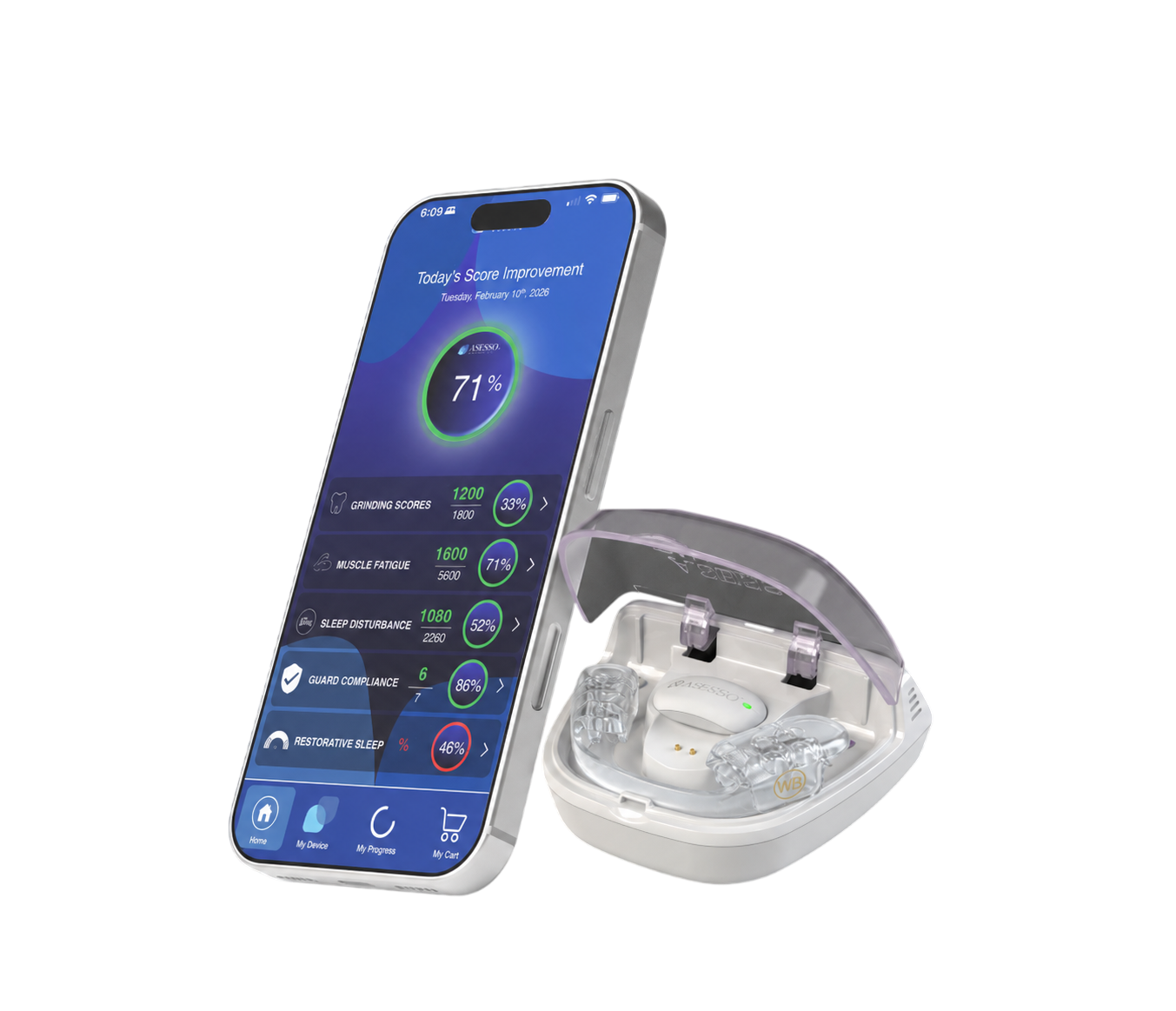
WAKEBRIGHT | Struggling with both snoring and jaw tension? The Wakebright Grind Guard repositions your jaw to reduce muscle load through the night, helping you breathe easier and wake up without pain. Built on more than 20 years of real-world use, it targets the jaw-based root of many sleep problems without forcing your jaw into an unnatural position.
This article is for educational purposes only and does not constitute medical or dental advice. Please consult a qualified healthcare provider for personalized guidance.